NVIDIA's DLSS 5 neural renderer, applied to your whole Windows desktop in real time. Everything on screen — games, video, photos — goes through the same neural network that DLSS 5 games use, and comes back sharper.
The guide below gets you running. How it works and what was measured: TECHNICAL.md. Русская версия: README.ru.md / TECHNICAL.ru.md.
Notice. Not affiliated with NVIDIA; NVIDIA, DLSS and the NVIDIA logo are NVIDIA Corporation's trademarks. The bundled NVIDIA runtimes (
nvngx_dlssnr.dll,nvngx_dlssg.dll) are NVIDIA's property, included unmodified, research/educational use only, no warranty, use at your own risk. Rights holders: say the word and the next build ships without them.
Important
AMD Radeon build - an active call for testers. A separate repository, NeuralScreen-AMD - the same overlay with the neural pass aimed at RX 7000 / 9000 (RDNA3/RDNA4). It has not run on a real Radeon yet, and that is what that release is for: start with native/AMD.md, then open an issue with NeuralScreen.log, probe_amd.log, card model and driver version.
 |
 |
 |
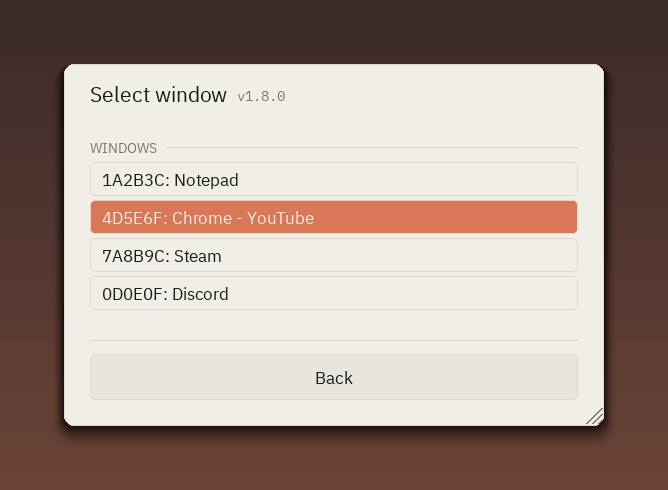 |
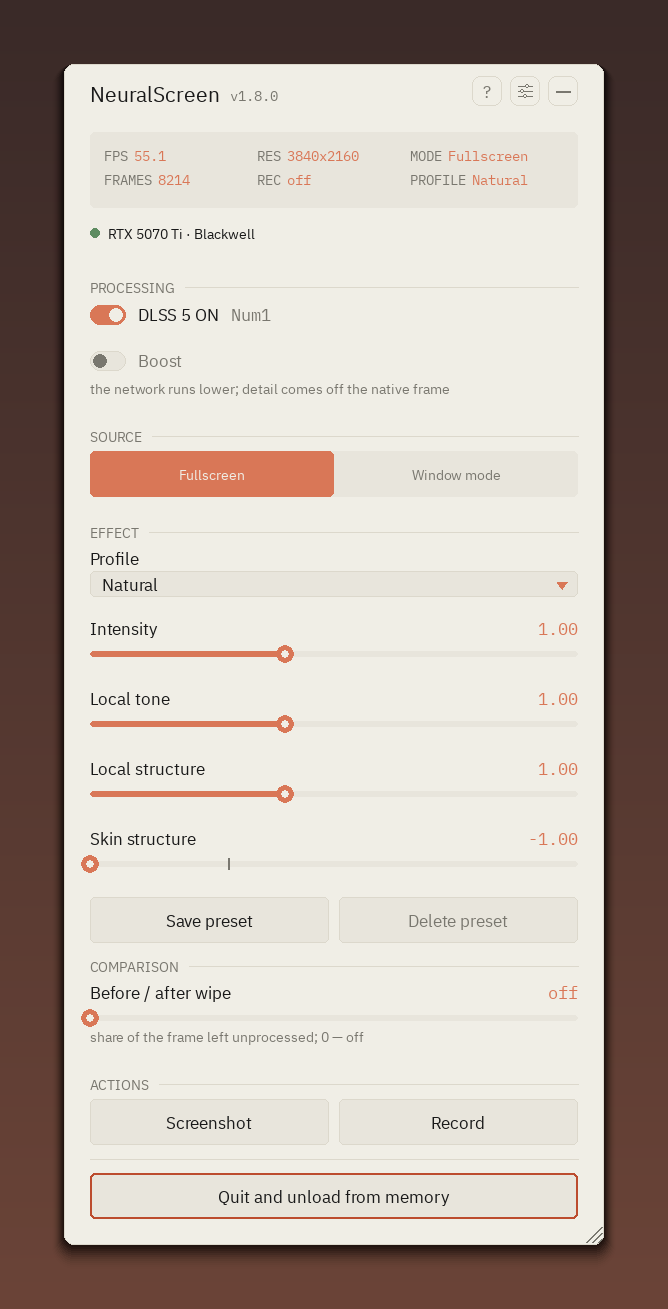
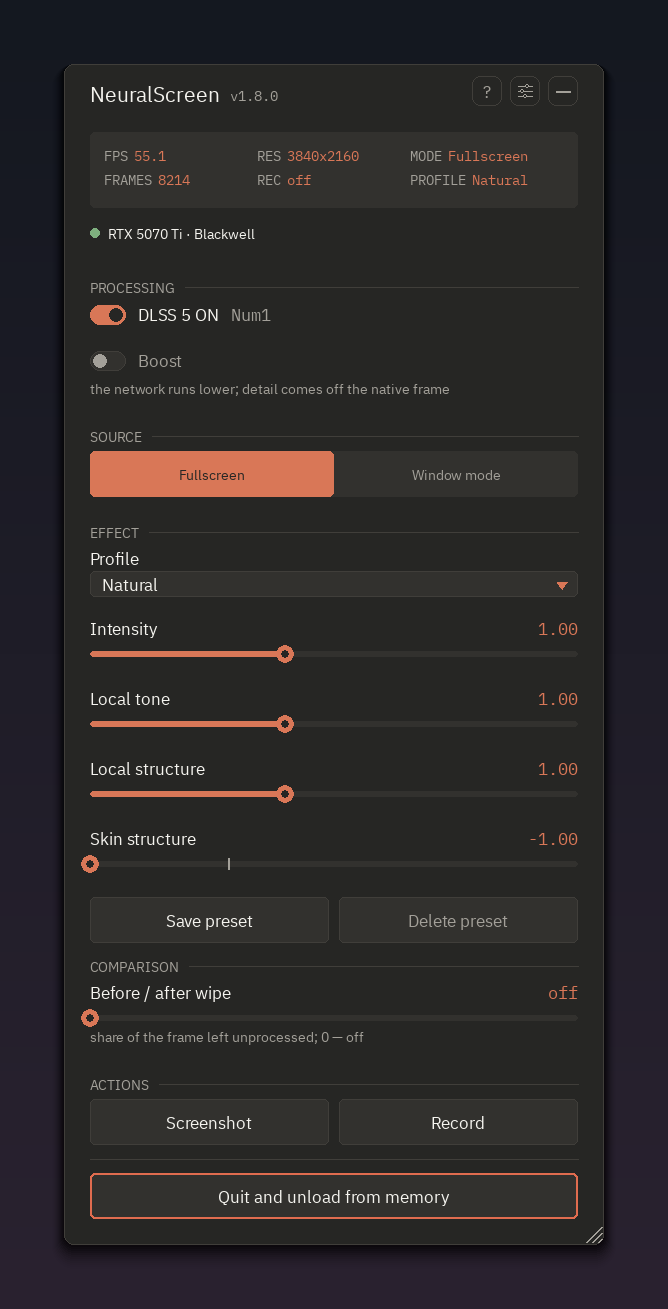
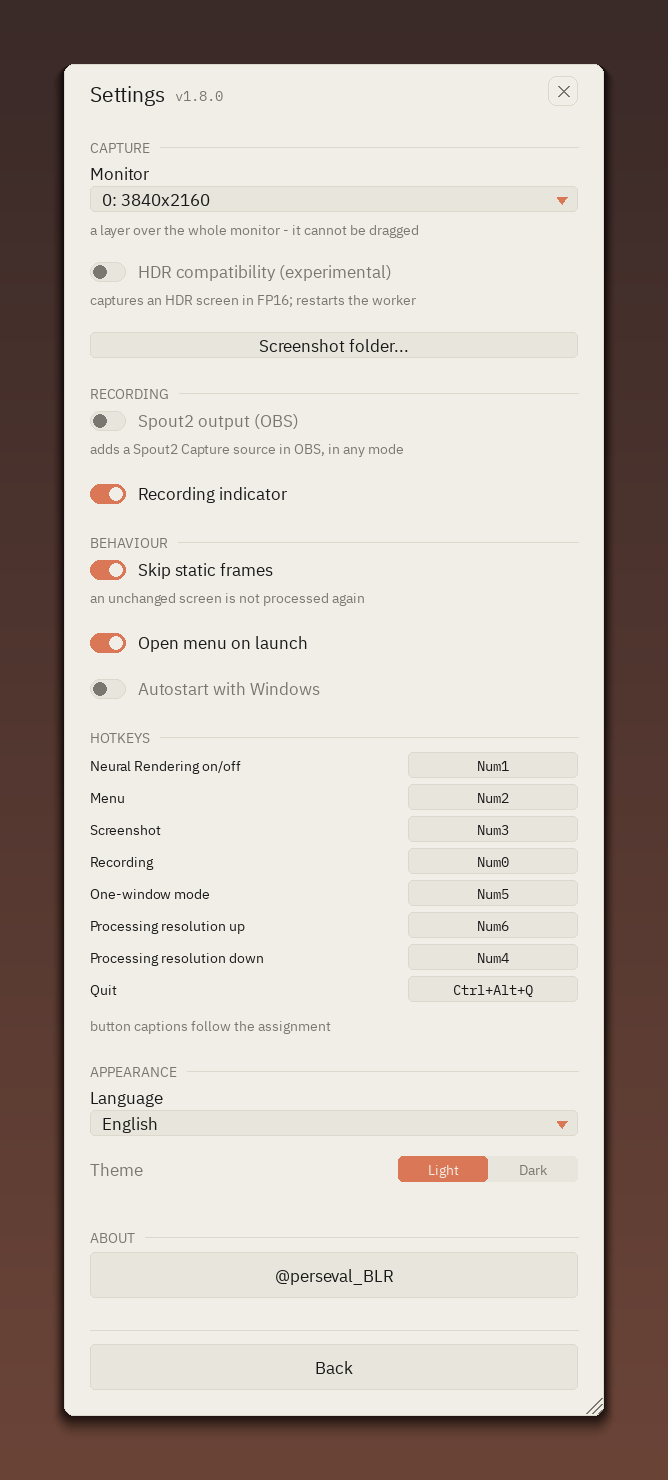
One menu inside the overlay, in light and dark themes; the settings page; the window list - and the Before / after wipe slider that splits the screen.
-
Windows 11, or Windows 10 — reported working.
-
An NVIDIA RTX card. Validated = reproduced locally; reported = user evidence; unverified = no successful run captured; known failure = the shipped runtime refuses or fails.
Family Neural Rendering Frame Generation RTX 50 validated (5070 Ti) validated (5070 Ti) RTX 40 reported, unresolved 4060 reports reported (4080 Super ×2; 4060 needs retest) RTX 30 unverified known failure (below Ada) RTX 20 known failure known failure (below Ada) Hybrid laptops and multi-GPU systems remain experimental; capture may use a slower fallback when the display is attached to the iGPU.
-
The latest NVIDIA driver, and Windows up to date. Not a formality: the neural runtime talks to the driver directly; an old driver is the commonest reason it refuses to start or the picture never appears.
-
Nothing installed. The release archive brings its own Python.
- Download the archive from Releases and unpack it anywhere. Everything is inside, including NVIDIA's runtime.
- Run
NeuralScreen.exe.
Windows will probably warn you about an unknown publisher — the program is not
signed with a paid certificate. Click More info → Run anyway, or use
NeuralScreen.vbs next to it.
There is no installer: to remove the program, delete the folder. Autostart is the one thing written outside it — turn it off before you move or delete it.
Do not use it in competitive online games. A fullscreen overlay over a game is what anti-cheat systems look for.
The program sits in the tray and draws over your desktop. Press Num2 for the menu. The hotkeys are on the numpad, so Num Lock has to be on.
| Key | What it does |
|---|---|
| Num2 | open / close the menu |
| Num1 | neural rendering on / off |
| Num7 | frame generation on / off |
| Num3 | screenshot |
| Num0 | start / stop recording, with sound |
| Num4 / Num6 | processing resolution down / up |
| Num5 | capture the window under the cursor |
| Ctrl+Alt+Q | quit |
Every key can be reassigned in the menu, under the sliders icon. While the menu is open it takes the mouse and keyboard, so it works on top of a game; closed, clicks go straight through it.
The whole screen is the default. Source, second in the menu, switches between Fullscreen and Window mode; choosing the second opens the list of windows, and hovering a row highlights that window. Num5 is the shortcut when the window is already in front of you: point at it and press. The overlay follows the window as it moves, and resizing it — a video going fullscreen, a different player size — reconfigures the worker in place, with no black moment. Minimising the window pauses processing.
The dot next to your graphics card is green when neural rendering really runs on it, red when it is not.
- Source — the whole screen or one window, and which window.
- Profile — how strong the effect is, from Faithful to Extreme; Natural by default. The four sliders underneath are the same thing in detail. Save preset stores the current values under a name and puts it in the Profile list; Delete preset removes it. Dark scenes are brightened automatically so shadows keep their detail. A profile moves the sliders only — the model below stays where you put it.
- Model — which network produces the picture, as opposed to how strongly. Three of them, and they are three different outputs rather than three strengths: Default suits a desktop, Natural and Cinematic are tuned for games and soften photographs and small text. Measured on a desktop capture, fine detail against the untouched frame: Default +18.7%, Natural −11.4%, Cinematic −23.4%. A saved preset keeps the model it was saved with.
- Before / after wipe — leaves the left part of the screen unprocessed so you can see what the effect is doing. Back to 0 when done.
- Boost — on by default. The network runs at a reduced resolution and a slider under the switch chooses which: measured on a 5070 Ti at 4K, 45.7 → 72.6 frames at the default step and 83.4 at the lowest. The picture stays sharp — the network's result is composed onto your original frame, so text and edges keep full resolution. Turn it off to compare.
- DLSS 4.5 FG — Frame Generation, off by default, with a ×2 / ×3 / ×4 multiplier beside the switch (and on Num7). DLSS-G's own desktop build: the depth is flat and the motion is estimated, there is no engine cooperation, so UI and text can distort — the known cost of the approach. The header pairs the two honest rates when they differ: "47 / 111 fps" is the network's output, then what the presenter shows. DLSS-G has a hardware floor of its own: on a card below Ada the runtime refuses and the switch flips back off with a short notice — no silent ON. Validated on RTX 50-series; adapters beyond it are unconfirmed.
Everything else is behind the sliders icon: monitor/GPU, a 30/60/custom/off frame limiter, HDR, media folders, Spout2, the recording indicator, static frame skipping, key assignments, keyboard navigation, theme and 12 languages.
Everything ships in the archive. To run your own runtime build (a newer
DLSS-G, say), drop the DLL into native/libraries/ — it wins over the
bundled copy; nr_dll / NS_NR_DLL remain the NR override.
Num0 records to the configured folder. Stop is non-blocking: the encoder
drains into a .partial, verifies the final MP4, then publishes it atomically
and shows the codec, FPS, audio state and exact path. Num3 freezes the
processed frame before any dialog; choose Save As or quiet unique-name
saving, plus PNG or JPEG, in settings. The open menu appears in both.
Recording externally:
- OBS (recommended): turn on Spout2 output (OBS) in the settings, then add a Spout2 Capture source in OBS. Works in any mode.
- NVIDIA App: it has no Spout input, so use one-window mode. In full-screen mode the overlay intentionally hides from Windows/OBS capture to prevent a feedback loop; use Spout or the built-in screenshot for the processed frame.
Nothing appears after launch. v1.13 first runs three synthetic frames
without desktop capture. A failed, unsupported or quarantined result blocks
the overlay instead of entering a restart loop. Use Create diagnostic
package on the Program tab (or the path in the failure dialog), then check
NeuralScreen.log.
The overlay is invisible in a game. True fullscreen cannot have anything drawn over it — a Windows rule. Switch the game to borderless.
The menu pointer is missing or frozen. A fullscreen game hides the system cursor, and the overlay only shows that one. Borderless fixes it.
Everything is too bright and the sliders do nothing. HDR is on for that display. Turn it off (Win+Alt+B), or try HDR compatibility in the settings — it is experimental; see HDR setup.
A key does nothing. Something else claimed it; reassign it in the menu.
- True fullscreen games cannot have an overlay drawn over them — borderless or windowed only.
- HDR displays: experimental, and off until you turn on HDR compatibility (settings, CAPTURE). Recording and Spout exports stay SDR. See HDR setup and limitations.
- Windows 10 and multi-GPU systems are experimental — adapter/output selection is covered by regression tests, but not by local multi-GPU hardware.
- A rotated display: 180° is turned back over on capture; 90° and 270° are not handled yet and come out with the sides swapped.
- Pipeline latency is 40–60 ms (17-20ms with Boost Mode) — fine interactively, not competitively; processing resolution is capped at 2560×1440, output is always your full native resolution.
- Window/menu recovery: v1.13 re-shows, raises and redraws the menu after taskbar, monitor or GPU reactivation; a full driver reset remains hardware-dependent.
- Lossless Scaling: there is no supported direct hand-off; one-window mode uses a separate presenter, so LS can still select the source HWND and show two windows.
- Frame generation on RTX 20/30: v1.13 has no FSR FG backend; it is a research candidate, not a promised compatibility mode.
The code here is source-available under the PolyForm Strict License 1.0.0: noncommercial use is free; distributing, modifying or copying it needs the licensor's permission - see LICENSE. NVIDIA's runtimes
ship unmodified and remain NVIDIA's property: nvngx_dlssnr.dll is the leaked 310.8.0 build (sm_75/86/89/120 kernels, RTX 20-50), nvngx_dlssg.dll is the
public 310.9.1.0 redistributable — both as received, no guarantees, research-only. Interface faces: IBM Plex (OFL-1.1, fonts/OFL.txt).