


Open-web future event prediction requires agents to identify reliable signals in noisy, redundant, incomplete, and sometimes conflicting evidence. ForeDreamer treats this as an evidence-to-memory transformation problem: raw search results are converted into structured, question-specific factual memory before the forecasting agent reasons over them.
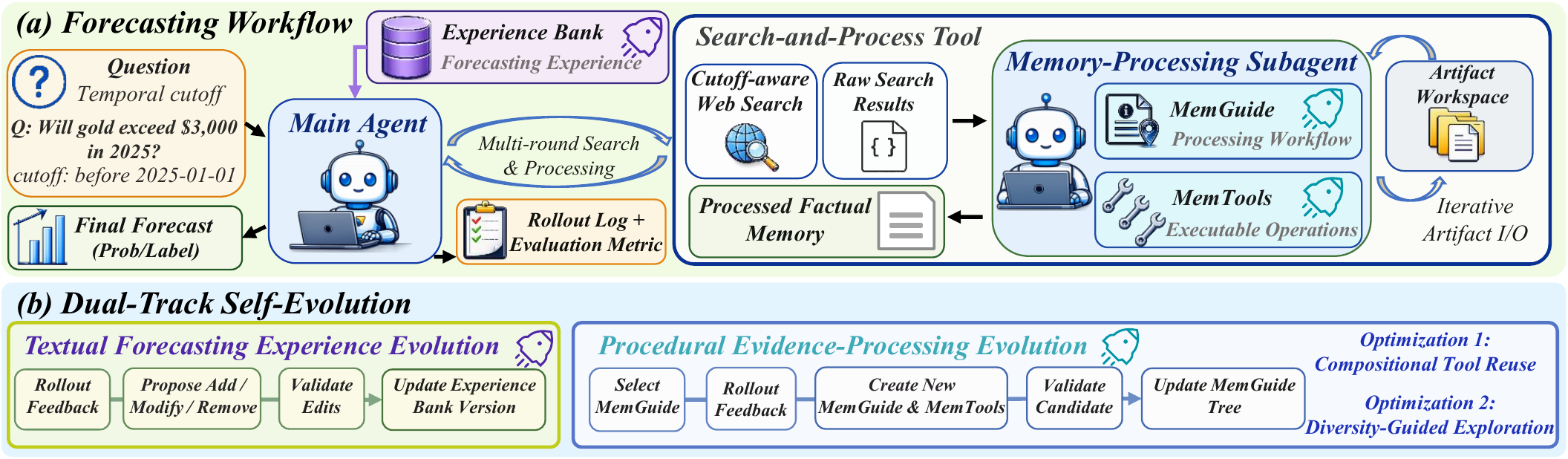
ForeDreamer separates two forms of memory:
- Factual memory is the processed evidence state for one forecasting question.
- Experiential memory persists across forecasting episodes and guides future search, evidence processing, and prediction.
The framework combines:
- a main agent that plans cutoff-aware web searches and produces forecasts;
- a memory-processing subagent that follows a MemGuide and executes sandboxed MemTools to transform search results into factual memory;
- textual experience evolution that updates an Experience Bank for search planning, evidence integration, and calibration;
- procedural experience evolution that updates MemGuides and executable MemTools;
- Compositional Tool Reuse and Diversity-Guided Exploration for less redundant and more diverse procedural evolution.
This repository focuses on the minimum code path required to evolve and evaluate ForeDreamer. Baseline implementations, ablation runners, large batch schedulers, and historical experiment outputs are not included.
.
├── data/
│   ├── FutureX/
│   └── Prophet-arena/
├── scripts/
│   ├── evolve.sh
│   └── test.sh
├── src/
│   ├── SelfEvolving/        # textual and procedural evolution
│   ├── prediction/          # datasets, runners, and metrics
│   ├── DefaultTool/         # search-result processing runtime
│   ├── MemGuide/            # initial evidence-processing guide
│   ├── MemTool/             # initial tools and sandbox runtime
│   ├── experience_bank.py
│   ├── run_eval.py
│   └── summarize_test_results.py
└── requirements.txt
The two main entry points are:
scripts/evolve.sh: evolve the Experience Bank, MemGuides, and MemTools, then select the best validated assets.scripts/test.sh: evaluate the selected assets and produce both per-example predictions and aggregate scores.
- Linux
- Python 3.10 or newer
- Bubblewrap (
bwrap) for sandboxed MemTool execution - an OpenAI-compatible LLM API
- a Tavily or Firecrawl search API
Install the system dependency on Ubuntu/Debian:
sudo apt-get update
sudo apt-get install -y bubblewrap
Create an environment and install the Python dependencies:
conda create -n foredreamer python=3.10 -y
conda activate foredreamer

python -m pip install --upgrade pip
python -m pip install -r requirements.txt

export PYTHON_BIN="$(which python)"
pm-rank is used to compute the Prophet Arena Brier score and average return.
ForeDreamer reads all credentials from environment variables. Do not write API keys into scripts or commit them to the repository.
For OpenAI or another OpenAI-compatible provider:
export OPENAI_API_KEY="your-llm-api-key"
export OPENAI_MODEL="your-model-name"
export OPENAI_BASE_URL="https://api.openai.com/v1"
OPENAI_BASE_URL defaults to https://api.openai.com/v1 and may be omitted when using OpenAI directly.
OpenRouter example:
export OPENROUTER_API_KEY="your-openrouter-key"
export OPENAI_BASE_URL="https://openrouter.ai/api/v1"
export OPENAI_MODEL="provider/model-name"Tavily is the default search provider:
export SEARCH_PROVIDER="tavily"
export TAVILY_API_KEY="your-tavily-key"
To use Firecrawl:
export SEARCH_PROVIDER="firecrawl"
export FIRECRAWL_API_KEY="your-firecrawl-key"
Both evolution and testing call the LLM and search APIs and may incur usage charges.
| File | Purpose |
|---|---|
data/FutureX/train-20of208.parquet |
20 examples used for evolution and validation |
data/FutureX/train.parquet |
all 208 resolved examples used as the test input |
Following the paper protocol, the 20 evolution/validation examples are excluded when reporting the held-out score. The remaining evaluation set contains 188 examples.
The repository contains the eight Prophet Arena categories used in the paper:
| Category | Evolution/validation file | Evaluation input |
|---|---|---|
| Climate and Weather | subset_data_Climate_and_Weather_train_5.csv |
subset_data_Climate_and_Weather_13.csv |
| Companies | subset_data_Companies_train_5.csv |
subset_data_Companies_27.csv |
| Economics | subset_data_Economics_train_5.csv |
subset_data_Economics_19.csv |
| Entertainment | subset_data_Entertainment_train_5.csv |
subset_data_Entertainment_93.csv |
| Mentions | subset_data_Mentions_train_5.csv |
subset_data_Mentions_26.csv |
| Other | subset_data_Other_train_5.csv |
subset_data_Other_37.csv |
| Politics | subset_data_Politics_train_5.csv |
subset_data_Politics_91.csv |
| Sports | subset_data_Sports_train_5.csv |
subset_data_Sports_200.csv |
data/Prophet-arena/subset_data_1200.csv contains the aggregate 1,200-example set.
The default evolution command uses the 20-example FutureX evolution/validation set and performs three update iterations as a lower-cost functional run:
bash scripts/evolve.shGenerated assets are written under runs/futurex/. The selected MemGuide and Experience Bank are recorded in runs/futurex/best_assets.json.
Test all 208 FutureX examples:
bash scripts/test.shThe test script uses:
TRAIN_DATA_PATH=data/FutureX/train-20of208.parquet
INPUT_PATH=data/FutureX/train.parquet
It predicts all 208 inputs once and reports both:
- the score on all 208 examples;
- the held-out score on the 188 examples remaining after removing the 20 evolution/validation IDs.
To test one or more comma-separated FutureX sample IDs:
RUN_SPECIFIC="sample-id-1,sample-id-2" bash scripts/test.shTo manually select a MemGuide:
MEM_GUIDE="guide_2.json" bash scripts/test.shThe paper uses 20 evolution/validation examples, 60 update iterations, four search results per request, and a 1:4 exploration-to-expansion ratio:
DATASET_TYPE=futurex \
TRAIN_DATA_PATH="./data/FutureX/train-20of208.parquet" \
VAL_DATA_PATH="./data/FutureX/train-20of208.parquet" \
RUN_DIR="./runs/futurex-paper" \
NUM_ITERATIONS=60 \
MEMGUIDE_ROUNDS_PER_CYCLE=10 \
EXPERIENCE_ROUNDS_PER_CYCLE=5 \
EXPLORATION_OVER_EXPANSION=1:4 \
SEARCH_MAX_RESULTS=4 \
PARALLELISM=2 \
bash scripts/evolve.sh
Evaluate the resulting assets:
DATASET_TYPE=futurex \
RUN_DIR="./runs/futurex-paper" \
TRAIN_DATA_PATH="./data/FutureX/train-20of208.parquet" \
INPUT_PATH="./data/FutureX/train.parquet" \
SEARCH_MAX_RESULTS=4 \
bash scripts/test.shThe following example evolves and evaluates ForeDreamer on the Companies category:
DATASET_TYPE=prophet_arena \
TRAIN_DATA_PATH="./data/Prophet-arena/subset_data_Companies_train_5.csv" \
VAL_DATA_PATH="./data/Prophet-arena/subset_data_Companies_train_5.csv" \
RUN_DIR="./runs/prophet-companies" \
bash scripts/evolve.sh

DATASET_TYPE=prophet_arena \
TRAIN_DATA_PATH="./data/Prophet-arena/subset_data_Companies_train_5.csv" \
INPUT_PATH="./data/Prophet-arena/subset_data_Companies_27.csv" \
RUN_DIR="./runs/prophet-companies" \
bash scripts/test.sh
Use the corresponding files from the data table to run another category.
By default, testing creates:
runs/EXPERIMENT_NAME/predictions.csv
runs/EXPERIMENT_NAME/test_summary.json
predictions.csv contains per-example model outputs and metrics. test_summary.json contains two evaluation scopes:
{
  "all_test": {
    "counts": {},
    "scores": {}
  },
  "train_overlap": {
    "key_field": "id or submission_id",
    "test_rows_in_train": 0,
    "test_rows_without_train": 0
  },
  "test_without_train": {
    "counts": {},
    "scores": {}
  }
}- FutureX overlap is determined with
idand reports exact-match accuracy. - Prophet Arena overlap is determined with
submission_idand reports mean Brier score and mean average return. - If the test input is already disjoint from the training set,
all_testandtest_without_traincontain the same examples.
| Environment variable | Default | Description |
|---|---|---|
PYTHON_BIN |
python3.10 |
Python executable |
DATASET_TYPE |
futurex |
futurex or prophet_arena |
RUN_DIR |
runs/$DATASET_TYPE |
Isolated evolution and test output directory |
TRAIN_DATA_PATH |
dataset-specific | Evolution data; during testing, IDs from this file are removed from the held-out summary |
VAL_DATA_PATH |
TRAIN_DATA_PATH |
Evolution validation data |
INPUT_PATH |
dataset-specific | Complete test/evaluation input |
OUTPUT_CSV |
$RUN_DIR/predictions.csv |
Per-example test output |
TEST_SUMMARY_JSON |
$RUN_DIR/test_summary.json |
Aggregate score summary |
NUM_ITERATIONS |
3 |
Number of evolution updates |
PARALLELISM |
1 |
Parallel evolution attempts |
MEMGUIDE_ROUNDS_PER_CYCLE |
2 |
Procedural updates per cycle |
EXPERIENCE_ROUNDS_PER_CYCLE |
1 |
Textual experience updates per cycle |
EXPLORATION_OVER_EXPANSION |
1:1 |
Exploration-to-rollout-expansion ratio |
SEARCH_MAX_RESULTS |
1 |
Search results per request |
MAX_TURNS |
2 |
Maximum main-agent turns |
SUBAGENT_MAX_TURNS |
10 |
Maximum memory-processing subagent turns |
ENABLE_API_CACHE |
1 |
Cache LLM and search requests under RUN_DIR/cache |
USE_RAW_CONTEXT |
1 |
Use Tavily raw_content when available |
RESUME |
1 |
Resume failed or missing test examples from an existing CSV |
RUN_SPECIFIC |
unset | Comma-separated event tickers or FutureX sample IDs |
MEM_GUIDE |
automatically selected | Override the selected MemGuide |
Show entry-point help:
bash scripts/evolve.sh --help
bash scripts/test.sh --helpAll generated state is isolated under RUN_DIR:
runs/EXPERIMENT_NAME/
├── best_assets.json
├── predictions.csv
├── test_summary.json
├── ExperienceBank/
├── FactualMemory/
├── HistoryEvolution/
├── HistoryRollout/
├── MemGuide/
├── MemTool/
└── cache/
The scripts do not modify the initial assets under src/MemGuide/ or src/MemTool/.
If you find ForeDreamer useful in your research, please cite:
@article{zhong2026foredreamer,
  title={ForeDreamer: A Self-Evolving Dual-Agent Memory Architecture for Future Event Prediction},
  author={Zhong, Linhao and Du, Zongze and Wu, Linyu and Bo, Yu and Li, Hourong and Jing, Chenchen and Chen, Hao and Xi, Yuling and Shen, Chunhua},
  journal={arXiv preprint arXiv:2608.20920},
  year={2026}
}ForeDreamer is evaluated on Prophet Arena and FutureX. We thank the authors of these benchmarks and the open-source projects used in this repository.