

Corewar consists of programs that run in a virtual machine. Each program's objective is to execute a special instruction ("live"), given each program task orientation. These programs simultaneously execute in the virtual machine and in the same memory zone, which enables them to write on one another.
The project must be coded in C - 😎 The project is divided into three separate parts:
It's the sandbox environment where the programs will run. It must offer all features that are useful for programs to run. It must be able to execute multiple programs.
It's the core of syntax and rules to make a valid program. It must be able to generate binary code executable by the Virtual Machine.
Must be able to run and leave the virtual machine. They are written in the assembly language specific to the virtual machine.
The virtual machine is a multi-program machine. Each program contains the following:
- REG_NUMBER registers of REG_SIZE byte search
- A register is a memory zone that contains only one value. In a real machine, it is embedded within the processor and can be accessed very fast. REG_NUMBER and REG_SIZE are defined in op.h.
- A C(Counter)
- This register contains the memory address (in the virtual machine) of the next instruction to be decoded and executed. This is useful to know where you are and to write things in memory.
- Carry Flag
- This flag is worth one if, and only if, the last operation returned zero.
The machine’s role is to execute programs passed as parameters, generating processes. It must check that each process calls the "live" instruction every CYCLE_TO_DIE cycles. If, after NBR_LIVE executions of the instruction live, several processes are still alive, CYCLE_TO_DIE is decreased by CYCLE_DELTA units. This starts over until there are no live processes left.
~/QWASAR-MSCS>./corewar -h USAGE
./corewar [-dump nbr_cycle] [[-n prog_number] [-a load_address] prog_name] ...
DESCRIPTION
-dump nbr_cycle
  dumps the memory after the nbr_cycle execution (if the round isn’t already over) with the following format: 32 bytes/line in hexadecimal (A0BCDEFE1DD3...)
-n prog_number
  sets the next program’s number. By default, the first free number in the parameter order
-a load_address
sets the next program’s loading address. When no address is specified, optimize the addresses so that the processes are as far away from each other as possible. The addresses are MEM_SIZE moduloEach program has a number. This number is generated by the virtual machine and is given to the programs in the r1 register at the machine startup (all others will be initialized at 0). With each execution of the "live" instruction, the machine must display "The program NBR_OF_PROGRAM(NAME_OF_PROGRAM) is alive." When a player wins, the machine must display "The player NBR_OF_PROGRAM (NAME_OF_PROGRAM) is done.".
The Virtual Machine emulates a parallel machine. As an implementation constraint, it is assumed that each instruction executes entirely at the end of its last cycle and waits for its entire duration. The instructions that start on the same cycle are executed according to the program’s number, in ascending order.
Let’s consider 3 programs (P1, P2, and P3), each consisting of the respective instructions 1.1 1.2 .. 1.7, 2.1 .. 2.7, and 3.1 .. 3.7. The timing of each instruction would look like this:
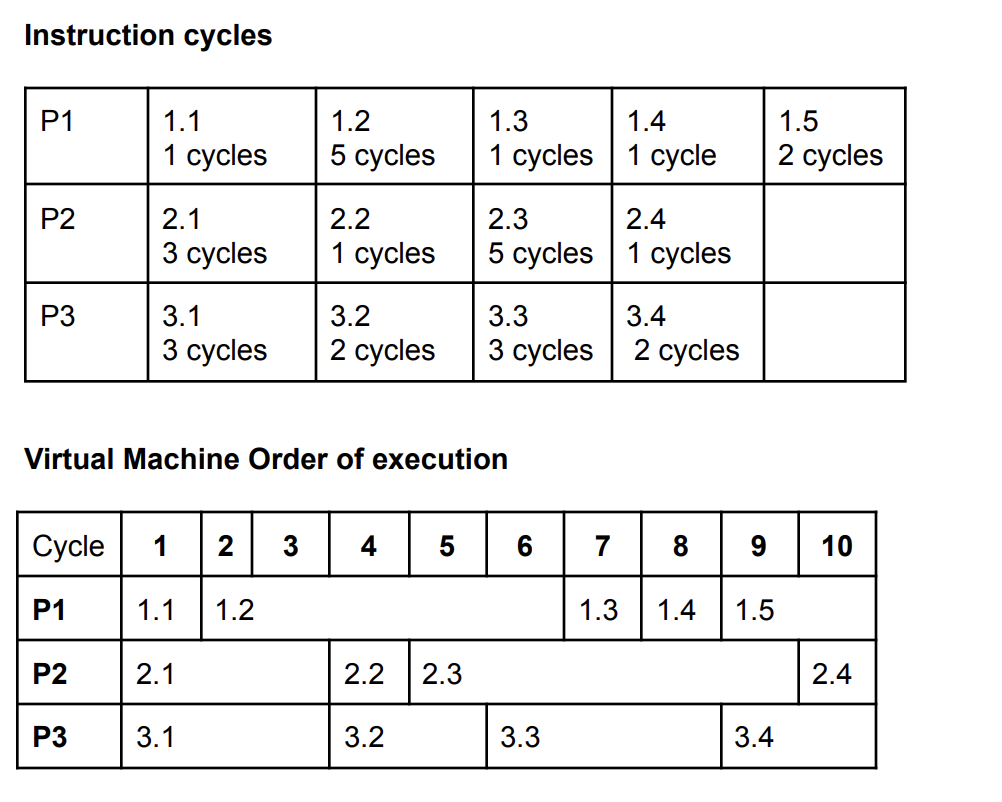
The machine must recognize the instructions below. If not a valid command, the Virtual machine moves to the next instruction.
MNEMONIC    | EFFECT
0X01 (live) | Takes 1 parameter: 4 bytes that represent the player's number.
Indicates the player is alive.
----------------
0x02 (ld)   | Takes 2 parameters: loads the first parameter to the second parameter.
Second parameter is a register. Ex: ld 34, r3 loads the REG_SIZE bytes
starting from the Counter + 34 % IDX_MOD into r3.
----------------
0x03 (st)   | Takes 2 parameters: Stores first parameter (a register) into the second
parameter (it can be another register or a number). Ex: st r4, 34 stores
r4 at the address of Counter + 34 % IDX_MOD; st r3, r8 copies r3 into
r8.
----------------
0x04 (add)  | Takes 3 parameters: 3 registers. Add the first to the second, and store
the result to the third. Modifies the carry.
----------------
0x05 (sub)  | Same as add, but Subtracting. Modifies the carry.
----------------
0x06 (and)  | Same as add, and sub, but does a binary operation AND between the
first and the second, and storing the result in the third parameter.
Modifies the carry.
----------------
0x07 (or)   | Same as and, but performing an OR.
----------------
0x08 (xor)  | Same as and and or, but performing an XOR.
----------------
0x09 (zjmp) | Takes 1 parameter, that must be an index. Jumps to this index if carry is
1. Else, does nothing, but still consume time.
Zjmp %23 -> if carry == 1, Counter + 23 % IDX_MOD to Counter
----------------
0x0a (ldi)  | Takes 3 parameters. First two are indexes and the third one is a register
Ex: ldi 3, %4, r1 -> reads IND_SIZ bytes from address Counter + 3 %
IDX_MOD, add 4 to this value (SumResult). REG_SIZE byte are read
from the Counter + SumResult % IDX_MOD and copies to r1.
----------------
0x0b (sti)  | Takes 3 parameters. The first one is a register. The other two can either
be indexes or registers. Ex: sti r2, %4, %5 -> copies the content for r2
into Counter + (4 + 5) % IDX_MOD.
----------------
0x0c (fork) | Takes 1 parameter, an index. Creates a new program, inheriting states
from the parent, and starting execution at COunter + parameter %
IDX_MOD
----------------
0x0d (lld)  | Same as ld without the %IDX_MOD. Modifies the carry
----------------
0x0e (lldi) | Same as ldi without the %IDX_MOD. Modifies the carry
----------------
0x0f (lfork)|  Same as fork without the %IDX_MOD.
----------------
0x10 (aff)  | Takes 1 parameter, a register. Displays to stdout the character
corresponding to the ASCII code of the content of the register (in base
10). A 256 modulo is applied to this ASCII code
The virtual machine job is to execute machine code. The assembler is responsible for setting the rules and syntax for writing the programs. We shall call it simply GAC (General Assembly Code).
Instructions are made of 3 elements:
- Label: An optional label, followed by the LABEL_CHAR character (here,":") declared in op.h.
- Opcode: An instruction code.
- Parameters: Instructions can have from 0 to MAX_ARGS_NUMBER parameters, separated by a comma.
Parameters can be:
- Register: From r1 to rREG_NUMBER.
- Direct: The DIRECT_CHAR character, followed by a value or a label (preceded by LABEL_CHAR).
- Indirect: A value or a label (preceded by LABEL_CHAR), which represents the value found at the parameter’s address (in relation to the Counter).
The assembler takes an instruction file in assembly code (the program) as a parameter and produces an executable for the virtual machine by converting its assembly code into machine code.
~/QWASAR-MSCS>./asm -h
   USAGE
./asm file_name[.s]

DESCRIPTION
file_name file in assembly language to be converted into file_name.cor, an executable in the Virtual Machine.Each instruction is composed of three elements:
-
Instruction code
-
Description of parameter types, except for the following instructions: live, zjmp, fork, fork.
-
Parameters 1 byte for register (in hexadecimal) DIR_SIZE bytes for direct (in hexadecimal) IND_SIZE bytes for indirect (in hexadecimal)
Parameters are grouped 4 by 4, to form a full byte.
Examples:
sti r2, 23, %34- Instruction code: 00 00 10 11 = 0x0b (Hex. representation)
- Param. Description: 01 11 10 00 = 0x78 (Hex. representation)
- Values: 0x02 0x00 0x17 0x00 0x00 0x00 0x22
Full Instruction (in Hexadecimal): 0b 78 02 00 17 00 00 00 22
Programs are written in GAC (General Assembly Code) assembly language, described in The Assembler section. When the virtual machine starts, each program is going to find its personal r1 register (the number assigned to it by the Virtual Machine).
Simple
.name "Simple"
.comment "Let's get started"

l2: sti r1,%:live,%1
    and r1,%0,r1
live: live %1
    zjmp %:live
Complex
.name "Complex"
.comment "Let's do it!"
sti r1,%:live,%1
sti r1,%:live2,%1
ld %1,r3
ld %33,r6
#While (r2 < 10)
forks:
add r2,r3,r2 #increment r2
xor r2,%15,r4 #if (r4) {carry = 0}
live2:
live %4
zjmp %:endwhile #if (carry)
fork %:forks
ld %0,r4 #carry = 1
zjmp %:forks
#EndWhile
endwhile:
ld %0,r4 #carry = 1
live:
live %4
zjmp %:live#ifndef _OP_H_ #define _OP_H_
#define MEM_SIZE (6 * 1024)
/* modulo of the index < */
#define IDX_MOD 512
/* this may not be changed 2^*IND_SIZE */ #define MAX_ARGS_NUMBER 4
#define COMMENT_CHAR '#' #define LABEL_CHAR ':' #define DIRECT_CHAR '%' #define SEPARATOR_CHAR ','
#define LABEL_CHARS "abcdefghijklmnopqrstuvwxyz_0123456789"
#define NAME_CMD_STRING ".name" #define COMMENT_CMD_STRING ".comment"
/*r1<-->rx*/ #define REG_NUMBER 16
typedef char args_type_t; typedef unsigned char code_t;
enum parameter_types { T_REG = 1,
T_DIR = 2,
T_IND = 4,
T_LAB = 8 };
typedef struct champion champion_t; typedef struct core_s core_t;
struct op_s {
char *mnemonique;
char nbr_args;
args_type_t type[MAX_ARGS_NUMBER];
char code;
int nbr_cycles;
int (*inst)(champion_t *, core_t *, code_t, int *);
};
enum op_types { OP_LIVE, OP_LD, OP_ST, OP_ADD, OP_SUB, OP_AND, OP_OR, OP_XOR, OP_ZJMP, OP_LDI, OP_STI, OP_FORK, OP_LLD, OP_LLDI, OP_LFORK, OP_AFF, OP_NOTHING, OP_NB
};
typedef struct op_s op_t;
/* size (in bytes) */ #define IND_SIZE 2 #define DIR_SIZE 4 #define REG_SIZE DIR_SIZE
/* op_tab */
extern const op_t op_tab[];
/* HEADER */
#define PROG_NAME_LENGTH 128 #define COMMENT_LENGTH 2048
#define COREWAR_EXEC_MAGIC 0xea83f3
typedef struct header_s {
int magic;
char prog_name[PROG_NAME_LENGTH + 1]; int prog_size;
char comment[COMMENT_LENGTH + 1];
} header_t; /* live */
#define MAX_CHAMPIONS 4
/* number of cycle before being declared dead */ #define CYCLE_TO_DIE 1536
#define CYCLE_DELTA 5
#define NBR_LIVE 40
#endif#include "corewar.h"
const op_t op_tab[] = {
{"live", 1, {T_DIR}, 1, 10, inst_live},
{"ld", 2, {T_DIR | T_IND, T_REG}, 2, 5, inst_ld},
{"st", 2, {T_REG, T_IND | T_REG}, 3, 5, inst_st},
{"add", 3, {T_REG, T_REG, T_REG}, 4, 10, inst_add},
{"sub", 3, {T_REG, T_REG, T_REG}, 5, 10, inst_sub},
{"and", 3, {T_REG | T_DIR | T_IND, T_REG | T_IND | T_DIR, T_REG}, 6, 6,
inst_and},
{"or", 3, {T_REG | T_IND | T_DIR, T_REG | T_IND | T_DIR, T_REG}, 7, 6,
inst_or},
{"xor", 3, {T_REG | T_IND | T_DIR, T_REG | T_IND | T_DIR, T_REG}, 8, 6,
inst_xor},
{"zjmp", 1, {T_DIR}, 9, 20, inst_zjmp},
{"ldi", 3, {T_REG | T_DIR | T_IND, T_DIR | T_REG, T_REG}, 10, 25, inst_ldi}, {"sti", 3, {T_REG, T_REG | T_DIR | T_IND, T_DIR | T_REG}, 11, 25, inst_sti}, {"fork", 1, {T_DIR}, 12, 800, inst_fork},
{"lld", 2, {T_DIR | T_IND, T_REG}, 13, 10, inst_lld},
{"lldi", 3, {T_REG | T_DIR | T_IND, T_DIR | T_REG, T_REG}, 14, 50,
inst_lldi},
{"lfork", 1, {T_DIR}, 15, 1000, inst_lfork}, {"aff", 1, {T_REG}, 16, 2, inst_aff}, {0,0,{0},0,0,0}
};- CoreWar - Origins
-
(f)open
-
read
-
write
-
getline
-
lseek
-
fseek
-
(f)close
-
malloc
-
realloc
-
free
-
exit