
Language / Idioma
English | Español
Samurai : XWA submodule focused on web cybersecurity — under active development
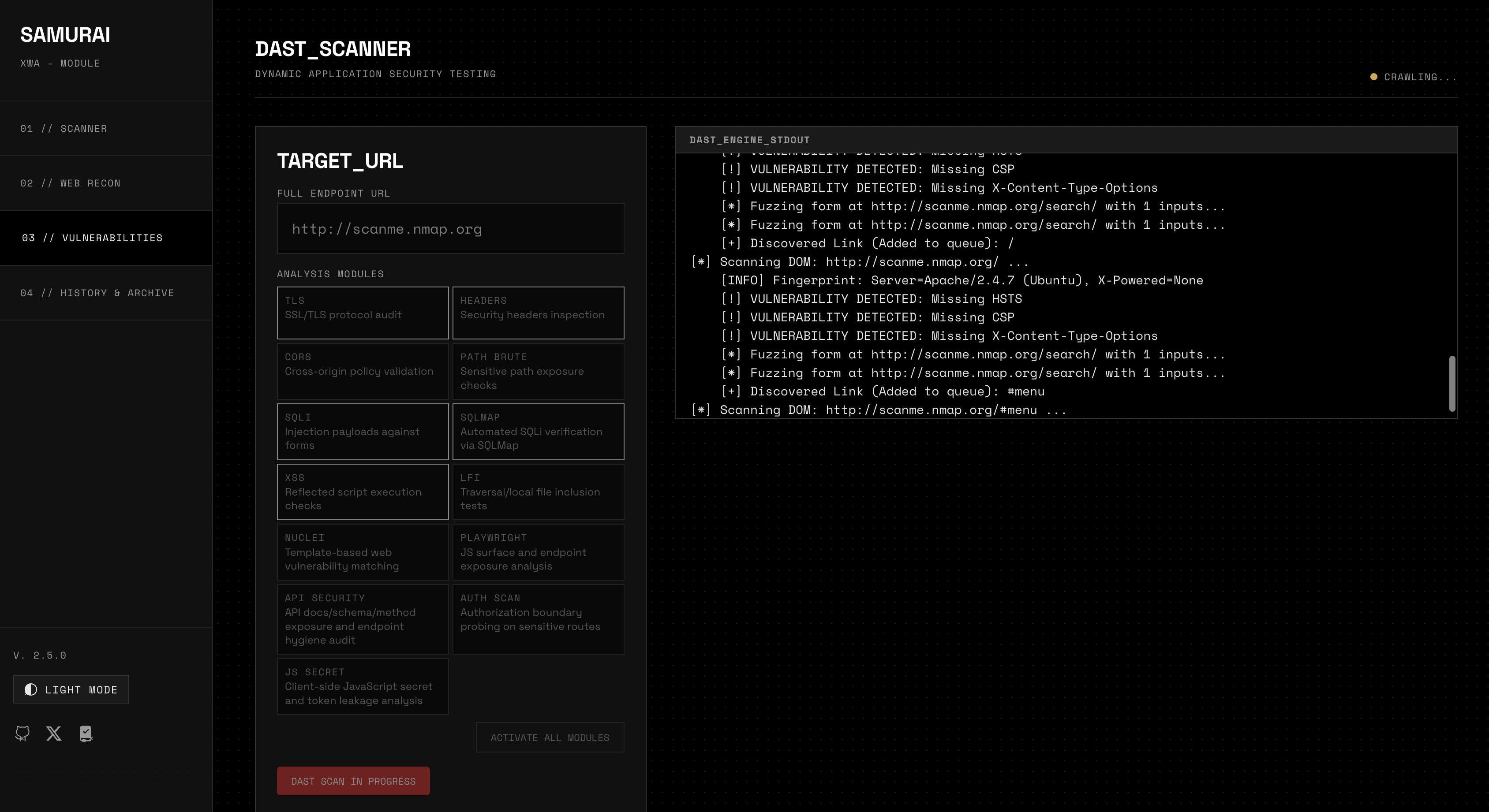
More screenshots...
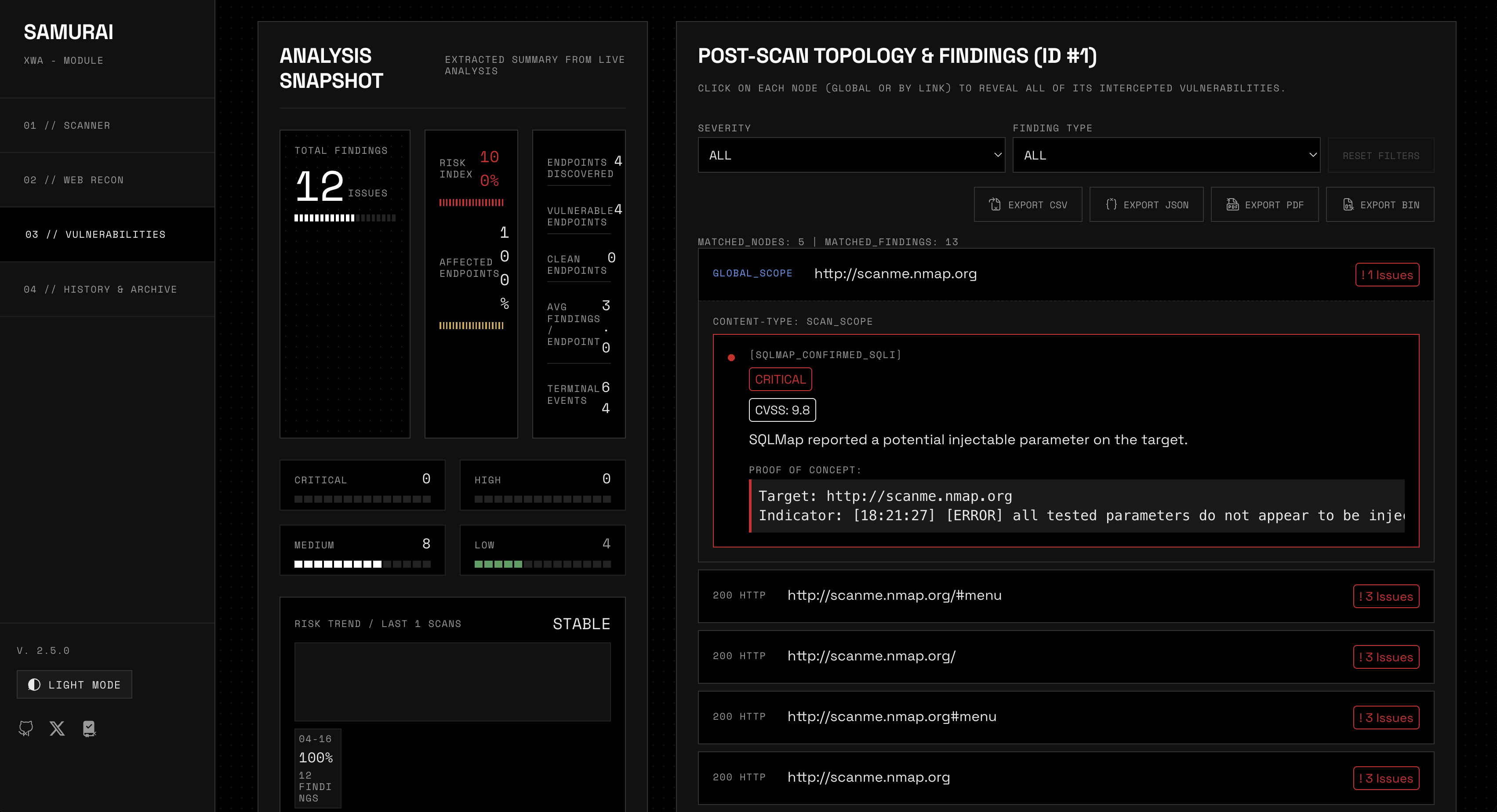
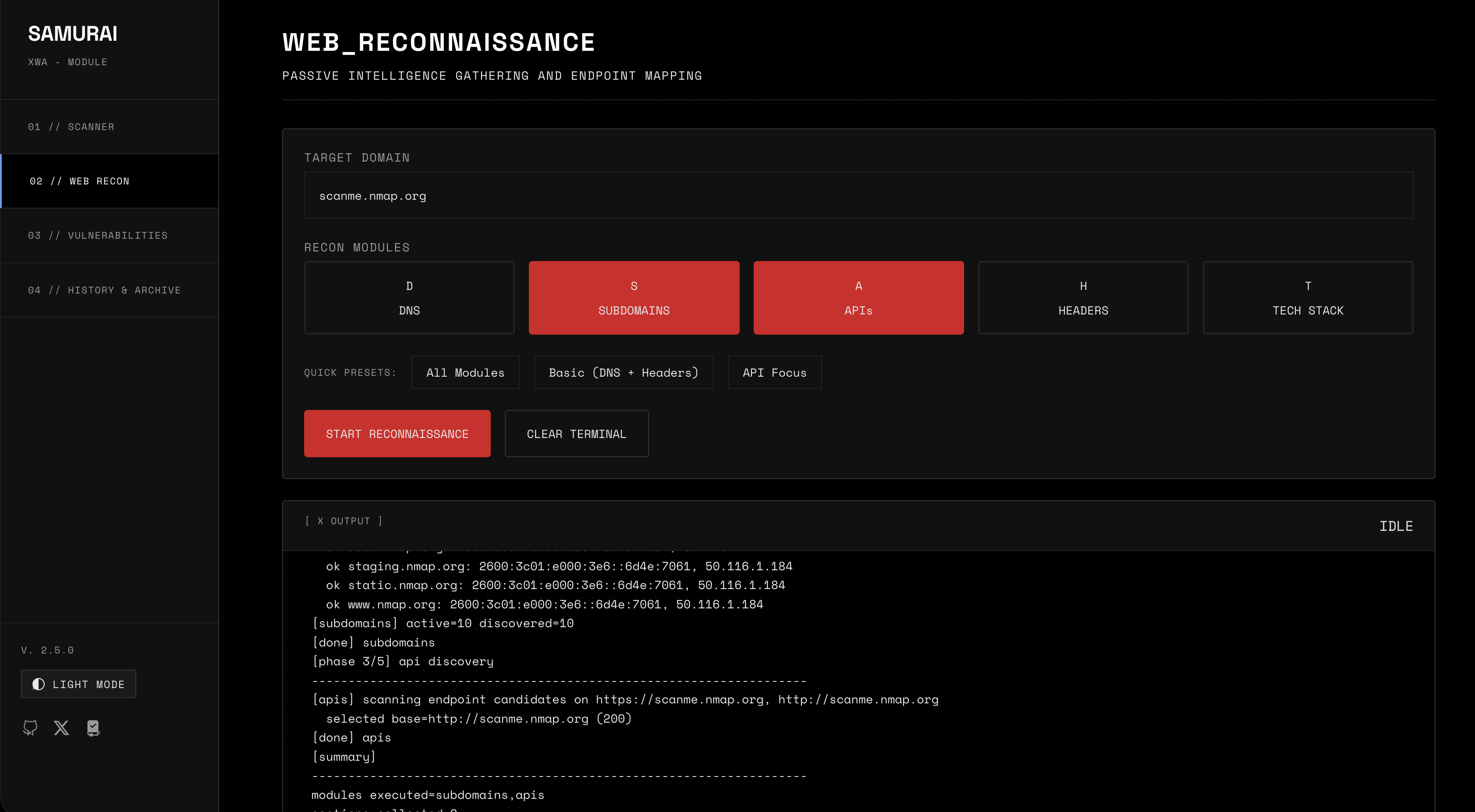
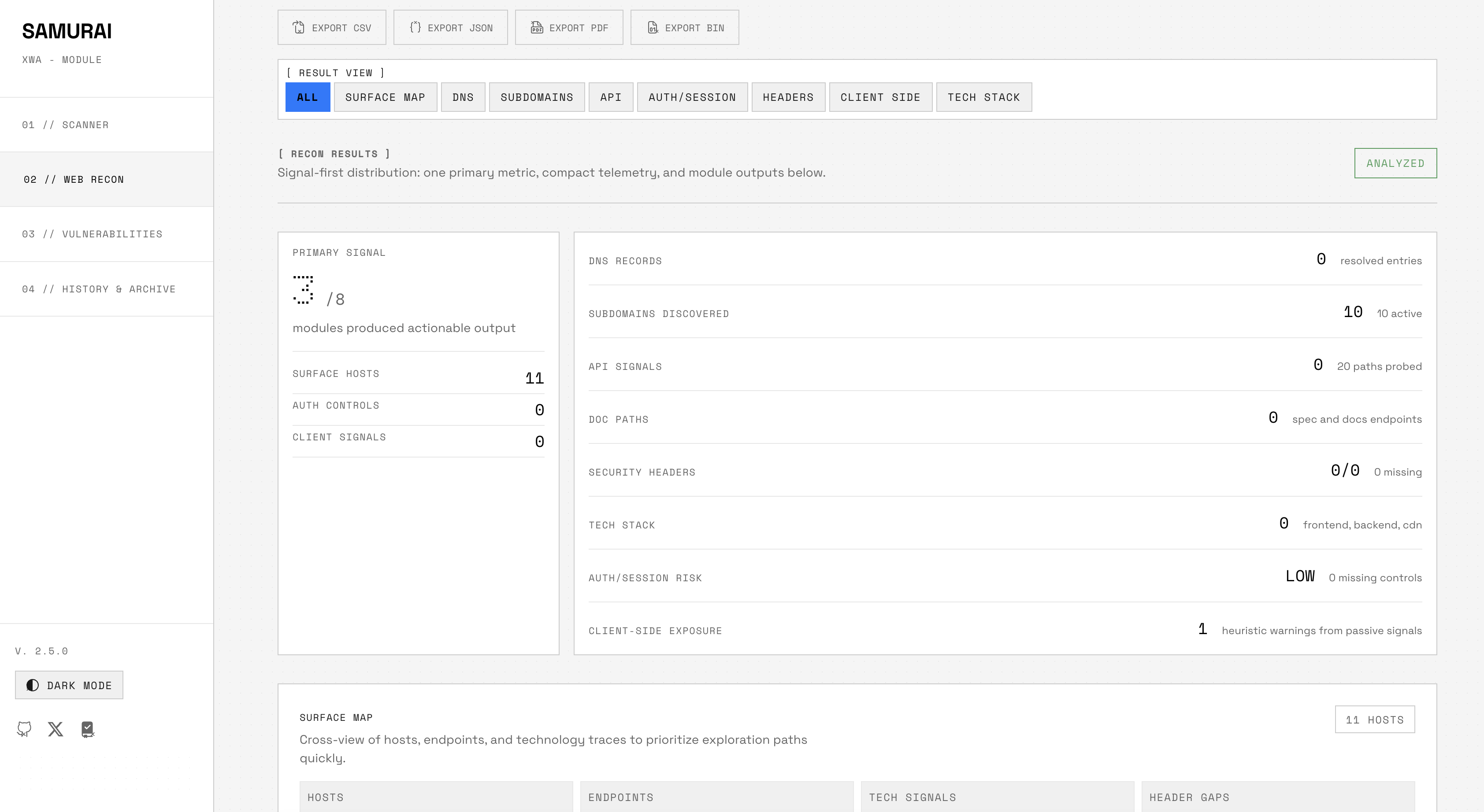
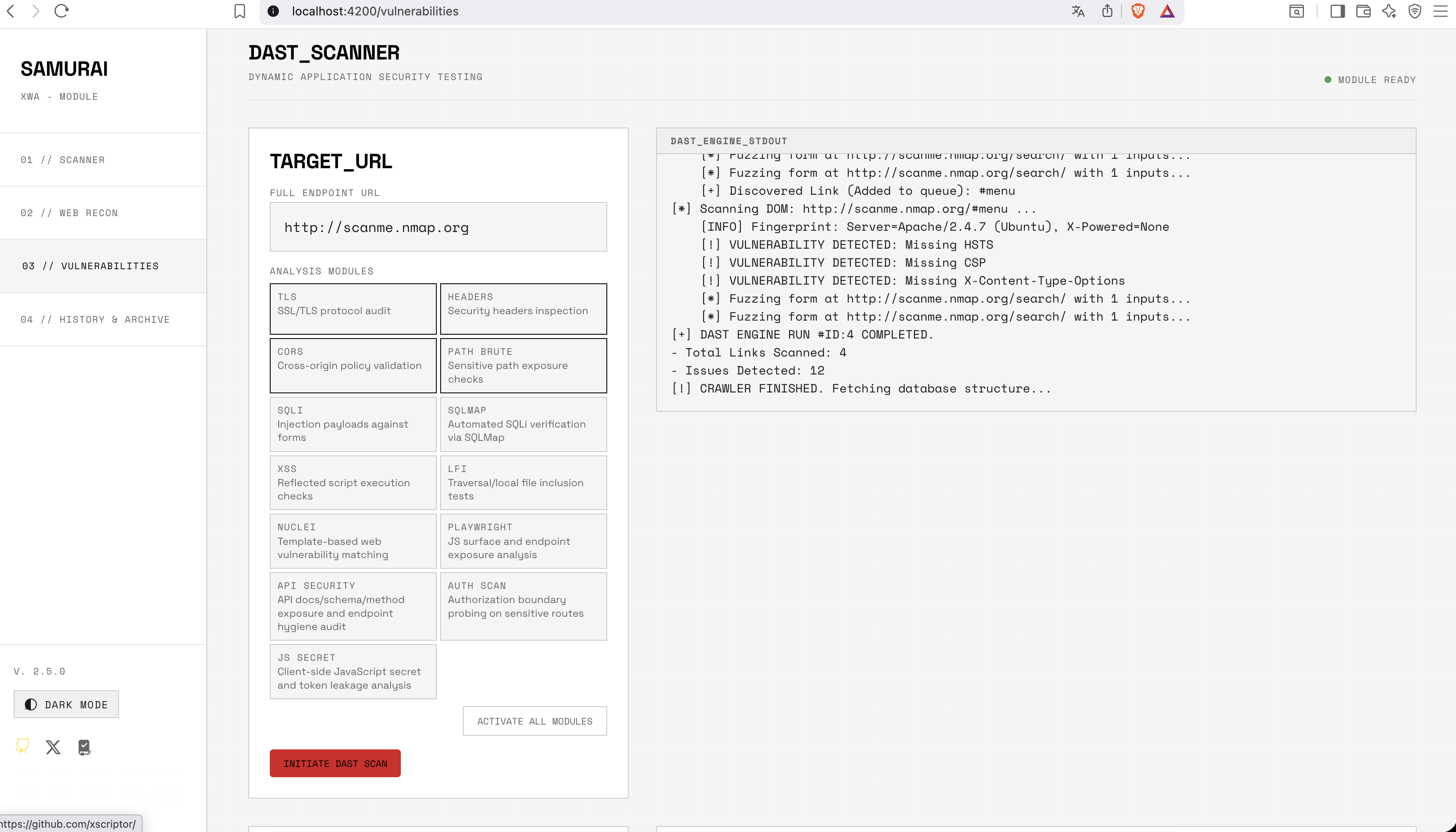
Samurai is a cybersecurity analysis platform with two interfaces sharing the same database:
| Interface | Directory | Language | Type |
|---|---|---|---|
| Samurai Web | /frontend + /backend |
Angular 22 + FastAPI/Python 3.13 | Web application (100% local, SQLite by default) |
| Samurai TUI | /samurai-tui |
Rust | Terminal application (standalone or Docker) |
- Port Scanning — Nmap with configurable profiles (quick, balanced, deep, UDP)
- Web Reconnaissance — DNS enumeration, subdomain discovery, API probing, security headers audit, technology fingerprinting
- Vulnerability Crawling (DAST) — Page discovery, HTTP header analysis, CORS/cookie/JS-secret checks, optional SQLMap and Nuclei modules with explicit timeouts
- Database Export — Full analytics dump as JSON (raw) or AES-256-GCM encrypted binary (
SAMURAI_DB_EXPORT_V1) - History & Archive — Persistent scan storage with findings and discovered topology
- Unified API —
xwa-sdkenvelopes:Analysisresponses andEventWebSocket streams
Requirements: Python 3.13 (uv recommended) and Node 24. External scanners (nmap, sqlmap, nuclei) are optional — missing binaries are reported as DEPENDENCY_MISSING instead of crashing.
# From the samurai repository root
./samurai.sh          # same as: ./samurai.sh local
The script creates backend/.venv with uv (Python 3.13), installs the local xwa-sdk binding when present, installs requirements, and starts:
| Service | URL |
|---|---|
| Frontend (Angular) | http://localhost:4200 |
| Backend (FastAPI) | http://localhost:8000 — docs at /docs |
| Health | http://localhost:8000/api/health |
| SQLite database | <repo>/samurai.db |
cd backend
~/.local/bin/uv venv --python 3.13 --seed .venv
.venv/bin/pip install -r requirements.txt
# Optional: local xwa-sdk binding (Event/Analysis dataclasses)
.venv/bin/pip install -e ../../xwa-sdk/bindings/python
.venv/bin/uvicorn app.main:app --port 8000cd frontend
export PATH="$HOME/.local/share/mise/installs/node/24/bin:$PATH"
npm ci # reproducible install from package-lock.json
npm start # ng serve --host 0.0.0.0 --poll 2000
npm test # Vitest via @angular/build:unit-test
npm run build # @angular/build:application (production)./samurai.sh dockerCompose starts frontend, backend (DB_DRIVER=postgresql) and PostgreSQL 17 with a healthcheck. Redis and Celery are no longer part of the stack.
./clean.shKills leftover processes, removes Docker containers/volumes/images, deletes node_modules/, .venv, dist/, Python cache, .angular/ cache and the local samurai.db* files. package-lock.json is preserved.
DB_DRIVER=sqlite(default) — local file database, zero external services. SQLite is opened withcheck_same_thread=FalseplusPRAGMA foreign_keys=ON,journal_mode=WALandbusy_timeout=5000.DB_DRIVER=postgresql— optional; usesDATABASE_URLwhen set, otherwiseDB_HOST/DB_PORT/DB_NAME/DB_USER/DB_PASS, withpool_pre_ping=True.DB_PATHoverrides the SQLite file location (default<repo>/samurai.db).wait_for_db()retries only for PostgreSQL; SQLite connects immediately.
TUI compatibility: the table schema (scans, discovered_links, findings) and the encrypted export format (SAMURAI_DB_EXPORT_V1: header + 16-byte salt + 12-byte nonce + AES-256-GCM ciphertext, PBKDF2-SHA256 600k iterations) are frozen and shared with samurai-tui. Do not change column types or the header.
The three live endpoints (/api/scan/live, /api/vuln/live, /api/recon/live) stream JSON Event envelopes instead of plain text:
{
  "seq": 4,
  "type": "item_found",
  "tool": "samurai",
  "analysis_id": "42",
  "ts": "2026-09-12T10:00:04Z",
  "payload": {
    "kind": "open_port",
    "port": "22", "protocol": "tcp", "service": "ssh", "version": "OpenSSH 9.6",
    "severity": "info"
  }
}| Event type | Payload |
|---|---|
analysis_started | {id, target, scan_type, profile?, modules?, timeout?} |
log | {line} — one terminal line (raw nmap output included) |
analysis_progress | {phase, message, data?} — e.g. contact intel with data.url/emails_count/phones_count |
item_found | Finding or port: {kind:"open_port", port, protocol, service, version, severity}, {kind:"unsanitized_input", url, forms}, {kind:"reflected_input", url} |
analysis_completed | {summary:{total_items, by_severity, ...}, status, scan_id, results?, ports?} |
analysis_error | {error:{code, message, detail, retryable}} |
seq is monotonic per connection starting at 1 and analysis_id is always the persisted scan id serialized as a string. If the optional xwa-sdk Python package is not installed, the backend emits the exact same structure via a built-in fallback.
| Method | Path | Description |
|---|---|---|
| GET | /api/health | {status, database, version, tool} (rate-limit exempt) |
| GET | /api/scans, /api/scans/{id} | Legacy history endpoints (kept) |
| GET/DELETE | /api/analyses, /api/analyses/{id} | Unified xwa-sdk Analysis aliases |
| GET | /api/analyses/{id}/export?format=json|csv | Single-analysis export with Content-Disposition |
| GET | /api/database/export/raw | Full DB export (JSON) |
| POST | /api/database/export/encrypted | {"password": "..."} → AES-256-GCM binary (TUI-compatible) |
Errors use the unified envelope {"error":{"code","message","detail","retryable"}}. CORS is configurable via XWA_CORS_ORIGINS (comma-separated origins or regexes; default localhost/LAN) with allow_credentials=False. In-process rate limiting defaults to 120 req/min per IP (SAMURAI_RATE_LIMIT_MAX, window SAMURAI_RATE_LIMIT_WINDOW seconds; 0 disables).
| Variable | Default | Purpose |
|---|---|---|
DB_DRIVER | sqlite | sqlite or postgresql |
DB_PATH | <repo>/samurai.db | SQLite file path |
DATABASE_URL | — | PostgreSQL URL (overrides DB_* parts) |
DB_HOST/DB_PORT/DB_NAME/DB_USER/DB_PASS | localhost/5432/samurai/postgres/postgres | PostgreSQL parts |
XWA_CORS_ORIGINS | localhost/LAN regex | Allowed origins (comma-separated) |
SAMURAI_RATE_LIMIT_MAX | 120 | Requests per window per IP (0 disables) |
SAMURAI_RATE_LIMIT_WINDOW | 60 | Rate-limit window in seconds |
SAMURAI_JWT_SECRET | — | Enables JWT auth + RBAC when set (POST /api/auth/login issues tokens; WebSockets take ?token=) |
SAMURAI_ADMIN_PASSWORD | changeme | Admin password for /api/auth/login (role admin; analysts are read-only) |
cd backend
.venv/bin/pip install -r requirements.txt -r requirements-dev.txt
.venv/bin/pip install -e ../../xwa-sdk/bindings/python   # optional but recommended
.venv/bin/pytest -q
The suite covers health/contracts, analyses CRUD + cascade, raw and encrypted exports (SAMURAI_DB_EXPORT_V1 roundtrip), parser helpers, the rate limiter, subprocess timeout helpers and the Event WebSocket shape (nmap is monkeypatched). The Angular 22 frontend ships its own Vitest suite (npm test): ApiService contracts, pure Event parsers, theme/i18n and the shared export toolbar.
| Document | Description |
|---|---|
| docs/manual.md | Development and production deployment guide |
| docs/ui-architecture.md | Frontend feature-driven architecture specification |
| docs/python-libraries.md | Backend Python dependency inventory |
| docs/uses/dast.md | DAST vulnerability scanning usage |
| samurai-tui/README.md | Terminal application: installation, configuration, Docker, usage |
| ROADMAP.md | Development phases and milestones |
samurai/
├── frontend/              # Angular 22 SPA (zoneless, core/shared/features)
│   └── src/environments/  # apiBaseUrl / wsBaseUrl (no hardcoded hosts)
├── backend/               # FastAPI Python (REST + WebSocket)
│   ├── app/
│   │   ├── main.py        # API routes, lifespan, CORS, rate limit
│   │   ├── database.py    # dual SQLite/PostgreSQL engine + PRAGMAs
│   │   ├── events.py      # xwa-sdk Event emitter (WS protocol)
│   │   ├── middleware.py  # in-process sliding-window rate limiter
│   │   ├── scanner.py     # Nmap port scanning engine
│   │   ├── crawler.py     # DAST vulnerability crawler (sqlmap/nuclei timeouts)
│   │   ├── db_exporter.py # Database export (raw + encrypted V1)
│   │   └── recon/         # Web reconnaissance modules
│   ├── tests/             # pytest suite (SQLite tmp DB)
│   └── requirements*.txt  # base / postgres / dev pins
├── samurai-tui/           # Rust terminal application (shares schema + export)
├── docs/                  # Technical documentation
├── samurai.sh             # Launcher: local (default) | docker
├── clean.sh               # Cleanup script (containers, caches, samurai.db)
└── docker-compose.yml     # frontend, backend (postgresql), postgres 17


