Governance for AI agents. One file. Zero dependencies.
Your agent just mass-emailed 10,000 customers with a hallucinated discount.
It had the tool. It had the permission. Nobody told it to stop.
Shape prevents this.
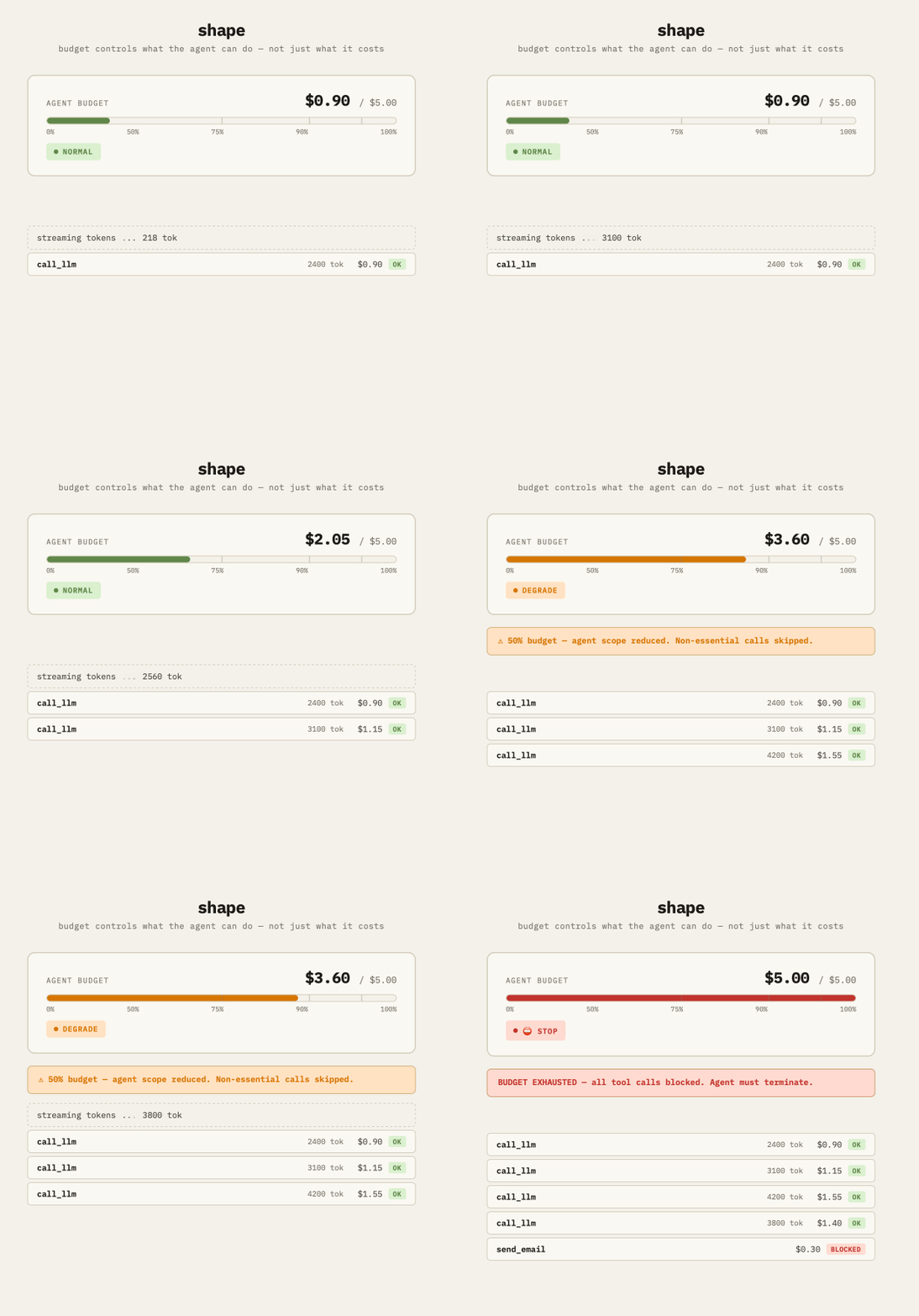
🌐 Visual explainer · 🎮 Interactive demo · 📄 Full article
from shape import Agent, ToolEffect

agent = Agent("customer-service", budget=5.00)

agent.tool("lookup_customer", effect=ToolEffect.READ,         fn=lookup_fn)
agent.tool("update_record",   effect=ToolEffect.REVERSIBLE,   fn=update_fn)
agent.tool("send_email",      effect=ToolEffect.IRREVERSIBLE, fn=email_fn)

agent.rules("""
    BLOCK send_email WHEN phase IS NOT commit
    BLOCK * WHEN budget ABOVE 90%
""")

# EXPLORE → read only, safe
with agent.explore() as ctx:
    customer = ctx.call("lookup_customer", id="C-1234")

# COMMIT → transactional, all-or-nothing
with agent.commit() as tx:
    tx.call("update_record", cost=0.01, id="C-1234", status="welcomed")
    tx.call("send_email",    cost=0.10, to=customer["email"], template="welcome")
    # if send_email fails → update_record is compensated automatically
Three phases. One transaction. Full audit trail.
AI agents get tool access — databases, APIs, payments, infrastructure. The frameworks (LangGraph, CrewAI, Strands) optimize for capability. None optimize for permission.
| Gap | What goes wrong |
|---|---|
| No lifecycle phases | Agent writes before it finishes reading |
| No transactions | 3-step action fails halfway — step 1 sticks |
| No budget control | Cost is a metric you check after the damage |
| No audit trail | You know what happened, not why it was allowed |
Shape fills all four. In ~400 lines of Python.
cp shape.py /your/project/No pip. No dependencies. No config server.
| Concept | One-liner | Docs |
|---|---|---|
| Phases | EXPLORE → DECIDE → COMMIT. Controls when agents can act | → phases |
| Effect classification | READ / REVERSIBLE / IRREVERSIBLE per tool | → effects |
| Transactions | All-or-nothing with automatic compensation | → transactions |
| Budget gates | Cost as a control signal, not a log line | → budget |
| Rule DSL | Human-readable governance rules | → rules |
| Proof traces | Structured record of why each call was allowed | → traces |
Shape governs any tool-calling agent via hooks (Architecture A):
| Agent | Directory | Setup |
|---|---|---|
| Kiro CLI | kiro/ |
PreToolUse/PostToolUse hooks |
| Claude Code | claude/ |
.claude/settings.json hooks |
| OpenAI Codex CLI | codex/ |
Config-based hooks |
Limitations (Architecture A): No transactional atomicity, no compensation, estimated budget, manual phase transitions. See each directory's README for details.
For full governance including transactions → use Architecture B (Shape as orchestrator). See → architecture.
from shape import Agent, ToolEffect, wrap_tool

agent = Agent("my-agent", budget=5.00)
governed_fn = wrap_tool(agent, "my_tool", original_fn, ToolEffect.REVERSIBLE)
Works with Strands, LangGraph, CrewAI, or raw Python. If your framework calls functions, Shape governs them. See → framework integration.
| Capability | Galileo | AWS AgentCore | Atomix | Shape |
|---|---|---|---|---|
| Phase enforcement | ✗ | ✗ | ✗ | ✓ |
| Transactional tool calls | ✗ | ✗ | ✓ (paper) | ✓ |
| Compensation / rollback | ✗ | ✗ | partial | ✓ |
| Cost as control signal | ✗ | ✗ | ✗ | ✓ |
| Proof traces | ✗ | ✗ | ✗ | ✓ |
| Readable rule DSL | ✗ | Cedar | ✗ | ✓ |
| Dependencies | many | AWS SDK | N/A | zero |
python -m pytest test_shape.py -v # 58 testsMIT