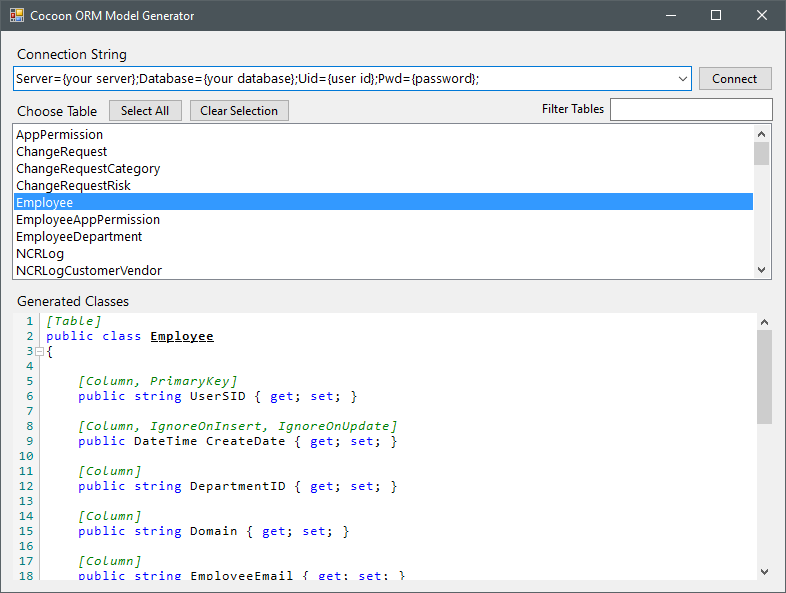
-
Developed by Rhett Thompson & Michael Kersey
- Massivly reduce the amount of code required for database access.
- Leverage simplicity and elegance.
- Speed up development time.
- Reduce bugs.
- Replace complicated stored procedures with simpler in-code versions.
- Includes most common database querying tasks in a simple API.
- Very fast and reliable.
- Stored procedures and inline SQL support.
- Requires no special training; examples are plentiful and directly applicable to your code.
- Includes a model generator to speed up model creation.
- Leverages data attributes similar to that of the Entity Framework and NHibernate in a simpler manner.
- Many utility functions for common database development including: Unique Identifier generation, object mapping, object typing, hashing functions, data encoding and compression.
class Customer
{
    [Column, PrimaryKey, IgnoreOnInsert, IgnoreOnUpdate]
    public int CustomerID { get; set; }

    [Column,]
    public string LoginEmail { get; set; }

    [Column]
    public string Password { get; set; }

    [Column]
    public string FirstName { get; set; }

    [Column]
    public string LastName { get; set; }

    [Column]
    public string Address1 { get; set; }

    [Column]
    public string Address2 { get; set; }

    [Column]
    public string City { get; set; }

    [Column]
    public string State { get; set; }

    [Column]
    public string PostalCode { get; set; }

    [Column]
    public string Country { get; set; }

    [Column]
    public string Phone { get; set; }

    [Column, IgnoreOnInsert, IgnoreOnUpdate]
    public DateTime CreateDate { get; set; }

    //an example of lazy loading: loads customer orders when accessed.
    public List<Order> orders
    {
        get
        {
            return Program.db.GetList<Order>(where: o => o.CustomerID == CustomerID });
        }
        set { }
    }

}

class Order
{
    [Column, PrimaryKey, IgnoreOnInsert, IgnoreOnUpdate]
    public int OrderID { get; set; }

    [Column]
    public int CustomerID { get; set; }

    [Column]
    public string OrderTypeID { get; set; }

    [Column, IgnoreOnInsert, IgnoreOnUpdate]
    public DateTime CreateDate { get; set; }

    public string CustomerFirstName { get; set; }

    [Join]
    public static JoinDef[] joins = new JoinDef[] {

        CocoonORM.Join<Order, Customer>(customer => customer.FirstName, order => order.CustomerFirstName)

    };

}You only need to instantiate this one time, prefereably in a central/global area of your application.
CocoonORM db = new CocoonORM("Server={your server};Database={your database};Uid={user id};Pwd={password};");Attributes are used to specify columns in models, and define the properties and relationships of columns
| Attribute | Description |
|---|---|
| Column | Signifies that a property in this class is mirrored as a field in the database. If not columns explicitly defined all properties are assumed to be columns. |
| Join | This field contains a Join definition; must be a static JoinDef, or IEnumerable. |
| PrimaryKey | Signifies that this column/property is a primary key |
| IgnoreOnInsert | Tells Cocoon to ignore this column when inserting objects/records; usually used for columns with default fields or identity columns that are automatically incremented etc. |
| IgnoreOnUpdate | Tells Cocoon to ignore this column in update. |
| IgnoreOnSelect | Tells Cocoon to ignore this column on data retrieval operations. |
| OverrideName | Overrides the name of this column. |
| AggSQLField | Signifies that this field should include aggregation SQL (sql select count(*) from ForeignTable where ForeignTable.Key = ThisTable.ForeignKey). |
Columns from foreign tables can be joined into a table model on select operations. Just add a static array/IEnumerable of JoinDef instances and decorate the field with the [Join] attribute.
[Join]
public static JoinDef[] joins = new JoinDef[] {

    CocoonORM.Join<ThisTable, ForeignTable>(thisTable => thisTable.ForeignKey, foreignTable => foreignTable.PrimaryKey, foreignTable => foreignTable.SourceField, thisTable => thisTable.DestinationField),
    CocoonORM.Join<ThisTable, ForeignTable>(foreignTable => foreignTable.SourceField, thisTable => thisTable.DestinationField)

};This is a minimal example.
//Retrieves a single order
Order order = db.GetSingle<Order>(where: o => 0.OrderID == 123);Basic CRUD operations
//insert a new customer into the database
Customer newCustomer = db.Insert(new Customer() { LoginEmail = "customer@email.com", FirstName = "bob" });

//retrieve a single customer from the database
Customer someCustomer = db.GetSingle<Customer>(where: c => c.CustomerID == newCustomer.CustomerID);

//change the customers last name
someCustomer.LastName = "barker";
db.Update(someCustomer); //no where parameter is needed; Cocoon will automatically use the primary key defined in the model

//delete the customer from the database
db.Delete<Customer>(where: c => c.CustomerID == someCustomer.CustomerID);//retrieve a single order from a stored procedure
db.ExecuteProcSingle<Order>(procedure: "OrderGet", parameters: new { OrderID = 5 });
//get a list of orders from a stored procedure that returns a list of orders
IEnumerable<Order> listOfOrders = db.ExecuteProcList<Order>(procedure: "OrderList");//@OrderID is parameterized from the OrderID in the new { OrderID = 5 }
db.ExecuteSQLSingle<Order>(sql: "select * from Orders where OrderID = @OrderID", parameters: new { OrderID = 5 });
//a basic SQL list
IEnumerable<Order> listOfOrders = db.ExecuteSQLList<Order>(sql: "select * from Orders");Cocoon ORM supports ambient transactions. You can read more about them here: https://msdn.microsoft.com/en-us/library/System.Transactions(v=vs.110).aspx
using (TransactionScope tran = new TransactionScope())
{
  db.UpdatePartial<Order>(fieldsToUpdate: new { OrderID = 2 }, where: o => o.OrderTypeID == OrderType.ONSITE);
  tran.Complete();
}The PredicateBuilder extension class adds two methods And & Or to assist in building dynamic where expressions.
Expression<Func<Customer, bool>> predicates = c => c.FirstName == c.FirstName;//start with an always true/false predicate to get started

if(!string.IsNullOrEmpty(FirstNameTextBox.Text))
    predicates = predicates.And(c => c.FirstName == FirstNameTextBox.Text);

if(!string.IsNullOrEmpty(LastNameTextBox.Text))
    predicates = predicates.And(c => c.LastName == LastNameTextBox.Text);

if(!string.IsNullOrEmpty(LoginEmailTextBox.Text))
    predicates = predicates.And(c => c.LoginEmail == LoginEmailTextBox.Text);

IEnumerable<Customer> list = db.GetList(predicates);| Function | Description |
|---|---|
| GenerateSequentialGuid | Generates a sequential COMB GUID. |
| GenerateSequentialUID | Generates a sequential Base36 unique identifier. |
| SHA256 | Creates an SHA256 hash of a string. |
| MD5 | Creates an MD5 hash of a string. |
| MD5ListHash | Creates an MD5 hash of a list of objects. |
| CompressString | Compresses a string using GZip. |
| DecompressString | Decompresses a string using GZip. |
| Base36Decode | Decode Base36 string. |
| Base36Encode | Base36 encode a value. |
| Base64Decode | Decode Base64 string. |
| Base64Encode | Base64 encode a string. |
The model generator is a simple application included with Cocoon ORM to generate C# model classes. All you need is a connection string to your database