




English | 中文
Disclaimer: This is an independent, community-maintained project. It is not affiliated with, sponsored by, or endorsed by CapCut, JianYing, or ByteDance Ltd. "CapCut" and "JianYing" (剪映) are trademarks of ByteDance Ltd. All product names, logos, and brands are the property of their respective owners and are used here only for identification (nominative) purposes.
An independent, community-maintained CLI for CapCut / JianYing draft files.
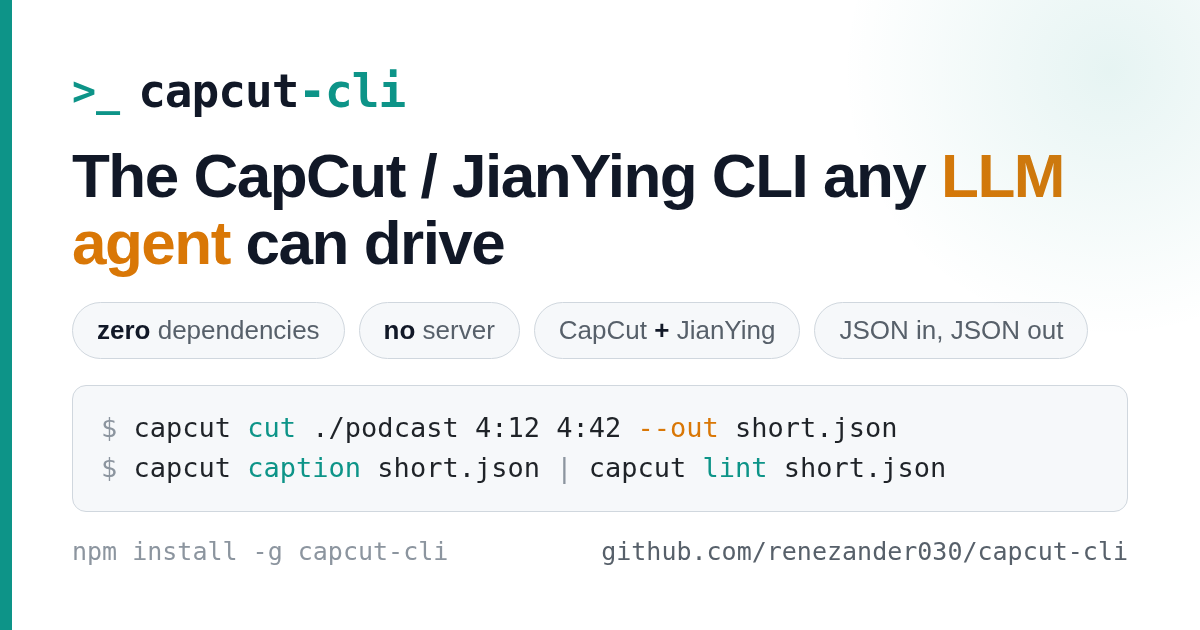
An independent CLI for CapCut / JianYing that any LLM agent can drive — zero dependencies, no server, both namespaces in one binary.
Every command reads and writes draft_content.json directly: JSON in, JSON out, no MCP server, no HTTP daemon, no state to babysit. That makes it a deterministic boundary any model (Claude, DeepSeek, GLM, Kimi) can call from a pipeline. Inspect drafts, build from scratch, add media, edit subtitles, auto-caption with whisper, translate to N languages, and cut long-form to shorts. Because there is no private API in the loop, it keeps working across ByteDance updates — and caption writes real caption objects, not the text-segment mimics other tools settle for.
Use it three ways:
- CLI —
npm install -g capcut-cli, thencapcut <command> <project> - Library —
import { loadDraft, lintDraft, saveDraft } from "capcut-cli"(typed, zero-dep) - Queue runner —
capcut servereads JSONL jobs from stdin and drops into n8n / Make / Coze
Run capcut doctor first to verify your environment (Node, whisper, draft directory).
See the changelog and releases for what's new in each version.
How capcut-cli fits into a typical viral-shorts pipeline. Steps 2 and 3 are LLM-driven (any model that returns JSON); steps 1, 4, and 5 are deterministic CLI calls. Step 6 stays human — every short-video platform forbids automated upload, so the publish click is yours.
flowchart LR
    A[Long video<br/>or CapCut project] --> B[capcut cut<br/>→ 60s candidate]
    B --> C[Claude / DeepSeek<br/>/ GLM / Kimi<br/>→ hook + script JSON]
    C --> D[capcut-cli<br/>add-text · add-audio<br/>apply-template]
    D --> E[CapCut / JianYing<br/>review + render MP4]
    E --> F[Publish<br/>YouTube Shorts · Reels · TikTok]
How capcut-cli differs from the other CapCut / JianYing tooling:
| Capability | pyJianYingDraft (Python, JianYing) |
pyCapCut (Python, CapCut) |
VectCutAPI (Python, HTTP server, formerly CapCutAPI) |
cutcli (Go, closed) |
capcut-cli (Node, this repo) |
|---|---|---|---|---|---|
Inspect drafts (info / tracks / materials / segments / texts) |
partial | partial | ❌ | ❌ | ✅ |
| Create drafts from scratch | ✅ | ✅ | ✅ | ✅ | ✅ |
Decorators (keyframe / transition / mask / text-anim / image-anim) |
✅ | ✅ | ✅ | ✅ | ✅ (v0.3.0) |
| SRT import → per-cue text segments | ❌ | ❌ | ✅ | ❌ | ✅ (v0.3.0) |
| Multi-style text (word-level highlight captions) | partial | partial | ❌ | ❌ | ✅ (v0.3.0) |
| Enum discovery for AI agents | ❌ | ❌ | partial | ❌ | ✅ — 13 categories × 2 namespaces |
| CapCut + JianYing namespaces in one binary | JianYing only | CapCut only | both | partial | both via --jianying |
| Templates (save/apply) | partial | partial | ❌ | ❌ | ✅ — 3 shipped templates |
| Schema docs | partial | partial | minimal | none | full (docs/draft-schema/) |
| Wikimedia Commons URLs with license gate | ❌ | ❌ | ❌ | ❌ | ✅ (v0.3.0) |
| Runtime deps | several Python deps | several Python deps | Flask + Python | none (Go binary) | zero (Node ≥ 18 built-ins only) |
| AI-tool integration | none | none | HTTP | none | Claude Code plugin |
| Install | pip install -r requirements.txt |
pip install pyCapCut |
clone + run server | binary download | npm install -g capcut-cli |
| License | none | none | none | unclear | MIT |
A capability map; see Commands for syntax.
- Inspect —
info·tracks·materials·segments·texts;segment/material <id>for progressive-disclosure drill-down;timeline(ASCII layout);export-srt. - Build & add —
inita draft, thenadd-video·add-audio·add-textfrom local files or Wikimedia Commons URLs (license-gated);add-sticker,add-effect. - Edit —
set-text·shift·shift-all·speed·volume·opacity·trim;batch(many edits, one write);--dry-runpreview, andrestoreundo (latest.bakor--step Nthrough snapshot history). - Maintain & compose —
prune(drop unreferenced materials) ·relink(repair broken media paths via--diror--from/--to) ·projects(list drafts on disk by name) ·diff(compare two drafts) ·concat(stitch drafts into one timeline, id-safe). - Decorate —
keyframe·transition·mask·bg-blur·text-style·text-anim·image-anim·text-ranges(word-level highlight captions);mix-mode·audio-fade·add-filter·bubble-text·add-cover·add-sfx·chroma. - Captions & translate —
caption(whisper → real caption objects, not text-segment mimics),import-srt/import-ass,translate(Anthropic-API multi-language clone, zero deps). - Templates —
save-template/apply-template; six ship intemplates/(gold-title,end-card,subscribe-cta,hook-question,lower-third,caption-pop). - Resilience —
version(support detection) ·lint(schema-aware CI checks, exit 0/1/2) ·migrate·decrypt; schema reference + version matrix. - Discover —
enums— 12 categories × 2 namespaces, no network. - Integrate —
describe(JSON tool spec for LLM/agent callers), Node library, Dockerfile, GitHub Action,serve(stateless JSONL runner for n8n/Make/Coze),export --batch(experimental render queue),completions <bash|zsh|fish>, Claude Code plugin. - Output — JSON by default (pipe to
jq),-Htable,-qquiet. Defaults (draftsdir,jianying,cols) can live in a.capcutrc;capcut configshows the resolved values.
Cross-platform: CapCut and JianYing in one binary (--jianying switches the enum namespace); macOS · Windows · Linux; pure Node ≥ 18, zero runtime deps.
- ⬜ JianYing 6.0+ decryption (currently detection only — see the
decryptworkaround) - ⬜ Windows path for
export --batch(currently macOS-only via AppleScript) - 🚫 HTTP server / cloud rendering / MCP server — out of scope per
PLAN.md;serveis a stateless JSONL runner instead. Vote on what lands next in Discussion #1.
CapCut stores projects as draft_content.json -- deeply nested, undocumented, with timing in microseconds and text buried inside escaped JSON-in-JSON. Every manual edit means: find the right segment ID, trace it to the material, figure out the content format, convert your timestamp, edit, pray you didn't break the structure. 15 seconds per change, minimum.
capcut-cli already knows the schema. One command, one change, 5 seconds.
$ capcut texts ./project
[{"id":"a1b2c3d4-...","start_us":500000,"duration_us":2500000,"text":"Welcome to the video"}]

$ capcut set-text ./project a1b2c3 "Fixed subtitle"
{"ok":true,"id":"a1b2c3d4-...","old":"Welcome to the video","new":"Fixed subtitle"}
Zero dependencies. JSON output by default. Pipeable. Works with CapCut and JianYing.
Prerequisites: Node ≥ 18 (built-ins only — no native modules). Two commands need extra tooling: caption shells out to a whisper binary, and translate needs ANTHROPIC_API_KEY. Run capcut doctor right after install to check all of this in one shot.
npm install -g capcut-cliVerify the installation:
capcut --version # prints the installed CLI versionOr run directly:
npx capcut-cli info ./my-project/Or build from source:
git clone https://github.com/renezander030/capcut-cli
cd capcut-cli
npm install && npm run build
node dist/index.js info ./my-project/ # or `npm link` to expose `capcut` globallyAdd the marketplace, then enable the plugin:
/plugin marketplace add https://github.com/renezander030/capcut-cli
/plugin enable capcut-cli
This gives Claude Code the /capcut-cli:capcut-edit skill -- it learns every command, the progressive disclosure navigation pattern, and how to find your CapCut projects on macOS/Windows. Auto-installs the CLI on first enable.
The core is importable and typed — no shelling out, no CLI process:
import { loadDraft, lintDraft, saveDraft, detectVersion } from "capcut-cli";

const { draft, filePath } = loadDraft("./my-project/draft_content.json");
console.log(detectVersion(draft).support.status);   // supported | untested | known-broken
const issues = lintDraft(draft);                     // [{ severity, code, message, location }]
saveDraft(filePath, draft);
Importing the package never runs the CLI. Exposed: loadDraft, saveDraft, findSegment, findMaterial, getTracksByType, extractText, updateTextContent, lintDraft, detectVersion, runDoctor, plus their types.
Zero runtime deps, so the image is just Node + the build output. Mount your drafts at /work:
docker build -t capcut-cli .
docker run --rm -v "$PWD:/work" capcut-cli info /work/draft_content.json
cat jobs.jsonl | docker run --rm -i -v "$PWD:/work" capcut-cli serveGate caption quality (overlaps, line length, missing files) on every push. lint exits 2 on errors, which fails the job:
- uses: renezander030/capcut-cli@v0.6
  with:
    project: ./drafts/my-short
args: --max-chars 32 --max-cue-secs 6capcut doctor # JSON report; exit 1 only on a hard failure (Node < 18)
capcut doctor -H # human-readable checklistOther CapCut / JianYing tooling exposes an HTTP API or MCP server. capcut-cli deliberately does not:
- No state to corrupt. Each command is JSON-in, JSON-out. The agent can interleave commands, retry safely, and exit any time. Versioning is
npm install -g capcut-cli@x.y.z. - No second tool to install. If the user has Node ≥ 18 they already have the runtime;
npx capcut-cliworks without a global install. No daemon, no port, no auth surface. - Works in every agent surface. Claude Code via the plugin — also
bash,make, GitHub Actions, cron, any wrapper that canexec. MCP ties you to one host; a CLI runs anywhereshruns.
The tradeoff is live streams — no progress events, no long-running render. That's intentional: every short-video platform requires a human render-and-publish step regardless (see PLAN.md).
Real transcript — Claude Code with the capcut-cli plugin, no server in the loop:
> Cut a 30-second teaser from this project starting at the climax around 4:12, add a hook title.

I'll inspect first.

→ capcut info ./project
{ "duration_us": 612000000, "segments": 24, "materials": 18 }

→ capcut segments ./project --track video
[{"id":"f1e2d3...","start_us":252000000,"duration_us":48000000,"speed":1.0}, ...]

Climax runs 4:12 → 5:00. Cutting a 30-second window centered there.

→ capcut cut ./project 4:00 4:30 --out ./teaser.json
{ "ok": true, "out": "./teaser.json", "duration_us": 30000000, "segments": 4 }

→ capcut add-text ./teaser.json 0s 3s "WAIT FOR IT" --font-size 28 --color "#FFD700"
{ "ok": true, "id": "a1b2c3...", "track": "text" }

Teaser ready at ./teaser.json. Open in CapCut to review and render.
The agent navigates info → segments → cut → add-text without holding any state. The CLI is the protocol — no second-tier server to maintain, version, or authenticate against.
JSON (default) -- pipe to jq, feed to scripts, consume from agents:
capcut texts ./project | jq '.[].text'
capcut info ./project | jq '.duration_us'
Human-readable (-H / --human):
capcut texts ./project -H
ID        Start   -End       Text
a1b2c3d4  0:00.50- 0:03.00   Welcome to the video
Quiet (-q / --quiet) -- exit code only, zero stdout on writes:
capcut set-text ./project a1b2c3 "New text" -q && echo "done"Dry run (--dry-run) -- preview any mutating command. It prints the normal JSON result with "dryRun":true added, but leaves the draft and its .bak untouched. Preview, then commit:
capcut speed ./project a1b2c3 2.0 --dry-run
# {"ok":true,"id":"a1b2c3...","old_speed":1,"new_speed":2,"dryRun":true}   ← nothing written
capcut speed ./project a1b2c3 2.0 # run for realcapcut info ./project # Project overview + material summary
capcut tracks ./project # List all tracks
capcut materials ./project # List all material types + counts
capcut materials ./project --type audios # List items of one material typecapcut segments ./project # List all segments with timing
capcut segments ./project --track text # Filter by track type
capcut texts ./project # List all text/subtitle content
capcut export-srt ./project > subs.srt # Export subtitles to SRTcapcut segment ./project a1b2c3 # Full detail for one segment + its material
capcut material ./project a1b2c3 # Full detail for one materialProgressive disclosure: info shows the shape, materials shows what's available, segment/material shows everything about one item. An AI agent navigates overview → list → detail, never gets more data than it needs.
No need to open CapCut first. Create a draft, add media, then open in CapCut.
# Create an empty draft
capcut init "My Short" --drafts ~/Movies/CapCut/User\ Data/Projects/com.lveditor.draft

# Add media
capcut add-video ./my-short ./clip.mp4 0s 10s
capcut add-audio ./my-short ./voiceover.wav 0s 10s --volume 0.9
capcut add-audio ./my-short ./music.mp3 0s 30s --volume 0.3

# Add titles
capcut add-text ./my-short 0s 5s "My Short" --font-size 24 --color "#FFD700"
init creates a valid draft_content.json from a built-in template. add-video and add-audio copy the file into the draft's assets directory so CapCut can find it. Open the project in CapCut and everything links up.
Options for add-video / add-audio: --volume <0-1>, --template <path> (custom draft template).
capcut add-text ./project 0s 5s "Title" --font-size 24 --color "#FFD700" --y -0.4
capcut add-text ./project 55s 5s "Subscribe!" --font-size 14 --align 1
Options: --font-size <n>, --color <hex>, --align <0|1|2> (left/center/right), --x <n> --y <n> (position, -1 to 1), --track-name <name>.
Every write command creates a .bak backup before modifying the file. Add --dry-run to any of them to preview without writing; capcut restore rolls the last write back.
capcut set-text ./project a1b2c3 "New subtitle"
capcut shift ./project a1b2c3 +0.5s
capcut shift ./project a1b2c3 -200ms
capcut shift-all ./project +1s
capcut shift-all ./project -0.5s --track text
capcut speed ./project a1b2c3 1.5
capcut volume ./project a1b2c3 0.8
capcut opacity ./project a1b2c3 0.5
capcut trim ./project a1b2c3 2s 5s
capcut restore ./project # undo the last write (single-step, from .bak)Extract any element from a project as a reusable template, then stamp it into other projects. Works with text, stickers, shapes, video, audio -- anything that exists as a segment.
# Save a styled text element as a template
capcut save-template ./project a1b2c3 "gold-title" --out gold-title.json

# Apply it to another project with new timing
capcut apply-template ./other-project gold-title.json 0s 5s

# Override the text content (keeps all styling -- font, color, size)
capcut apply-template ./project gold-title.json 5:00 4s "Chapter 3: The Forge"

# Save a sticker and reuse it
capcut save-template ./project d4e5f6 "subscribe-btn" --out subscribe.json
capcut apply-template ./project subscribe.json 9:50 5s --x 0.35 --y -0.35
Templates preserve everything: styling, colors, font size, scale, resource IDs, shadow settings, shape params. Only the ID, timing, and optionally position/text get changed on apply.
Workflow: build a template library
# Create elements in CapCut, then extract them
mkdir -p ~/.capcut-templates
capcut save-template ./project abc123 "lower-third"   --out ~/.capcut-templates/lower-third.json
capcut save-template ./project def456 "end-card"      --out ~/.capcut-templates/end-card.json
capcut save-template ./project ghi789 "subscribe-cta" --out ~/.capcut-templates/subscribe-cta.json

# Stamp them into every new project
capcut apply-template ./new-project ~/.capcut-templates/lower-third.json 0s 5s "New Episode"
capcut apply-template ./new-project ~/.capcut-templates/end-card.json 9:55 5s
capcut apply-template ./new-project ~/.capcut-templates/subscribe-cta.json 9:50 5sPhase 1 / 2 / 4 — write to materials on existing segments:
capcut keyframe    ./project a1b2c3 uniform_scale 0s 1.0
capcut keyframe    ./project a1b2c3 uniform_scale 3s 1.2
capcut transition  ./project a1b2c3 dissolve --duration 0.4s
capcut mask        ./project a1b2c3 heart --size 0.6 --feather 20
capcut bg-blur     ./project a1b2c3 2
capcut text-style  ./project c1c1c1 --shadow --border-width 0.1 --border-color "#000000"
capcut text-anim   ./project c1c1c1 --intro typewriter --outro fade-out
capcut image-anim  ./project a1b2c3 --intro fade-in --outro fade-out
capcut add-sticker ./project 7089817320127663629 2s 4s --x 0.3 --y -0.3
capcut add-effect  ./project vhs 0s 5s --params '[80]'
capcut text-ranges ./project c1c1c1 --styles '[
  {"start":0,"end":5,"font_color":"#FFD700","bold":true},
  {"start":6,"end":14,"font_color":"#FFFFFF"}
]'
See skills/capcut-edit/references/api-reference.md for every flag and value
format.
# Blend mode on a video segment (multiply, screen, overlay, …)
capcut mix-mode    ./project a1b2c3 screen

# Fade audio in/out — real audio_fades objects, not volume keyframes.
# Note: --fade-out, because --out is the global output-path flag.
capcut audio-fade  ./project a1b2c3 --in 0.5s --fade-out 1s

# Colour filter on its own track (slugs from `enums --filters`)
capcut add-filter  ./project warm 0s 10s

# Speech-bubble shape on a text segment (slugs from `enums --bubbles`)
capcut bubble-text ./project c1c1c1 --bubble rounded

# Set the project cover / thumbnail from a local image (--time in ms)
capcut add-cover   ./project ./thumb.png --time 1500

# Sound effect on a dedicated track (slugs from `enums --audio-effects`)
capcut add-sfx     ./project big-house 2s 1s

# Green-screen / chroma key on a video segment (or --off to clear)
capcut chroma      ./project a1b2c3 --color "#00FF00" --intensity 0.5

# ASS / SSA subtitle import, alongside import-srt
capcut import-ass ./project subs.ass --track-name captionscapcut enums --transitions -H # 116 CapCut transitions
capcut enums --masks # JSON
capcut enums --scene-effects --jianying # switch namespace (912 slugs)
capcut enums --text-intros | jq '.[] | select(.slug | startswith("fade"))'Categories: --transitions, --masks, --image-intros, --image-outros,
--image-combos, --text-intros, --text-outros, --text-loop-anims,
--scene-effects, --character-effects, --audio-effects, --fonts.
add-video and add-audio accept a Wikimedia URL anywhere they accept a file
path. The CLI fetches through the Commons imageinfo API, license-checks, and
streams the file into the draft's assets dir.
# pageimages API — the official "give me the image for this page" call
capcut add-video ./project \
  "https://en.wikipedia.org/w/api.php?action=query&titles=Barcelona&prop=pageimages&piprop=original&format=json" \
  0s 5s

# /wiki/File: page
capcut add-audio ./project \
  "https://commons.wikimedia.org/wiki/File:Wind_and_rain.ogg" \
  0s 30s

# Direct CDN (still license-checks)
capcut add-video ./project \
  "https://upload.wikimedia.org/wikipedia/commons/a/ab/Some_image.jpg" \
  5s 5s

# Bypass refusal on restrictive/unknown license (you take responsibility)
capcut add-video ./project "https://en.wikipedia.org/wiki/File:Copyright_logo.svg" 10s 3s --force-license
Output JSON includes a wikimedia block: file_title, license,
license_class (permissive / fair-use / restrictive / unknown), artist,
credit, description_url, width, height, mime. Attribution the
CC-BY family requires — use artist + description_url in your YouTube
description.
Non-Wikimedia HTTPS URLs are refused before any network call. Download separately and pass a local path.
# From a file — one text segment per cue on a "captions" track
capcut import-srt ./project subs.srt --track-name captions --time-offset -120ms

# From stdin (Whisper output, etc.)
faster-whisper --output-format srt < audio.wav \
  | capcut import-srt ./project - --style-ref c1c1c1
--style-ref <seg-id> mirrors font/color/shadow/border/background from an
existing text segment onto every new cue.
Extract a time range from a project into a new file. Clips edge segments, rebases timing to zero, removes empty tracks, cleans up orphaned materials.
# 60-second teaser from a 10-minute video
capcut cut ./project 1:00 2:00 --out ./teaser.json

# 30-second highlight
capcut cut ./project 3:00 3:30 --out ./highlight.json

# Then add titles to the short
capcut add-text ./teaser.json 0s 5s "MYCENAE" --font-size 24 --color "#FFD700"
capcut add-text ./teaser.json 55s 5s "Full video in description" --font-size 14
Cutting long-form into viral Shorts is what I built this for. The full pipeline — picking the right 60-second story, writing hooks that hold attention, the Claude skill that orchestrates
capcut-cliend-to-end — is the Viral Story Shorts Blueprint.
Multiple edits, one JSON parse, one file write:
echo '{"cmd":"set-text","id":"a1b2c3","text":"Line one"}
{"cmd":"set-text","id":"d4e5f6","text":"Line two"}
{"cmd":"shift","id":"a1b2c3","offset":"+0.3s"}
{"cmd":"volume","id":"g7h8i9","volume":0.5}' | capcut batch ./project
Output: {"ok":true,"succeeded":4,"failed":0}
Batch tolerates per-operation errors and continues processing. Operations: set-text, shift, shift-all, speed, volume, opacity, trim.
Segment and material IDs are UUIDs. The first 6-8 characters work as prefix match:
$ capcut texts ./project | jq '.[0].id'
"a1b2c3d4-0000-0000-0000-000000000001"

$ capcut set-text ./project a1b2c3 "Hey everyone"
{"ok":true,"id":"a1b2c3d4-0000-0000-0000-000000000001","old":"Welcome","new":"Hey everyone"}1.5s-- 1.5 seconds500ms-- 500 milliseconds+0.5s/-1s-- relative offset1:30-- 1 minute 30 seconds0:05.5-- 5.5 seconds
Generate shell completions:
capcut completions <bash|zsh|fish>capcut completions bash >> ~/.bashrcmkdir -p ~/.zsh/completions
capcut completions zsh > ~/.zsh/completions/_capcutEnsure ~/.zsh/completions is in your fpath before running compinit.
mkdir -p ~/.config/fish/completions
capcut completions fish > ~/.config/fish/completions/capcut.fish
Completes command names and global flags (--jianying, -H/--human, -q/--quiet, -v/--version).
CapCut stores projects as JSON (draft_content.json on Windows, draft_info.json on macOS). This CLI reads and modifies that JSON directly. It preserves the original file's indentation style on save.
Typical project location:
- Windows:
C:\Users\<you>\AppData\Local\CapCut\User Data\Projects\com.lveditor.draft\<id>\ - macOS:
/Users/<you>/Movies/CapCut/User Data/Projects/com.lveditor.draft/<id>/
Close the project in CapCut before editing, reopen after. CapCut reads the JSON on project open.
| Symptom | Cause & fix |
|---|---|
| Edits vanish / project looks unchanged | CapCut was open. It keeps its own copy of the draft in memory and overwrites your file when it next saves. Close the project in CapCut, run the CLI, then reopen. This is the single most common gotcha. |
| Track / layer order looks scrambled in CapCut | Older builds wrote tracks in command-call order, but CapCut lays out the timeline from the tracks-array order. Recent builds normalize the array to the canonical layer order (video → audio → overlays → text) on every save. Update, re-run the edit, reopen. (#21) |
| Need to undo an edit | capcut restore <project> reverts the last write. Earlier writes are recoverable too: capcut restore <project> --list shows the snapshot history (kept in <draftdir>/.capcut-cli-history/, last 20), and --step N rolls back N writes. Preview any command first with --dry-run to avoid the round-trip. |
caption fails: whisper not found |
caption shells out to a whisper binary. Install one (pip install openai-whisper, brew install whisper-cpp, or faster-whisper) or pass --whisper-cmd <path>. |
translate fails: ANTHROPIC_API_KEY |
Set the env var (export ANTHROPIC_API_KEY=…) or pass --api-key. |
audio-fade --out seems ignored |
--out is the global output-path flag. Use --fade-out for the fade-out duration. |
doctor can't find your project dir on Linux |
The default-path probe only knows the macOS/Windows locations — CapCut Desktop isn't shipped for Linux. Pass the draft path explicitly. |
requires Node >= 18 |
The CLI uses Node 18+ built-ins (fetch, fs promises). Upgrade Node, then re-run capcut doctor. |
# Get all subtitle IDs and text
capcut texts ./project | jq '.[] | "\(.id) \(.text)"'

# Fix 3 typos + sync timing in one shot
echo '{"cmd":"set-text","id":"a1b2c3","text":"Corrected line one"}
{"cmd":"set-text","id":"d4e5f6","text":"Corrected line two"}
{"cmd":"set-text","id":"g7h8i9","text":"Corrected line three"}
{"cmd":"shift-all","offset":"+0.3s","track":"text"}' | capcut batch ./project
Four changes, one file write. Done in under 5 seconds.
End-to-end recipes in examples/:
- Cut one long video into multiple shorts
- Batch-fix subtitles (typos + timing in one pass)
- Build a short from scratch — clip + VO + music + title, no GUI
- Translate subtitles via SRT round-trip
- Save a styled title once, reuse across many projects
- Programmatic Ken Burns zoom keyframes
- Unfinished-pan keyframe pattern for epilogue stills
- Pre-flight check on VO + word-level timestamps
- Want the full viral-shorts system, not just the CLI? Get the Viral Story Shorts Blueprint + Claude Skill — the complete pipeline I use to ship Shorts at volume.
- By the same author: draftyard — governed AI pipelines for service businesses (Go, MIT). Same design DNA: single binary, no API needed, structured JSON boundary between agent and tool.
- Author: I'm Rene Zander — I build AI-driven content automation systems. More guides at renezander.com.
- Hire me for AI/automation work: renezander.com/contact.
CapCut™ and JianYing™ (剪映) are trademarks of ByteDance Ltd. This project is unofficial and is not affiliated with or endorsed by ByteDance; the marks are used nominatively to describe interoperability.
MIT