
GIS Analyst · Data Scientist
Translating complex geospatial data into clear insight about how our world changes.
noahweidig.com • Projects • Publications • Substack • noah@noahweidig.com
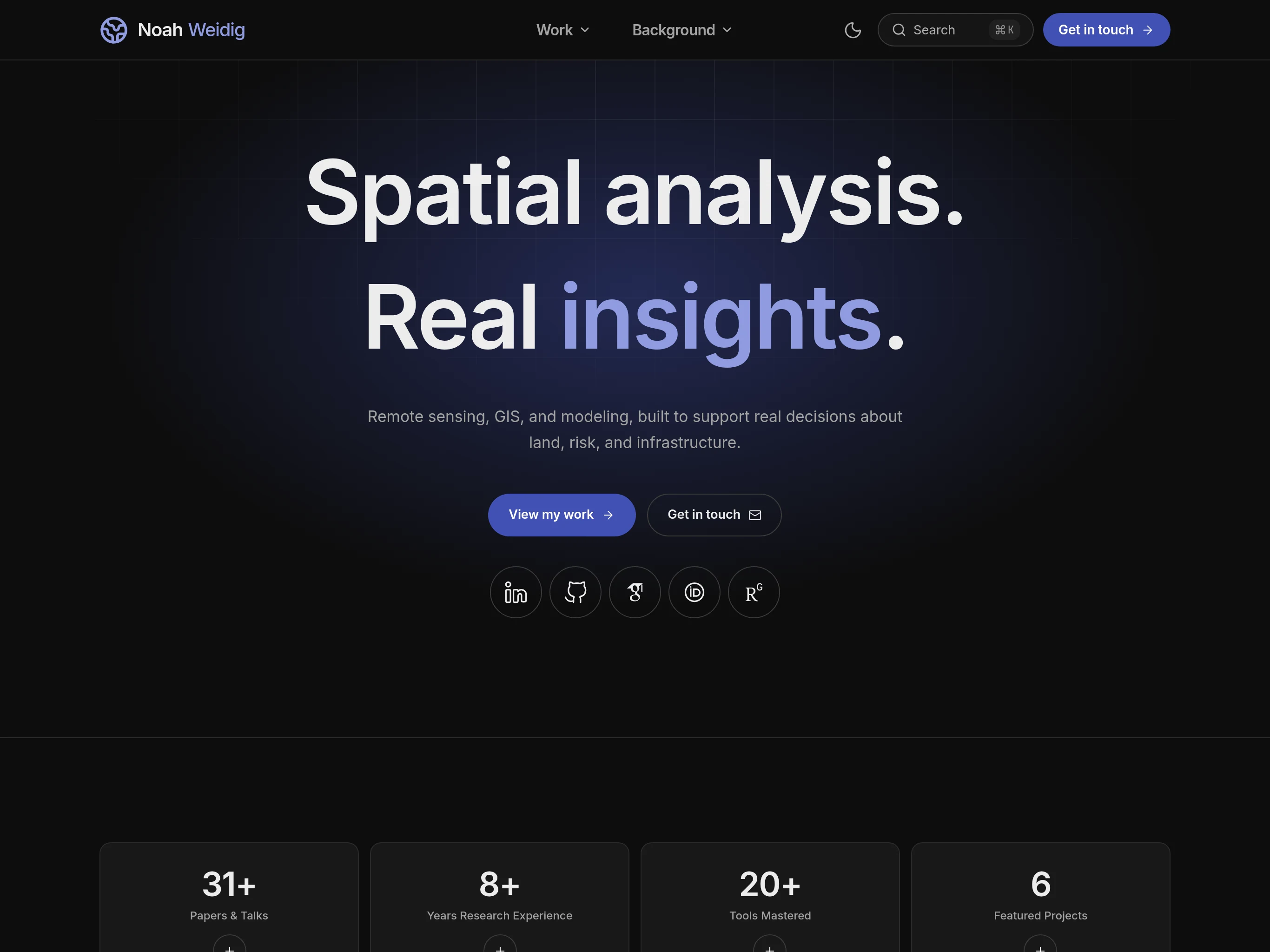
Yes, you’re welcome to fork and use this code for your own website. I’m happy to keep the project open source and encourage others to build on it.
However, please don’t present the design or code as your own. I put a significant amount of time and effort into creating this site, and I’d really appreciate it if you kept the original attribution intact.
Feel free to fork and customize this repository. Just give proper credit by linking back to noahweidig.com.
Thanks for respecting the work and helping keep the project open source!
I leverage remote sensing, GIS, and data science to translate complex data into clear insight about how our world changes. I believe understanding patterns through time gives people the power to see beyond the moment and shape a more intentional world.
Currently a GIS & Remote Sensing Research Associate at the University of Florida, with a focus on wildland-urban interface (WUI) risk, land-use change, and spatial decision-making.
Actively seeking Data Scientist or GIS Analyst roles.
Projects, experience, education, awards and the skills list are generated from
the Markdown front matter in src/content/, so the site is always the current
version of them. This README used to keep a second, hand-typed copy of each
one; those copies drifted, so they are now links (#252):
| Projects | https://noahweidig.com/projects |
| Publications | https://noahweidig.com/publications |
| Experience | https://noahweidig.com/experience |
| Education | https://noahweidig.com/education |
| Awards & grants | https://noahweidig.com/awards |
| CV | https://noahweidig.com/cv |
| Writing | https://noahweidig.substack.com |
Built with Astro 7, TypeScript and Tailwind CSS 4, deployed to GitHub Pages — no external theme dependency. Everything ships as static HTML: there is no framework runtime on the page, only a single hand-written module (src/client/ui.ts) for the theme toggle, search dialog, filters and scroll reveals.
| Path | Holds |
|---|---|
src/content/ |
the site's content, one Markdown file per entry, in six collections |
src/content.config.ts |
the Zod schema each collection is validated against at build time |
src/pages/ |
routes — file-based, with [...slug].astro generating every detail page |
src/layouts/ |
Base (head, chrome), Page (section index), Detail (article) |
src/components/ |
cards, rows, the search dialog, the map |
src/styles/ |
the design tokens and component layer; fonts.css holds the @font-face set |
src/lib/ |
site constants and the date/citation formatters |
src/client/ |
the browser-side modules behind ui.ts (theme, search, filters, ...) |
scripts/ |
build-time tooling: generate/, sync/ and check/ |
docs/ |
longer notes on the content pipelines, URLs and design tokens |
public/ |
static assets served verbatim — media, fonts, PDFs, favicons |
Content lives in a directory per entry (src/content/projects/chartifyr/index.md). The directory name is the URL slug.
npm install      # install the toolchain
npm run dev      # local dev server
npm run build    # astro check + build to dist/ + pagefind index
npm run preview  # serve dist/
npm run lint     # prettier --check + astro check + token check
npm test         # node --test
npm run lists the rest (PDFs, screenshots). npm run lint is the gate: Prettier (.prettierrc.json), astro check for types, and scripts/check/tokens.mjs, which fails on hardcoded hex colors outside src/styles/global.css.
Every push to main builds and publishes to GitHub Pages through .github/workflows/publish.yml; pull requests get a Netlify deploy preview. The other workflows:
ci-*.ymlrun on pull requests (workflow linting) or on a schedule (the monthly link sweep). Lighthouse and the link check run as jobs inpublish.yml, reusing its build.bot.ymlruns weekly: it refreshes the Zotero publications, citation stats, project and publication images and the CV and résumé PDFs in order, commits once, and callspublish.ymlto deploy.
Every workflow that needs a build goes through the .github/actions/build-site composite action, so each check scores the same bytes that get deployed. Scripts live in scripts/: generate/ (icons, PDFs, screenshots), sync/ (Zotero, citation stats) and check/ (tokens). Browser code is src/client/.
More detail on the content pipelines, URLs, search and design tokens is in docs/architecture.md.
MIT © 2026 Noah Weidig