

Welcome to Polychro, the polyglot, deterministic linting engine for the AI era — validating any semi-structured specification, in-process, at the speed an agent can generate it.
Polychro comes from the Greek πολύχρωμος — many-colored, for the many formats and many languages it lints.
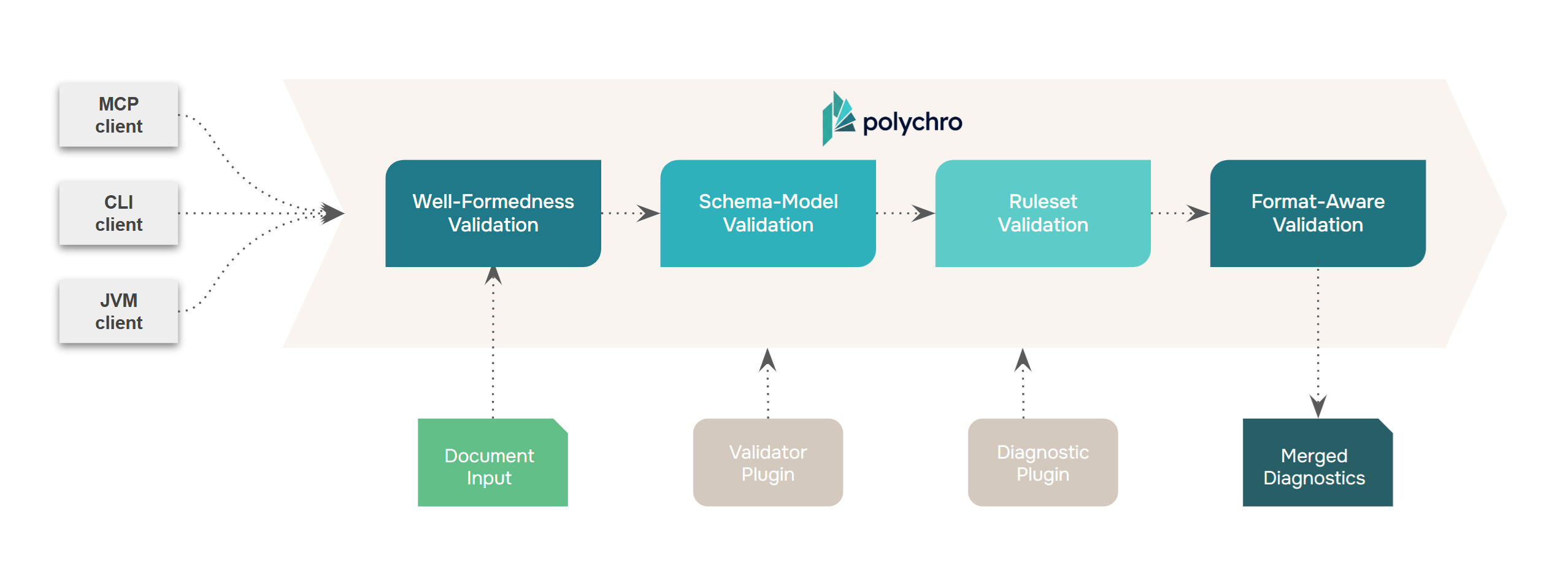
Polychro is the spec-validation engine. It reads a specification — YAML, JSON, XML, Markdown, or HTML — and runs it through a composable pipeline of validators (well-formedness → schema-model → ruleset → format-aware) with sub-second latency and no subprocess required. One config, one diagnostic format, one binary.
Each validator is a focused slice of the linting problem. The pipeline discovers them, runs them in order, and merges their findings into a single unified Diagnostic stream — so a YAML capability, a JSON Schema, a Markdown instruction file, and an HTML email are all linted the same way. The project ships everywhere it is needed: a native binary, a JVM library, an MCP server, a GitHub Action, and idiomatic Go / Node.js / Python SDKs.
Polychro is built for AI agent loops, where non-deterministic generation needs deterministic guardrails. An agent can generate a spec and have it validated in the same turn — fast enough to sit inside a tight tool-calling loop, and callable directly over MCP.
- Not a meta-linter. Super-Linter and MegaLinter bundle dozens of third-party tools in a large Docker image and orchestrate them in CI. Polychro is a single engine, not an orchestrator: it owns the spec-validation slice end to end — well-formedness, schema, rulesets, and format-aware checks — in one binary, with no Docker dependency and no per-tool config to stitch together.
- Not OpenAPI-only. Spectral-family rule engines lint API contracts. Polychro speaks the same Spectral ruleset format, but treats arbitrary YAML, JSON, Markdown, and HTML as first-class specs — capabilities, MCP manifests, CRDs, instruction files, and documentation, not just OpenAPI.
- Not a Node.js tool. Polychro runs as a GraalVM-native binary with sub-second cold start, or in-process inside any JVM application — no Node.js runtime, no 2–5 s subprocess startup, usable inside an agent loop.
| Feature | Description |
|---|---|
| Polyglot Validation | Lint YAML, JSON, XML, Markdown, and HTML specs through one pipeline |
| Composable Pipeline | Layered well-formedness → schema-model → ruleset → format-aware validation |
| Native Executable | Standalone binaries for Linux, macOS, and Windows — no JVM required |
| MCP Server Mode | Expose linting as MCP tools for AI agent consumption out of the box |
| GitHub Action | Lint specs in CI with structured SARIF output |
| Spectral-Format Rulesets | Execute governance rulesets with given/then semantics |
| Polyglot Custom Functions | Embed sandboxed JavaScript, Python, or Groovy rule functions (GraalVM) |
| Java Custom Functions | Native RuleFunction SPI — fastest path, no GraalVM required |
| Schema-Model Validation | Formal document models including JSON Schema Draft 2020-12 and JSON Structure |
| Well-Formedness Validation | Duplicate keys, encoding, depth limits, and YAML-specific traps |
| Format-Aware Validation | Heading hierarchy, internal links, relative file references, HTML structure / accessibility / security |
| Unified Diagnostics | All validators produce the same Diagnostic format — one pipeline, one output |
| Embeddable Java API | In-process linting for JVM applications — no subprocess, no Node.js |
| SDK Clients | Idiomatic wrappers for Go, Node.js / TypeScript, and Python over the native binary |
| Pluggable SPI | Add custom validators via ServiceLoader — zero framework coupling |
The "lint your specs" space mostly solves a 2019 problem: how do we govern OpenAPI files in CI? Polychro is built for the 2026 problem: how do we validate any spec, in-process, at the speed an AI agent generates it? The market splits into three layers, and Polychro deliberately occupies the bottom one:
- Meta-linters / orchestrators — Super-Linter, MegaLinter. Large Docker images that bundle dozens of third-party linters and run them in CI. They delegate spec linting to a rule engine.
- Spectral-family rule engines — Spectral (Node), Vacuum (Go), Redocly Lint (TypeScript). Single-purpose linters for OpenAPI / AsyncAPI rulesets.
- Embeddable, polyglot, agent-era spec engines — Polychro. A composable pipeline that runs as a native binary, a JVM library, an MCP server, or a GitHub Action.
Polychro replaces the rule-engine layer and absorbs the spec-validation slice of the meta-linters — collapsing what is today three or four tools, two or three config files, and a Docker dependency into one binary, one config, one diagnostic format, sub-second. Because it speaks the Spectral ruleset format natively, existing rule investment carries over unchanged.
For a dimension-by-dimension comparison, and guidance on when another tool is a better fit, see the Comparison guide on the Shipyard.
You can run Polychro with the native CLI, as an MCP server, or embed it as a JVM library. The CLI has the least friction, so start there.
# Lint any spec — Polychro detects the format
polychro lint my-spec.yml

# Apply a curated governance ruleset
polychro lint --ruleset polychro:governance my-spec.yml

# Validate an HTML email with the email profile
polychro lint --validator html=email welcome-email.html

# Emit agent-optimized output for an AI loop
polychro lint --format agent my-spec.yml# Serve linting as MCP tools (Ctrl-C to stop)
polychro serve --ruleset polychro:ai-safety{
"mcpServers": {
"polychro": {
"command": "polychro",
"args": ["serve", "--ruleset", "polychro:ai-safety"]
}
}
}<dependency>
<groupId>io.polychro</groupId>
<artifactId>polychro-core</artifactId>
<version>1.0.0-alpha3</version>
</dependency>Linter linter = Linter.builder()
.config(getClass().getResourceAsStream("/.polychro.yml"))
.build();
Document doc = Document.fromString(yamlContent, "yaml");
List<Diagnostic> issues = linter.lint(doc);go get github.com/naftiko/polychro/polychro-go # Go
npm install polychro # Node.js / TypeScript
pip install polychro # Python# Python example — same surface in Go and Node.js
from polychro import Linter
linter = Linter(ruleset="polychro:ai-safety")
result = linter.lint("my-spec.yml")
if result.has_errors:
print(result.to_agent_format())Full installation steps for the CLI, the SDKs, and every platform are in the Installation guide on the Shipyard.
The complete, always-up-to-date Polychro documentation lives on the Naftiko Shipyard. Start here and keep exploring:
- 🧭 Concepts — Spec-Driven Integration
- 🚣 Installation
- 🚤 Getting Started
- ⛵ Tutorial
- ⭐ Features
- 🏗️ Architecture
- ⌨️ CLI Reference
- 🚢 Guide — Rulesets
- 🔧 Guide — Configuration
- 🔌 Guide — MCP Server
- 🧩 Guide — Validator Plugin
 Guide — GitHub Action
- 🌊 FAQ
- 📣 Releases
- 🔭 Roadmap
- 🔩 Contribute
Want to see Polychro in action without installing anything? The upcoming Shipyard Playground lets you author a spec, lint it live with Polychro, and serve the result with Ikanos — all from your browser. Keep an eye on the Shipyard for its release.
| Ruleset | Purpose |
|---|---|
polychro:governance |
Completeness and discoverability — metadata, consumers, operations, orchestration, exposed adapters |
polychro:ai-safety |
Catches patterns that fool schema validation but break at runtime — port conflicts, dangling references, circular dependencies |
polychro:security |
Hardened security posture for production specs — authentication enforcement, secret exposure prevention |
Polychro is part of the Naftiko Fleet (Community Edition), which adds free complementary tools:
| Tool | What it does |
|---|---|
| Ikanos | Capability engine for Spec-Driven Integration — Polychro lints the capabilities it serves. |
| Crafter | Free Naftiko extension for Visual Studio Code to help with editing and linting specs. |
| Warden | Naftiko custom templates for CNCF's Backstage to help with scaffolding and cataloguing capabilities. |
| Skipper | Operator and Helm chart for CNCF's Kubernetes to help with the operations of Ikanos capabilities. |
Please join the community of users and contributors in this GitHub Discussion forum!