
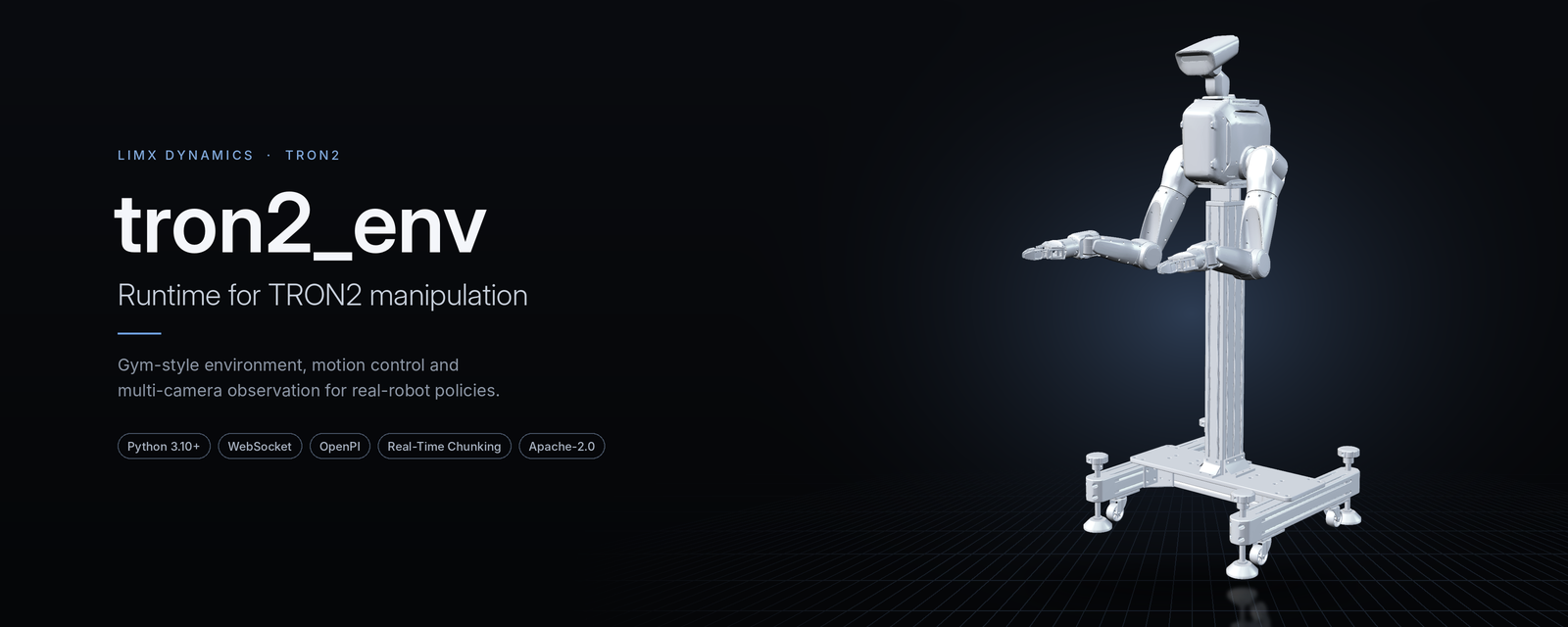


Part of the TRON2 open-source ecosystem. Where to start and the other TRON2 repositories: TRON2 quick start.
tron2_env is the public TRON2 runtime package used by the TRON2 OpenPI
deployment example. It provides robot communication, motion execution,
observation collection, and RTC helper utilities for real-robot deployment.
Only the WebSocket robot transport is exposed; the low-level path is not part of this release.
- Gym-style runtime.
Tron2Envwraps the robot behindreset()/step()so a policy client only deals in observation and action vectors. - Smooth, high-rate motion.
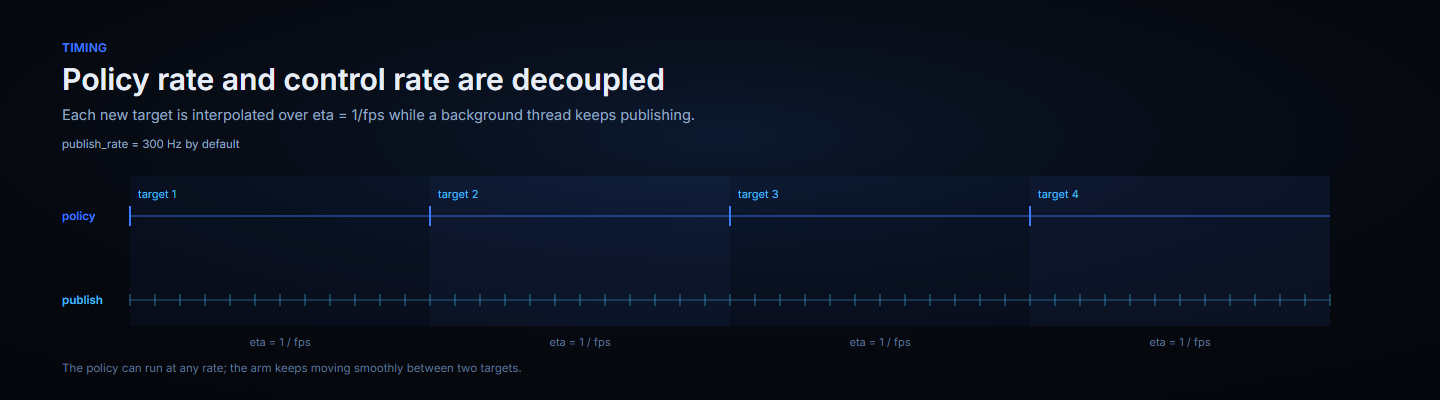
MotionControllerinterpolates each policy target and publishes commands from a background thread (300 Hz by default), so policy FPS and control rate stay decoupled. - Modular hardware layouts. ServoJ or ServoP arms, grippers or BrainCo2 hands, head, chassis and lifter are composed into explicit 16D to 31D state/action vectors.
- Multi-camera observation. Images and state come from TRON2 Bridge, or from locally attached RealSense cameras.
- Real-Time Chunking helpers.
ActionQueueandLatencyTrackerfor smooth chunked-action execution. - Testable without a robot. A mock-transport Quick Start and a software-only test suite run anywhere.
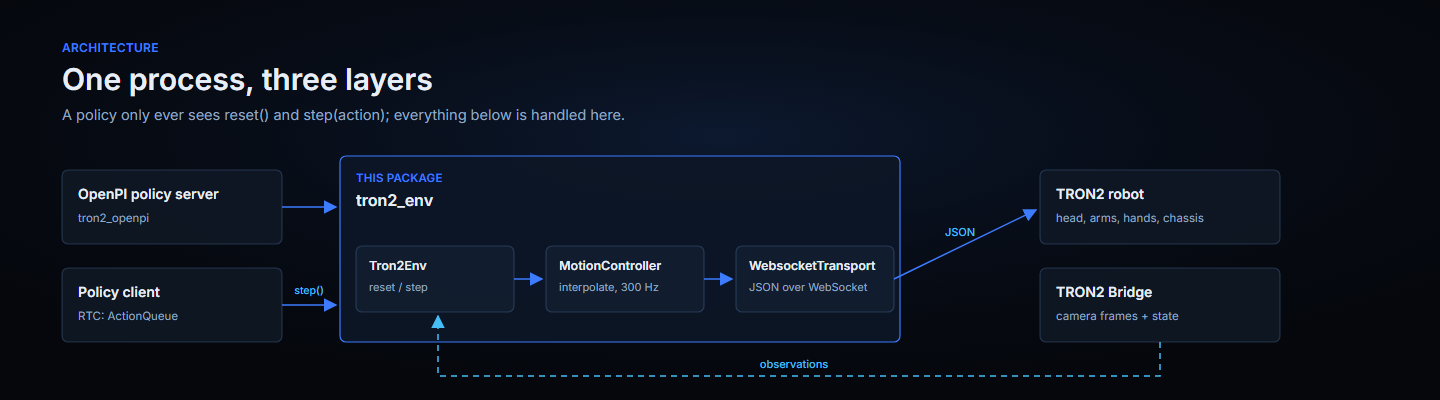
Tron2Env reads observations through BridgeObservationProvider (TRON2 Bridge)
or MultiCameraManager (local RealSense, legacy), and sends each policy target
through MotionController to WebsocketTransport as WebSocket JSON. Each target
is interpolated over eta = 1/fps on a background thread, so the policy can step
at any rate while the arm still receives commands at publish_rate.
From PyPI:
python -m pip install "tron2-env[bridge,openpi]"Or from source as an editable package:
git clone https://github.com/limxdynamics/tron2_env.git
cd tron2_env
python -m pip install -e ".[bridge,openpi]"
Optional extras:
| Extra | Purpose |
|---|---|
bridge |
WebSocket bridge observation support. |
camera |
Local RealSense camera support through pyrealsense2. |
openpi |
Image formatting helper dependency used by the optional policy wrapper. |
replay |
Parquet and YAML dependencies for examples/replay_data.py. |
dev |
Test runner dependencies. |
all |
Bridge, camera, OpenPI helper, and replay dependencies. |
Install the development dependencies and run the mock transport example:
python -m pip install -e ".[dev]"
python examples/mock_quickstart.py
python -m pytest -q
The example uses an in-memory transport. It does not open a network connection, discover hardware, or send commands to a real robot.
The public package covers the runtime layer of a deployment: Tron2Env and
Tron2Config for the robot loop, WebsocketTransport and MotionController for
command delivery, BridgeObservationProvider and the legacy MultiCameraManager
for observation, explicit layout objects for arms, hands, head and chassis, and
ActionQueue / LatencyTracker plus joint index helpers for RTC.
Not included: low-level robot transport, private robot safety controllers, robot calibration or customer profiles, and model weights, datasets or training code.
For policy deployment, keep this package next to
tron2_openpi:
parent-directory/
├── tron2_openpi/
└── tron2_env/
tron2_openpi/examples/tron2/pi_client.py adds ../tron2_env/src to
sys.path, so it can import tron2_env directly during local development.
Clone tron2_openpi as a sibling, sync it and check the import resolves back to
this checkout:
cd ..
git clone https://github.com/limxdynamics/tron2_openpi.git
cd tron2_openpi
uv sync
PYTHONPATH="$(cd ../tron2_env/src && pwd)" uv run python -c "import tron2_env; print(tron2_env.__file__)"
The printed path should point to ../tron2_env/src/tron2_env/__init__.py.
The following example connects to the configured robot and may send commands. Only run it in an authorised environment with the normal robot bring-up and emergency-stop procedures in place.
from tron2_env import Tron2Config, create_motion_controller

config = Tron2Config(
    robot_ip="ROBOT_IP",
    port=5000,
    init_joints=None,
    init_head=None,
)

controller = create_motion_controller(
    config,
    backend="websocket",
    publish_rate=300.0,
)

try:
    state = controller.get_joint_states(timeout=1.0)
    print(state)
finally:
    controller.disconnect()
For policy deployment, use tron2_openpi/examples/tron2/pi_client.py; it wires
the policy client, Tron2Env, observations, and action playback together.
examples/replay_data.py replays a recorded parquet trajectory directly through
tron2_env. It uses the deployment YAML from the sibling tron2_openpi
repository for robot IP, initialization pose, backend, and playback rate.
Always dry-run first, and drop --dry-run only after confirming the file, replay
range, robot address, initial pose and workspace safety:
python -m pip install -e ".[replay]"
python examples/replay_data.py \
  --file /path/to/trajectory.parquet \
  --deploy-config ../tron2_openpi/configs/deploy/tron2_deploy.local.yaml \
  --data-key action \
--dry-runTron2Config contains robot-level settings:
| Field | Description |
|---|---|
robot_ip |
TRON2 robot WebSocket controller address. |
port |
Robot controller WebSocket port. |
init_joints |
Optional 14-value arm initialization pose. |
init_head |
Optional 2-value head initialization pose. |
init_ee_z_min |
Minimum end-effector Z height before initialization routes through the intermediate joint pose; set to None to disable this check. |
state_queue_maxlen |
Robot state feedback queue length. |
polling_rate |
Robot state polling rate. |
connection_timeout |
WebSocket connection timeout. |
EnvConfig is used by Tron2Env and the TRON2 client to select observation
mode, action playback rate, debug recording, bridge settings, and camera
settings. The public deployment templates in tron2_openpi/configs/deploy/
show the recommended values.
RobotModules selects one arm mode, one paired end-effector type, the head and
the mobile base; PhysicalLayout flattens them into the policy state/action
vector in a fixed order.
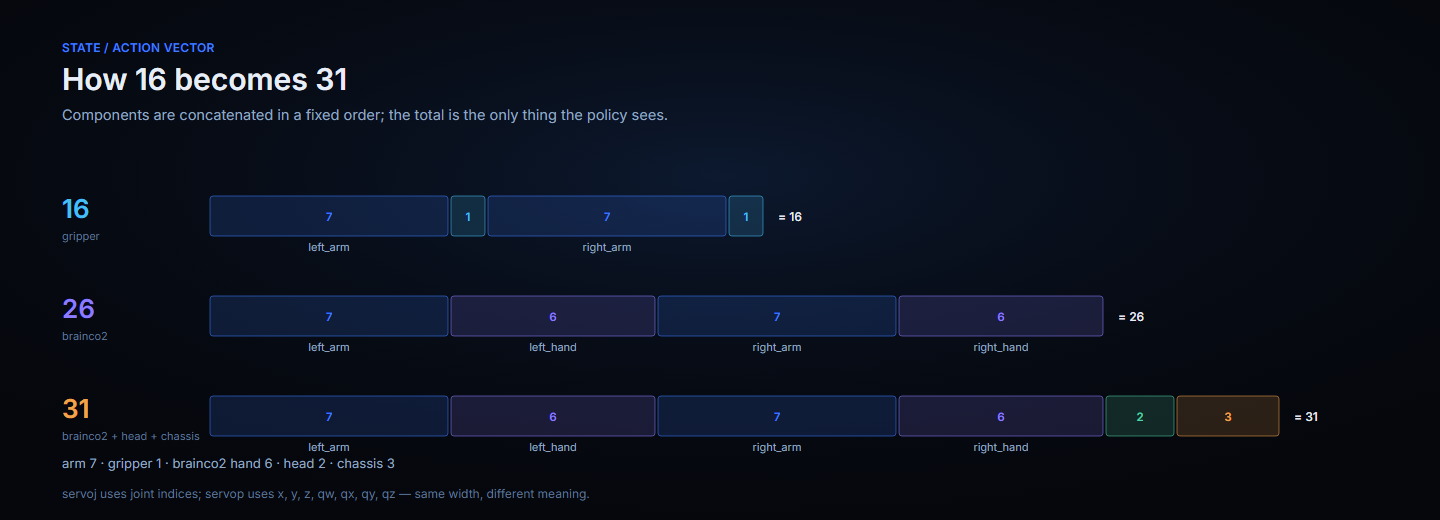
| Module combination | Physical dimension |
|---|---|
| ServoJ/ServoP + paired grippers | 16 |
| ServoJ/ServoP + paired grippers + head | 18 |
| ServoJ/ServoP + paired grippers + chassis/lifter | 19 |
| ServoJ/ServoP + paired grippers + head + chassis/lifter | 21 |
| ServoJ/ServoP + paired BrainCo2 hands | 26 |
| ServoJ/ServoP + paired BrainCo2 hands + head | 28 |
| ServoJ/ServoP + paired BrainCo2 hands + chassis/lifter | 29 |
| ServoJ/ServoP + paired BrainCo2 hands + head + chassis/lifter | 31 |
Legacy configs that specify only state_dim: 16 or 18 remain supported.
Other dimensions require RobotModules or an explicit state_layout so the
runtime does not guess physical semantics from vector width. When
RobotModules is used, any supplied state_dim and state_layout must exactly
match the derived layout.
Modular real-robot configurations also have these constraints:
- ServoP represents each arm as
[x, y, z, qw, qx, qy, qz]; quaternion values must not be linearly interpolated or blended. - BrainCo2 requires a valid
BrainCo2Config.command_time, and both arms use the same end-effector type. - When Bridge supplies images, ServoP and BrainCo2 physical state must come from the robot WebSocket.
- Lifter control requires millimetre position state; raw joint values are observation-only.
- The public package supports the WebSocket control backend only.
See configs/deploy/tron2_deploy.client.example.yaml in the sibling
tron2_openpi repository for a complete deployment YAML example.
Bridge mode:
- Reads images from TRON2 Bridge.
- Can read bridge-aligned joint state.
- Does not require camera USB cables to be attached to the host computer.
Legacy RealSense mode:
- Reads images from locally attached RealSense cameras.
- Reads robot state from the WebSocket robot transport.
- Requires camera serial numbers to be mapped to policy camera names.
The policy image names are cam_high, cam_left_wrist and cam_right_wrist.
- Confirm bring-up poses before commanding a real robot.
- Start motion tests at low speed and with short action chunks.
- Keep emergency stop access available while using real-robot clients.
- Treat local configuration files as private deployment assets.
- This package exposes runtime plumbing; it does not replace robot-level safety procedures or private low-level safety systems.
- The public CI and
examples/mock_quickstart.pycover software-only paths. They do not validate robot safety, calibration, Bridge, RealSense, or real-hardware behaviour.
- All runtime network interfaces—the robot-control WebSocket, TRON2 Bridge observation WebSockets, and OpenPI policy WebSocket—are supported only on a controlled robot LAN restricted to authorised systems.
- Do not expose these interfaces directly to the Internet or to an untrusted or shared network. Public port forwarding, cross-site links, and cloud deployment require a separate security review and appropriate transport protection.
- The current robot-control interface uses
ws://and does not establish transport encryption or client authentication. Bridge deployments may also be configured to skip server-certificate verification. Network segmentation, firewalling, and access control are therefore part of the required deployment trust boundary. - Treat camera images, robot state and metadata, and policy actions as protected runtime data. Do not capture, forward, or publish them without the applicable data and deployment approval.
Beyond the Quick Start, CI also runs:
python -m compileall -q src tests examples
python -m build
See .github/workflows/ci.yml for the exact job, CONTRIBUTING.md for
contribution boundaries and SECURITY.md for private vulnerability reporting.
- If imports fail, make sure
tron2_envandtron2_openpiare siblings and thatPYTHONPATHincludes the parent directory. - If WebSocket connection fails, verify
robot_ip,port, network reachability, and robot controller state. - If bridge observations time out, verify the Bridge host, WebSocket path, TLS setting, and topic availability.
- If legacy cameras are missing, verify RealSense permissions and serial number mappings.
- If actions look discontinuous, check policy FPS, publish rate, RTC settings, and action normalization stats in the policy checkpoint.
| Repository | Description |
|---|---|
| tron2_openpi | OpenPI derivative for TRON2: pi0 / pi0.5 policy serving, TRON2 transforms, deployment configs and robot clients. |
| tron2-robot-description | URDF / Xacro, MuJoCo and USD models for TRON2 variants. |
Most of this package is LimX-developed TRON2 runtime code. The RTC
ActionQueue is modified vendored source derived from the LeRobot
implementation at commit ca87ccd9413c59c30f524967222d2e3f1b7bb549. It was
ported from PyTorch to NumPy and adapted for TRON2. See NOTICE for details.
Unless otherwise noted, this package is distributed under the Apache License
2.0 in LICENSE. Notices for vendored third-party source are listed in
NOTICE; licenses for external direct dependencies are inventoried in
THIRD_PARTY_DEPENDENCIES.md.