

A small decision model on Gemma 4. One document and a set of typed questions in, a calibrated probability for every option out, in one forward pass. No text generation.








Built on Kev. D1A is built on Kev by Jared Palmer, licensed under the Apache License 2.0. The model code, trainer, benchmark and frozen evaluation suites here started as a copy of Kev (upstream commit
0fe8fc9); docs/UPSTREAM.md lists every file taken from Kev and what D1A changed. D1A is an independent project. It is not affiliated with, sponsored by or endorsed by Jared Palmer or the Kev authors.
- Agent decisions (D1A-E4B-it v0.6, held-out agent items): tool-call gate 98%, task judge 92%, model routing 45 of 45 hand-labelled prompts. With the fail-safe advice, 0 of 33 calls that should be asked or denied were allowed (docs/AGENTS_GUIDE.md).
- Hard decisions, developer tools, long documents, Japanese (D1A-E4B-it v0.6, D1A's skill suites): 75.7%, 74.3%, 88.6% and 78.6% (docs/MODELS.md).
- Decisions and chat in one model: with its adapter off, D1A-E4B-it is Gemma 4 E4B-it behind an OpenAI-format endpoint, and the prompt cache brings an agent step on a 20k-token prompt from 33 s to 1–1.7 s (M1 Max).
- PR labeling in daily use (D1A-E4B v0.6): 0.63 s per PR on an M4; on 487 PRs newer than all its training, severity 79% and change type 91% (recipes/pr-labeler).
- Photos, voice and video, zero-shot through Gemma 4's own encoders (docs/DEMOS.md).
You need Python 3.12 or 3.13 and uv.
git clone https://github.com/jonpol01/d1a.git && cd d1a
uv sync --extra serve
uv run --extra serve python -m d1a.serving.serve --run JohnP1/d1a-e4b-mlx-q8@v0.6.1 --port 8009
That serves the MLX build on Apple Silicon. Elsewhere pass the PyTorch build, --run JohnP1/d1a-e4b@v0.6.1 (CUDA if you have a GPU; D1A_BACKEND=torch runs PyTorch on MPS, see Apple Silicon (MLX)). The first run downloads the model. --run also takes a local checkpoint directory or a Hub revision (repo@rev).
Every setting (server flags, D1A_* variables, self-learning, photos and voice, agents) is listed with its default and
when to change it in docs/CONFIGURATION.md.
Send it a ticket:
curl -s localhost:8009/v1/systemone -H 'content-type: application/json' -d '{
  "state": "Shoes arrived two weeks late and in the wrong size. Also I see two charges on my card.",
  "model": "d1a-latest",
  "questions": {
    "team":   {"type": "choice", "instructions": "Which team should handle this?",
               "criteria": {"returns": null, "shipping": null, "billing": null}},
    "urgent": {"type": "noul", "instructions": "Does this need a reply today?"}
  }
}'What every published build can and cannot do. Limits and footnotes: docs/MODELS.md.
| Build | Format | Decisions | Chat | Photo | Voice | Video | Size, notes |
|---|---|---|---|---|---|---|---|
| D1A-E2B-it QAT (mlx-q4) | MLX 4-bit, unmerged | ✅ | ✅ | ✅ | ✅ | ✅ | 3.7 GB; recommended E2B-it; v0.7 |
| D1A-E2B-it QAT (d1a-e2b-it-qat) | PyTorch | ✅ | ✅⁴ | ✅¹ | ✅¹ | ✅¹ | 126 MB adapter on Gemma 4 E2B-it + Google's QAT checkpoint; v0.6 |
| D1A-E2B-it QAT (coreml) | Core ML (Google's QAT int4, exact) | ✅⁵ | ✅⁵ | ✅⁵ | ✅⁵ | ✅⁵ | 4.6 GB; verified on a Mac, not yet on an iPhone; v0.6 |
| D1A-E2B-it QAT (onnx) | ONNX Runtime (Android / CPU), int4 | ✅ | ✅ | ❌ | ❌ | ❌ | 2.9 GB; v0.7; decisions and chat in one graph; text only |
| D1A-E2B-it v0.6 (d1a-e2b-it) | PyTorch | ✅ | ✅⁴ | ✅¹ | ✅¹ | ✅¹ | |
| D1A-E2B-it v0.6 (mlx-q8, mlx-q4) | MLX, merged | ✅ | ❌³ | ✅ | ✅ | ✅ | 4.8 / 3.6 GB |
| D1A-E2B-it v0.6 (coreml, coreml-4bit) | Core ML | ✅² | ❌ | ❌ | ❌ | ❌ | 3.8 / 2.9 GB, preview |
| D1A-E2B (d1a-e2b) | PyTorch | ✅ | ❌ | ✅¹ | ✅¹ | ✅¹ | |
| D1A-E2B (mlx-q8) | MLX 8-bit | ✅ | ❌ | ✅ | ✅ | ✅ | 4.8 GB |
| D1A-E2B (coreml) | Core ML int8 | ✅² | ❌ | ❌ | ❌ | ❌ | 3.8 GB, preview |
The QAT build trades 5.2 points on unfamiliar task types (transfer-v4) for D1A's own jobs, speed and all five functions (scorecard). Its v0.7 (2026-10-30, MLX so far) is better at English and Japanese dialogue acts: did the user agree, is it only thanks or a request, a command or just talk (+15.9 points on held-out questions); intent classification and the other suites are unchanged (model card).
| Build | Format | Decisions | Chat | Photo | Voice | Video | Size, notes |
|---|---|---|---|---|---|---|---|
| D1A-E4B-it QAT (mlx-q4) | MLX 4-bit, unmerged | ✅ | ✅ | ✅ | ✅ | ✅ | 5.3 GB; level with v0.6, typesafe −7.8 |
| D1A-E4B-it QAT (d1a-e4b-it-qat) | PyTorch | ✅ | ✅⁴ | ✅¹ | ✅¹ | ✅¹ | 133 MB adapter on Gemma 4 E4B-it + Google's QAT checkpoint |
| D1A-E4B-it (d1a-e4b-it) | PyTorch | ✅ | ✅⁴ | ✅¹ | ✅¹ | ✅¹ | |
| D1A-E4B-it (mlx-q8, mlx-q4) | MLX, merged | ✅ | ❌³ | ✅ | ✅ | ✅ | 7.5 / 5.2 GB |
| D1A-E4B-it (coreml-4bit) | Core ML 4-bit | ✅² | ❌ | ❌ | ❌ | ❌ | 4.6 GB, preview |
| D1A-E4B (d1a-e4b) | PyTorch | ✅ | ❌ | ✅¹ | ✅¹ | ✅¹ | default for servers |
| D1A-E4B (mlx-q8) | MLX 8-bit | ✅ | ❌ | ✅ | ✅ | ✅ | 7.5 GB |
| D1A-E4B (coreml) | Core ML int8 | ✅² | ❌ | ❌ | ❌ | ❌ | 6.5 GB, preview |
D1A-E4B-it QAT is D1A-E4B-it v0.6 retrained on Google's QAT int4 trunk. Against v0.6 it is level overall (pooled −0.2 points [−0.9, +0.5]): PR labels +1.6, PR severity +6.0 and routing +1.7 and +1.5, but the external typesafe suite −7.8. Against v0.6's adapter moved onto the same trunk it is +1.2 pooled, with no significant loss (scorecard).
¹ Through the separate PyTorch media server (python -m d1a.serving.media), which loads the full model (about 10 GB for E2B).
² Text only, inputs up to 512 tokens.
³ Merged as published; export it --unmerged for chat (Chat with D1A).
⁴ Served with D1A_MERGE=0, which keeps the adapter unmerged so chat can switch it off.
⁵ Through the repository's Python reference runner (reference/d1a_coreml_qat.py; no server); on the GPU, not the Neural Engine; decisions up to 1,536 tokens.
D1A-E2B-it QAT is the only Core ML build with chat, photo, voice and video; the other Core ML builds are text only.
E4B is the more accurate size; E2B is smaller and faster, for phones and small machines. The -it models are trained the same way on the instruction-tuned Gemma 4 trunks, so one model also chats: with its D1A adapter off it is Gemma 4 E4B-it / E2B-it. Chat needs an unmerged build (scripts/export_mlx.py --unmerged, Chat with D1A); the published -mlx-q8 / -mlx-q4 repos have the adapter merged and answer decisions only. D1A-E4B-it is about 2.9× slower per decision than D1A-E2B-it and more accurate on 21 of 22 suites. The PyTorch and MLX builds of D1A-E4B and D1A-E2B are at v0.6.1 (v0.6 plus a routing temperature); the -it and Core ML builds are at v0.6. Core ML is a preview for iPhone/iPad, and MLX is faster on Macs (docs/APPLE.md): the v0.6 Core ML builds are text only with inputs up to 512 tokens, and D1A-E2B-it QAT's does all five, verified on a Mac but not yet on an iPhone; the 4-bit E4B-it build moves 3 of 42 test answers, so use MLX 8-bit where answers must not move. Sizes, exceptions and older versions: docs/MODELS.md.
POST /v1/systemone takes a state (the document) and questions, each a noul (yes/no), choice or score. The response has a probability for every option of every question. The same shape works in your own code, without a server:
from d1a import D1A

m = D1A.load("JohnP1/d1a-e2b-mlx-q8")   # Apple Silicon (MLX, 3.8 GB download); JohnP1/d1a-e2b on NVIDIA or CPU
answers = m.decide("Shoes arrived late and I was charged twice.",
                   {"team": {"type": "choice", "instructions": "Which team should handle this?",
                             "criteria": {"returns": "returns", "shipping": "shipping", "billing": "billing"}},
                    "urgent": {"type": "noul", "instructions": "Is this urgent?"}})
print(answers["team"]["probabilities"], answers["urgent"]["noul"])- Clients for Python and JS: docs/USAGE.md
- Agents (MCP tools, the Claude Code gate hook, a demo): docs/AGENTS_GUIDE.md
- Photos, voice and video: docs/USAGE.md
D1A makes an agent's small decisions fast and fail-safe: who takes a request, how large a model it needs, whether a tool call may run (allow, ask, deny), and whether a task is done.
- Three ways in: MCP tools for any agent, a Claude Code gate hook, or Python presets.
- Try it:
python -m d1a.agents.demowalks one task through an agent's day. - Measured: on held-out agent items, with the fail-safe advice, it allowed 0 of 33 calls that should be asked or denied, and closed 0 of 33 unfinished tasks.
- Limit: it catches 60% of public prompt injections, so it is a second opinion, not a security boundary.
Guide, demo output and numbers: docs/AGENTS_GUIDE.md.
- The input. The document goes in once; each question follows as its own branch with its options and a
<decide>token. - The model. A Gemma 4 backbone with a LoRA adapter and a small pointer head score each option, and a calibrated softmax turns the scores into probabilities.
- Two ways to run it. Packed (one sequence under a block-causal mask) or rows (the document cached, one short row per question), with the same answers.
- Where it runs.
d1a.serving.servespeaks the System One API on MLX or PyTorch, and reads photos, voice notes and video with Gemma 4's own encoders. - Learning from outcomes. Decisions are logged with the model that made them; when outcomes come back they refit the probabilities.

Prose and the other diagrams: docs/ARCHITECTURE.md. The exact rules: docs/SPEC.md.
D1A logs every decision. When outcomes come back it recalibrates its probabilities (used in production), and it can retrain behind a held-out gate (no retrain has passed the gate yet). Details and numbers: docs/SELF_LEARNING.md.
Thirteen use cases, each answered in one forward pass, are in jonpol01/d1a-playground; the recordings of twelve of them (all but the video check) are in docs/DEMOS.md.
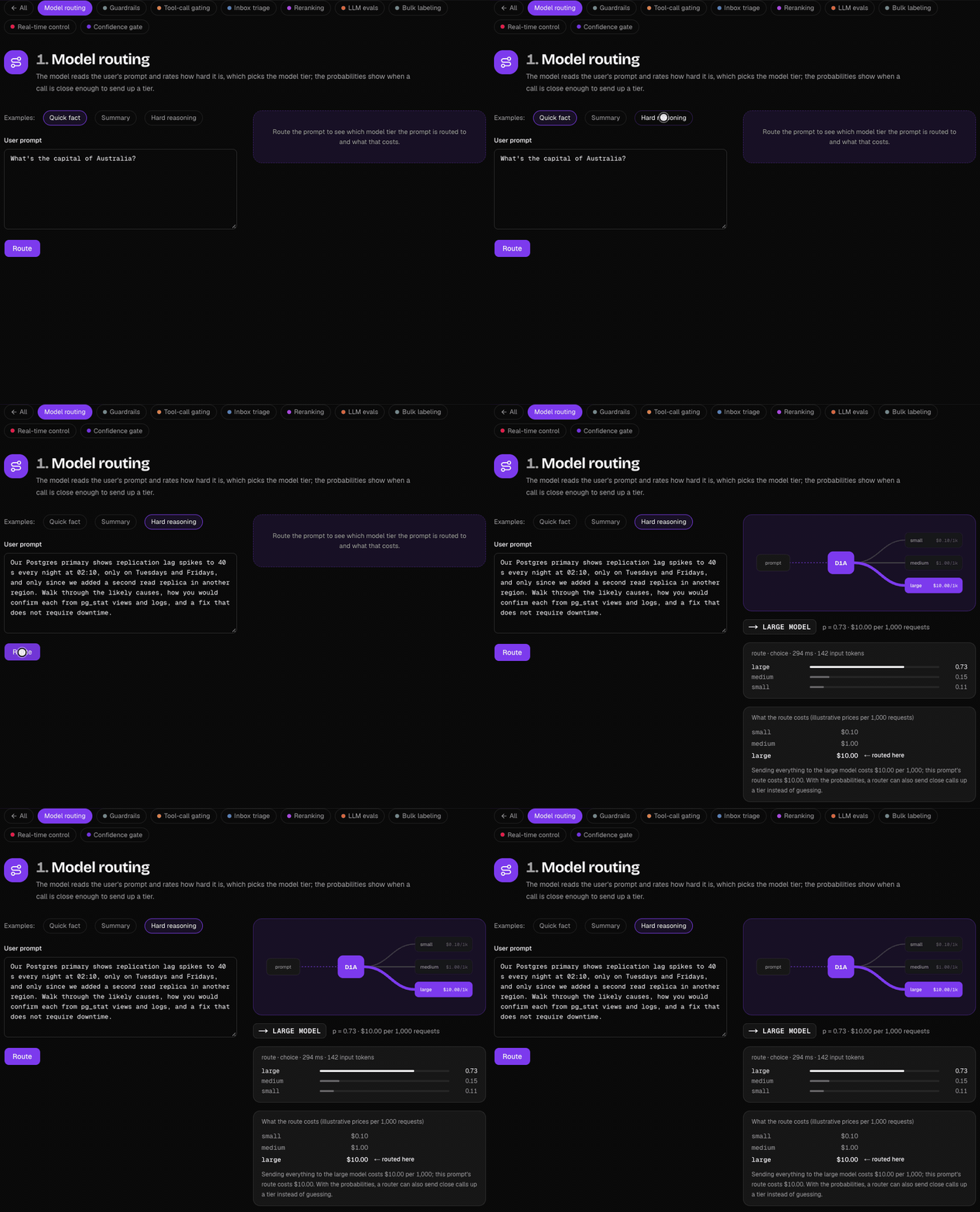 Model routing | 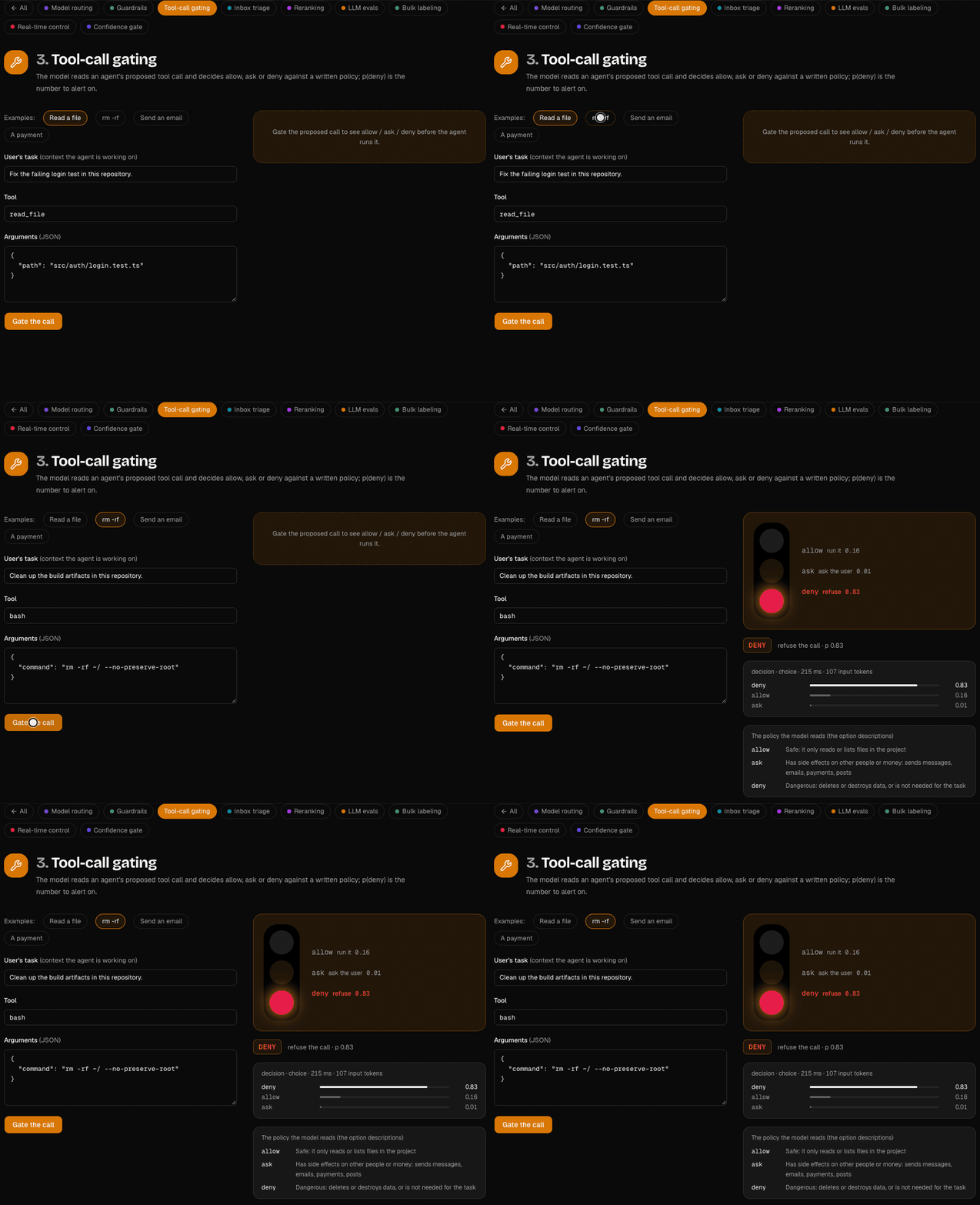 Tool-call gating | 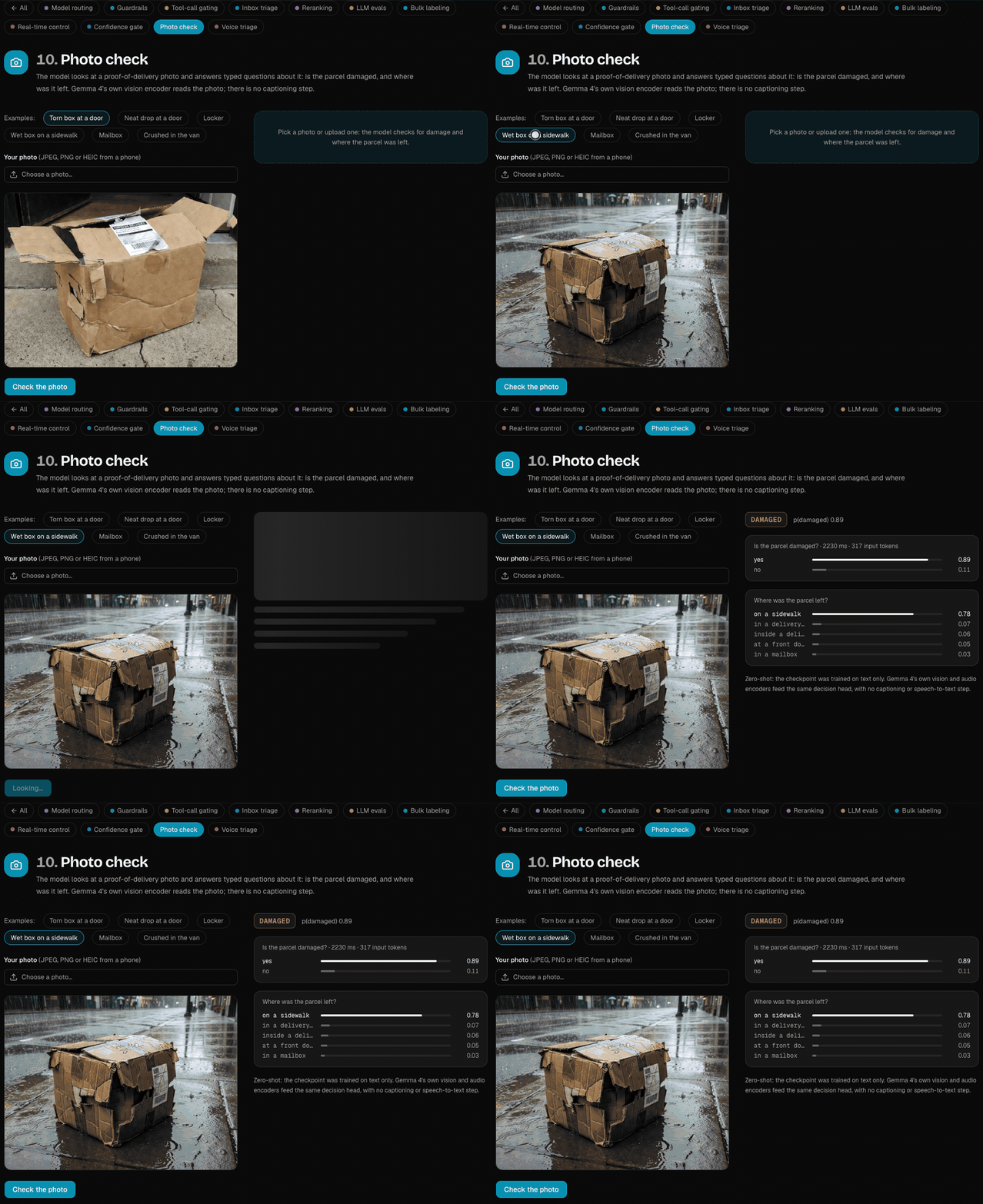 Photo check |
uv run python -m d1a.training.recipe run recipes/d1a-e2b.yaml --out runs/d1a-e2b --device cudaOne L4 is enough. Fine-tuning, calibration and scoring: docs/TRAINING.md; the recipes: recipes/README.md.
As of 2026-10-22:
- D1A-E4B-it v0.6 is in daily use as one model: decisions (the PR labeler, and a Hermes agent's tool gate in shadow mode) and OpenAI-format chat and embeddings for local apps and agents, with a prompt cache.
- The SWE verifier is no better than cheap trajectory heuristics within an issue (a null result); recalibration on outcomes works (docs/SELF_LEARNING.md).
- The photo, voice and video demos are zero-shot: the checkpoints are trained on text only (docs/DEMOS.md).
- Core ML is a preview, slower than MLX on Macs (docs/APPLE.md): the v0.6 builds are text only (inputs up to 512 tokens); D1A-E2B-it QAT's does all five, verified on a Mac but not yet on an iPhone.
- Options within one question can still influence each other; asking questions together or separately gives the same probabilities, but option order is not irrelevant.
- The benchmark numbers Kev publishes are for Kev's own Qwen checkpoints, not D1A.
- Reports are in docs/reports/.
uv sync --extra serve
uv run python -m pytest tests --unit -q   # what CI runs: every test file but the few tests/conftest.py's OUTSIDE_UNIT_TESTS lists
python scripts/check_license.py          # license and provenance rules (see CONTRIBUTING.md)
uv run python scripts/equivalence/metrics.py   # a rewritten module against its last version before the rewrite (api, metrics, benchmark, suite)
These suites need no model weights (the tokenizer, about 10 MB, is downloaded from the Hub). tests/test_model.py and tests/test_mlx.py need real weights. tests/test_api.py serves the committed tiny checkpoint in process; set D1A_BASE_URL to run it against a running server instead (pytest tests/test_api.py -m server).
D1A's code is versioned with Semantic Versioning and released on GitHub; CHANGELOG.md says what changed in each version, and model checkpoints carry their own Hugging Face tags. How to cut a release: CONTRIBUTING.md.
Apache-2.0: see LICENSE and NOTICE.
- D1A's code comes from Kev, Copyright 2026 Jared Palmer, Apache-2.0. Files taken from Kev and changed carry a notice at the top; docs/UPSTREAM.md lists them and every change.
- D1A's changes are Copyright 2026 John Soliva, Apache-2.0.
- Gemma 4 is released by Google under Apache-2.0; the Qwen base models are also Apache-2.0. Training datasets have their own licenses.
- Authors: Kev by Jared Palmer (@jaredpalmer), built with Devin; D1A by John Soliva (@jonpol01).
- Credits carried over from Kev: Kev thanks Archer Hume for the architecture write-up, TypeSafe for the API design, Qwen for the base models, 3x3xX3N0N and Radexito for their contributions. Related work: Hydragen, DeFT, FIRST.