
Portable agent runtime that uses the [hugpy] self-hosted LLM fleet as its
inference brain. Phase 1 of AGENT-SYSTEM-DESIGN.md: gateway + tool-call
adapter, assess→act→observe loop with a crash-safe SQLite journal, a
workspace-jailed toolset, markdown memory, and a CLI. Python ≥ 3.10,
stdlib only — zero dependencies.
                    ┌──────────────────────────── hugpy (fleet) ───────────────────────────┐
                    │ central + workers: platform · engine · fleet · server · media · …     │
                    │ OpenAI-compatible /v1 — every local model, incl. B (Qwen3-Coder-Next) │
                    └───────▲───────────────────────▲──────────────────────────▲───────────┘
                            │ inference             │ inference                │ B reductions
   ┌────────────────────────┴──┐   ┌────────────────┴──────────┐   ┌───────────┴───────────────┐
   │ hugpy-station             │   │ hugpy-agent               │   │ abstract-toolserver       │
   │ desktop + headless console│──▶│ agent runtime · TUI ·     │◀─▶│ comms · ledgers · boards ·│
   │ tmux seats per locus      │   │ OpenCode/qwen seats       │   │ exchanges · MCP · b_ask   │
   └────────────┬──────────────┘   └────────────┬──────────────┘   └───────────▲───────────────┘
                │ keeper/codex seats            │ --serve                      │ tools (MCP/HTTP)
   ┌────────────▼──────────────┐   ┌────────────▼──────────────┐               │
   │ abstract-gpt (Codex seat) │   │ abstract-claude serve ────┼───────────────┘
   │ abstract-claude (Claude)  │   │  └ abstract-serve-core    │
   └───────────────────────────┘   └───────────────────────────┘
          everything ships through abstract-pypit → PyPI (+ GitHub)
| Package | Role | PyPI |
|---|---|---|
| hugpy (14 lockstep dists) | the self-hosted LLM fleet: central, workers, engine, media, server | hugpy |
| hugpy-station | Electron desktop + headless backend; tmux seats, prompt composer, loop/bug scan | deb via central install links |
| hugpy-agent | agent runtime on the fleet; hugpy-agent tui over the shared Serve API |
hugpy-agent |
| abstract-claude | Claude Code launch/session/rollover + abstract-claude serve (roles keeper/chat/worker/local) |
abstract-claude |
| abstract-serve-core | the HTTP routes abstract-claude serve actually runs (queue, relay, rollover sweeps) |
abstract-serve-core |
| abstract-gpt | Codex/ChatGPT seat counterpart of abstract-claude | abstract-gpt |
| abstract-toolserver | one tool service per host: comms, ledgers, boards, exchanges, MCP bridge, B on call | abstract-toolserver |
| abstract-pypit | one-command publisher: bump → build → PyPI → GitHub push | abstract-pypit |
python3 -m venv .venv && . .venv/bin/activate
python -m pip install --upgrade pip   # old distro pips choke on modern wheels
pip install -e .
hugpy-agent models # lists fleet models from the configured basehugpy-agent imports no abstract-* package and no vendor SDK
(anthropic / openai / google …), in the core or in any extra. import hugpy_agent and hugpy-agent --help run with nothing else installed.
Two ways capabilities are added, both opt-in:
-
mctextra —pip install hugpy-agent[mct]adds the Mediated Context Terminal (hugpy_agent.mct). Its only dependency isjsonschema(control- plane envelope validation); it is not a vendor SDK. -
Adapter plugins (
hugpy_agent.adaptersentry-point group) — third-party capability providers register themselves; hugpy-agent discovers them at first use and never imports them directly (seehugpy_agent/adapters.py). Install the provider package separately and it lights up; absent one, hugpy-agent states its fallback rather than failing:adapter name provided by (example) capability fallback when absent local_searchabstract-toolserver[files]in-process content search over roots central HTTP finder ( /api/finder/search)Claude Code as the MCT reasoning model ("A") needs only the
claudeCLI onPATH(driven as a subprocess); no Python package is imported for it.
bootstrap.sh takes a bare box to a running systemd user service
(idempotent — re-run to upgrade):
export HUGPY_API_KEY=<key>              # prefer env over flags for secrets
bash bootstrap.sh --central https://dev.hugpy.ai/api \
    [--session <discord-session-endpoint-url>] \
    [--task-source discord-inbox|queue] [--workspace <dir>]
journalctl --user -u hugpy-agent -f     # watch it heartbeat / run tasks
It creates ~/hugpy-agent/venv, upgrades that venv's pip (old distro pips
choke on modern wheels), pip-installs the package (from the local checkout for
now; PyPI later), installs a desktop launcher for the terminal console (skipped
silently on a headless box), then runs python -m hugpy_agent.install,
which writes ~/.config/systemd/user/hugpy-agent.service
(Restart=on-failure, %h-portable, ExecStart=… serve), writes all
config including the key to the 0600 env file
~/.config/hugpy-agent/agent.env (never the unit file, never argv), enables
linger, and enables + starts the unit.
The serve daemon polls a task source every HUGPY_POLL_INTERVAL (10s)
and runs each task as a normal journaled run (policy, audit, escalation all
apply). Sources (HUGPY_TASK_SOURCE):
discord-inbox— polls the operator session (HUGPY_DISCORD_SESSION) for inbound messages starting withtask:; the rest of the message is the task. The outcome is replied into the channel (task finished (run <id>): outcome=… steps=…). On startup the first poll only sets the message watermark — historicaltask:messages are never replayed (re-send a task that landed while the daemon was down).queue— a local file (HUGPY_TASK_QUEUE, default<workspace>/.hugpy_agent/tasks.queue), one task per line; append lines to dispatch. One task is consumed (atomically) per poll cycle.- (unset) — fail-closed idle: the daemon heartbeats and does nothing.
SIGTERM (systemctl --user stop hugpy-agent) finishes the current task,
then exits cleanly.
The secure install link's .sh one-liner works unchanged on macOS
(curl -fsSL …/agent/install/<id>.sh | bash — it curls the same Python
installer and runs it under the system python3). The installer creates its
venv, writes the credential, and builds a user-level app bundle
~/Applications/hugpy Agent.app whose icon opens the terminal console in
Terminal.app (via the same hold-open launcher script Linux uses). No sudo,
nothing in /Applications. On a headless Mac reached over SSH with no GUI
login the bundle is skipped.
Honest floors (below these, don't expect a working install rather than a half-working one):
- hugpy-agent needs python3 ≥ 3.10 — install the Xcode Command Line
Tools (
xcode-select --install) or Homebrew python. - OpenCode (the interactive console TUI) needs Node ≥ 18
(
brew install node); it's an optional peer — the agent runs without it. - Mountain-Lion-era Macs (OS X 10.8) are below the floor on both counts (their python and TLS stack are too old for modern PyPI/wheels); use a modern macOS.
macOS service mode (a launchd equivalent of the systemd user unit) is
out of scope here — bootstrap.sh is Linux/systemd only. On macOS run the
console from the app bundle (or hugpy-agent serve by hand).
serve --node (or HUGPY_AGENT_NODE=true) makes the daemon a fleet node:
it enrolls once with central's /agent/register, heartbeats every ~30s, and
pulls operator-dispatched tasks — running each exactly like any other task
(policy, audit, escalation, journal all apply). It composes with the local
task source: serve --node alone runs node tasks only; serve --node --task-source queue runs both (a queue file and dispatched tasks). Node
config:
HUGPY_AGENT_CENTRAL(or--central) — base URL of central's/agent/*routes; empty falls back toHUGPY_BASE(the/apidual-mount serves/agentthere). When central's site API-key policy is on, register needs a console key — setHUGPY_API_KEY(it rides as theBeareron register).HUGPY_AGENT_NAME/HUGPY_AGENT_CAPABILITIES— what the node advertises at register (defaults: the box hostname /chat,tools).
The node's enroll token is minted once by register and persisted, with the
node id and pull cursor, to <workspace>/.hugpy_agent/node_state.json (mode
0600, gitignored) — never logged, never committed. If central forgets the
node (a 410, e.g. a db reset) the daemon silently re-enrolls; a revoked node
(403) drops its dead token and idles until re-enrolled. An unreachable
central never crashes the daemon — it backs off (exponential, capped) and keeps
heartbeating to journalctl.
Precedence: env > .env in the workspace > agent.toml in the workspace.
CLI flags (--base, --model, --workspace, …) beat everything.
Each variable is two rows: the top row is variable · default · values (the
shape/enum it accepts), and the row beneath it is the full purpose.
| variable | default | values |
|---|---|---|
HUGPY_BASE |
https://dev.hugpy.ai/api |
URL |
| purpose | fleet base URL — may end in /api, /v1, /api/v1, or be a bare origin; routes are normalized and probed |
|
HUGPY_API_KEY |
(none) | hp_… token |
| purpose | Bearer token, sent whenever set. Required for chat since 2026-07-14: dev's /v1 family now enforces keys (mint in the console under API access); the /api/ml/* amenities and /api/models catalog were still open at that time |
|
HUGPY_MODEL |
Qwen~Qwen3-Coder-Next-GGUF |
model id |
| purpose | a model id from /v1/models (default = the coder brain, 2026-07-17 switch: reliability over speed; for thinking-family brains see HUGPY_NO_THINK) |
|
HUGPY_AGENT_BRAIN |
(unset) | model id |
| purpose | the DEDICATED agent-brain override — same effect as HUGPY_MODEL but named so it can't be conflated with other components' model knobs on a shared box; wins over HUGPY_MODEL when both are set. Central's copy of this default lives in constants.DEFAULT_AGENT_BRAIN |
|
HUGPY_WORKSPACE |
cwd | path |
| purpose | the directory the agent works in (and is jailed to) | |
HUGPY_MAX_STEPS |
25 |
int |
| purpose | step cap per run | |
HUGPY_MAX_GENERATIONS |
2 |
int |
| purpose | per-run cap on async GPU generation jobs (generate_image / generate_scene); exceeding it returns a structured refusal to the model, not an exception |
|
HUGPY_NO_THINK |
false |
bool |
| purpose | suppress model "thinking": append /no_think to the wire copy of the latest user turn on every chat call (never to stored history). Required for Qwen3-family brains, which otherwise spend the whole token budget inside <think> and never emit a tool call. Off by default since the 2026-07-17 coder-brain switch (~10% faster without the suffix); enable it when pointing at a thinking-family brain. Regardless of this knob, <think>…</think> spans are always stripped from output before parsing |
|
HUGPY_TOOLS_MODE |
prompted |
prompted | constrained | auto | native |
| purpose | how tool-calls are delivered. The default makes zero probe traffic; only auto/native run the native-tools probe — one tiny live call per (base, model) per box, cached 7 days in ~/.cache/hugpy_agent/probe.json (honors XDG_CACHE_HOME). The probe is expensive server-side today (the /v1 shim drops max_chunks on the central→worker hop, 2026-07-14 capture), so it never fires unasked |
agent.toml uses bare attribute names (model = "...", optionally under
[agent]). Secrets belong in env or .env (gitignored), never in
agent.toml or the source.
hugpy-agent run "Read the files in this workspace, describe what the project \
does, and write your findings to report.md" --model Qwen2.5-3B-Instruct-GGUF
hugpy-agent chat                  # interactive REPL, same tools
hugpy-agent runs                  # journaled runs in this workspace
hugpy-agent resume <run_id>       # continue an interrupted run
Progress streams to stderr; the final structured report
{outcome, steps, tool_calls, est_tokens, answer} prints to stdout (pipeable
to jq).
| group | tools | notes |
|---|---|---|
| local | fs_read / fs_write / fs_glob, shell, http_fetch |
workspace-jailed (symlink-safe); shell risk-classed destructive; fetch is GET-only, 64KB cap |
| fleet: text ML | summarize, keywords, embed, similarity |
sync POST /api/ml/*; risk class remote_compute |
| fleet: file ML | transcribe, classify, detect, segment, depth, vision |
multipart upload of a workspace file; image-ref results (depth maps, masks) are fetched into artifacts/ and the path returned |
| fleet: generation | generate_image, generate_scene |
async job: enqueue → poll (2s cadence, 10min ceiling, SIGINT-safe) → artifact saved as artifacts/<job_id>.<ext>; capped per run via HUGPY_MAX_GENERATIONS; the job_id is journaled the moment enqueue returns, so resume re-polls the same job and never enqueues a duplicate |
| meta | models_list, remember, final_answer |
final_answer is the schema'd termination signal |
Every fleet ML tool takes an optional model_key; when omitted it is
resolved from the /api/models catalog by task (cached per run). An
unresolvable task, a capacity gap (local_serving_disabled), or any job
failure comes back to the model verbatim as structured data — never an
exception, never masked.
The /v1 seam silently drops the OpenAI tools field today, so the harness
owns tool-calling (design §3.1): tool JSON schemas are injected into the
system prompt using the Qwen/Hermes <tool_call>{…}</tool_call> convention,
parsed, schema-validated (with benign string→number/bool coercion), given
ONE repair round-trip on invalid output, and aborted with a structured error
if the model keeps failing. A native passthrough tier exists but is opt-in:
set HUGPY_TOOLS_MODE=auto (or native) to probe for seam support. The
probe result is cached per box — not per workspace — with a 7-day TTL, so a
machine probes each (base, model) pair at most once; under the default
prompted mode no probe request is ever sent.
Every chat payload carries "max_chunks": 1 (kills the known
continuation-prompt leak) and known leak strings are scrubbed defensively.
usage is null at the seam today, so token accounting is a client-side
estimate (gateway.estimate_tokens).
Every harness and client in this package reaches the station toolserver
(abstract_toolserver, :7004, ~200 tools: fs_*, exchange_*, ledger_*,
todo_*, prompt_*, comms_*, ui_*, vl_*, vm_*, db_*, …) through ONE
stdlib client, hugpy_agent.toolserver_client.ToolserverClient:
| method | what |
|---|---|
list_tools() |
cached [{name, description, input_schema}] (POST /mcp?mode=flat tools/list; falls back to /ts/categories + /ts/list) |
call(name, args, timeout) |
POST /ts/call; returns the tool's value (tool errors are the {"error"} data the server sent); transport/auth raise ToolserverError / ToolserverAuthError |
call_json(name, args) |
errors-as-data JSON string (what tool handlers feed the model) |
health() / status() |
{url, ok, tool_count, auth: ok|open|missing|rejected, version, latency_ms, error}; status() is cached 30 s so UIs can poll it |
as_openai_tools() / as_anthropic_tools() |
{"type":"function","function":{…}} / {name, description, input_schema} lists (allowlisted tools only by default) |
classify(name) / allowed(name) |
readonly | mutating | privileged, and the allowlist verdict |
Configuration (env > ~/.hugpy/toolserver.env > station/operator env files):
| variable | meaning |
|---|---|
TOOLSERVER_URL |
base URL (default http://127.0.0.1:7004; STATION_CONSOLE_TOOLSERVER also read) |
TOOLSERVER_OPERATOR_TOKEN |
the operator token — the same variable the toolserver itself reads; sent as X-Operator-Token (+ Authorization: Bearer). TOOLSERVER_TOKEN, HUGPY_OPERATOR_TOKEN, STATION_CONSOLE_TOOLSERVER_TOKEN are accepted aliases. A 401 with no token set names this variable in the error. |
HUGPY_AGENT_TOOLSERVER=0 |
switch the bridge off for the process (CLI: --no-toolserver) |
HUGPY_AGENT_TOOLSERVER_ALLOW / _DENY |
comma lists of tool names (* and vm_* globs); deny wins |
HUGPY_AGENT_TOOLSERVER_TOOLS |
meta (default) or flat — see below |
HUGPY_AGENT_TOOLSERVER_URL / _TOKEN / HUGPY_AGENT_LOCUS |
per-workspace overrides (agent.toml / .env; the token never belongs in agent.toml) |
Allowlist defaults (toolserver_client.classify, decided from the tool name):
readonly tools (*_list/get/read/state/find/search/…) are on everywhere;
mutating tools (todo_add, ledger_put, comms_ping, exchange_record,
…) are on but pass the loop's policy gate as network risk (--policy ask
escalates, auto allows, readonly denies); privileged tools — vm_*,
vmpool_*, sys_* (sys_run_cmd), browser_*, handoff_*, fs_write_file,
db_query unless it is a SELECT, oauth/session control (claude_oauth_*,
gpt_oauth_*, gpt_login_*, claude_reset/restore/set_model,
session_spin/release, ui_click_verify) — are OFF until named in
HUGPY_AGENT_TOOLSERVER_ALLOW (or *); a refused call comes back to the model
as {"error": "... set HUGPY_AGENT_TOOLSERVER_ALLOW=<name> ..."}, never a crash.
Per harness:
chat/run/resume/serve --daemon(the station seat backend,hugpy-agent chat --model …): the agent loop registers three meta-tools by default —ts_categories,ts_list,ts_call— whose handlers go through the shared client (tools/toolserver.py);ts_callis risk-classed by its TARGET tool, so the existing policy gate sees what it actually does. Startup prints one[toolserver] ready|unavailable|disabled: …line.--no-toolserverremoves them for the run.HUGPY_AGENT_TOOLSERVER_TOOLS=flatadditionally registers every allowed toolserver tool as its own ToolSpec (native tool-calling models); a local jailed tool of the same name (fs_glob) wins.hugpy-agent serve(:9126,service/): API-profile sessions get the same meta-tools;GET /api/statecarriestoolserver: {url, ok, tool_count, auth}andGET /api/toolslists the catalog withclass,riskandallowedper tool. Nativeclaude-code/codexprofiles keep their own client-side tool configuration.mct/mct-serve: A (claude -p --strict-mcp-config) gets the toolserver as a second MCP server (type: http,<url>/mcp?mode=flat, token in the header) with--allowedTools mcp__toolserver__<name>for the allowlisted tools and--disallowedToolsfor the privileged ones; the grant is recorded in the ledger (a.toolserver_tools) and the access log, like--native-tools all.--no-toolserver(orHUGPY_AGENT_TOOLSERVER=0) keeps A confined to B's tools alone.fleetTUI (fleet_tui.py): the status bar showstoolserver ok (N tools)/auth rejected/unreachable, probed off the UI thread on each refresh.- subagents (
spawn) inherit a filtered view of the parent's registry, so they hold at most the parent's toolserver tools.
CLI:
hugpy-agent tools health                      # OK  url=… auth=ok tools=198 version=0.0.28
hugpy-agent tools list [--all] [--json-out]   # name  class  description (privileged hidden unless --all)
hugpy-agent tools call fs_glob --json '{"path":"/srv/vm_mgr/docs","pattern":"*.md"}'
hugpy-agent tools call vm_stop --json '{…}' --allow-privileged   # one-off bypass
Exit codes: 0 ok · 1 failure / tool error · 2 auth (missing or rejected token).
hugpy-agent console opens a full-screen terminal control center (including
over SSH); when piped, it prints one status snapshot. It needs no hcon script,
browser, or Node installation. Python's standard curses module supplies the
terminal interface on Linux/macOS.
Use Tab or 1–6 to move between Models, Workers, Queue, Metrics, Results, and Frontends. Up/Down selects a row; Enter opens its action menu. / filters rows, C clears filters, R refreshes, and Q exits. Worker/model names are picked from lists, never retyped.
- Model menu: inspect capacity, load, unload, assign, test, or open an agent frontend with that model (Hermes Agent, Claude Code, Qwen Code, OpenCode, Aider).
- Frontends tab: installed/not-installed indicators; choose a frontend and then select a chat-capable fleet model. A missing tool can be installed from the console after an explicit confirmation, or its installation guide can be opened.
- Worker menu: browse its models, load a chosen model, unload a resident model, or inspect its resources.
- Test dialog: enter a prompt, choose a token limit and whether evictions are allowed. T tests the visible chat models, hot models first, one at a time. S stops the remaining tests after the current call finishes. A failed call stops the batch to avoid overlapping work after an uncertain timeout.
- Capacity benchmark: press M to derive exact central quants from one verbose
catalog snapshot, classify GPU-only/spill/RAM-only configurations against each
worker, and run the deterministic nine-task grading battery. Workers run in
parallel; distinct models also use the worker's advertised concurrent lanes.
The same model's quant/config mutations remain serial. Before every task, the
console rechecks that the exact worker is hot, loaded, pinned to the intended
quant, and using the intended allocation/4-bit/MoE settings, then calls that
worker directly. A base quant's full bytes are charged to disk and transfer;
4-bit and MoE only change runtime-memory estimates. Finished base quants are
removed from that worker's cache to make room for cold central quants; central
llm_storageis never a deletion target. Results are retained in the console and exported as JSON plus an ODS metrics workbook under~/.hugpy_agent/console/reports/. - Results retain responses and failures for the current session; select a result and press Enter to read it. Opening another frontend suspends the console and returns to it when that program exits.
Frontend adapters supply the selected fleet endpoint, model and API key only
to the child process. Hermes uses a named custom provider with Chat Completions,
configured in a fresh console-owned profile under ~/.hugpy_agent/console/hermes/.
The profile references an environment variable for the key; it retains session
files after exit, and its path is recorded in Results. Your original Hermes
profile is untouched. Aider uses openai/<fleet-model> for the main, weak and editor
models. Claude Code uses Hugpy's Anthropic Messages shim. OpenCode refreshes its
fleet model map; Qwen Code receives the selected model even when a different
OPENAI_MODEL was previously set. These are agent frontends; inference remains
on Hugpy's workers. Binary detection does not certify model/tool-call compatibility.
Adapters were checked against the Hermes provider documentation
and Aider OpenAI-compatible documentation.
Reads and calls run in the background, so navigation stays responsive. The screen refreshes automatically, showing snapshot age, missing data and progress. Load/unload confirmations name the target model and worker. Exiting does not cancel a request already accepted by the fleet. The commands below remain available for scripting; they are not required for the interactive workflow.
The main view ranks models by preparation needed: ready now, hot / queue active, load into free VRAM, transfer + load, eviction needed, or won't fit GPU. Each row shows a candidate worker, historical tok/s and a start estimate where supported. Worker rows show free/total VRAM in GiB.
hugpy-agent console --base http://127.0.0.1:7002 status
hugpy-agent console workers --json
hugpy-agent console models --json
hugpy-agent console inspect MODEL
hugpy-agent console plan --task text-generation
hugpy-agent console call MODEL 'Reply with hello' --max-tokens 64
hugpy-agent console load WORKER_ID MODEL --alloc-mode gpu_only
hugpy-agent console unload WORKER_ID MODEL
hugpy-agent console request /llm/model-groups
hugpy-agent console request /llm/workers/WORKER_ID/config --method POST --body @config.json
hugpy-agent console exec MODEL -- your-headless-program its-arguments
Use HUGPY_BASE and HUGPY_API_KEY through the normal agent configuration.
Operator-only APIs additionally use HUGPY_OPERATOR_TOKEN from the environment;
the console never prints this token. An API key alone may not grant placement
or control access. Explicit bases retain their path (/api, /v1, /api/v1);
bare origins address central directly. Set HUGPY_CONSOLE_TIMEOUT to adjust the
per-request timeout (120 seconds by default).
status/models/plan inspect placements with at most four concurrent reads.
plan provides a hot-first manual testing order, not a reservation or automatic
sweep. call sends one bounded chat request without retry and defaults to
no_makeroom; add --allow-eviction when you intend to displace other models.
Other task types and controls are available through request, with an explicit
HTTP method for mutations. A timed-out mutation or call may still be running:
inspect queue/worker state before retrying. load acceptance means loading was
requested, not that the model is ready; verify residency afterward.
exec validates the exact catalog model and launches an existing program with
OPENAI_BASE_URL, OPENAI_API_BASE, OPENAI_API_KEY and OPENAI_MODEL in its
environment. It preserves arguments without a shell, strips the operator token,
and returns the child's exit code. Programs must support these environment
variables; it does not install or configure arbitrary third-party tools.
Capacity classifications use central's fits_free_vram / fits_total_vram
placement fields, including its MoE/headroom/calibration rules. The central API
must run the accompanying source change; older servers show capacity unknown.
Total VRAM fit means eviction may help, not that pinned allocations can be
evicted. Admission, policy, context size, routing and concurrent calls can change
the result. CPU/offload feasibility remains visible in inspect's raw placement.
Load estimates use matching worker/model historical measurements across recorded variants (conservatively the slowest); throughput shows the fastest recorded matching variant and is not a promise for the next call. Queue records lack worker attribution and remaining token budgets, so busy queues and eviction have unknown start ETA. Idle/hot is approximately zero preparation time, excluding prompt prefill. Missing observations are reported as unknown with visible errors; partial snapshots exit nonzero. JSON output is available for automation.
hugpy-agent console --opencode launches OpenCode — the
open-source terminal coding agent — pre-wired to the hugpy fleet: it fetches
the fleet's live model list, writes an opencode.json (in
~/.hugpy_agent/console/ by default) with a hugpy provider pointed at the
fleet's OpenAI-compatible /v1 endpoint, and drops you into the OpenCode
TUI with the agent brain preselected. Your API key is passed as an
environment reference, never written into the config file. OpenCode is an
optional peer, not a dependency — install it once with npm, and everything
else in hugpy-agent works fully without it:
npm config set prefix ~/.npm-global && npm install -g opencode-ai   # once
hugpy-agent console                                                  # every time
Useful flags: --model KEY to open on a different model, --no-sync /
--offline to skip the model-map refresh and reuse the last-written config
(e.g. when the fleet is unreachable), --workspace DIR to keep a separate
console dir, and --print-config to inspect the generated config without
launching. Each sync keeps the previous config as opencode.json.bak.
hugpy-agent launch starts OpenCode by default (--opencode is accepted as an
alias); pick another harness with --harness claude-code|qwen-code|hermes|aider
or the matching --claude-code/--qwen-code/--hermes/--aider shorthand.
hugpy-agent --opencode, console --opencode and harness stay valid.
Every launcher takes the same two harness settings, each applied through the
harness's native mechanism (table: src/hugpy_agent/harness_settings.py):
| harness | --allow-all / --yolo (this launch only) |
--small-model (titles; default hugpy/Qwen2.5-Coder-1.5B-Instruct-GGUF) |
|---|---|---|
| opencode | --auto + OPENCODE_PERMISSION all-allow |
opencode.json small_model |
| claude-code | --dangerously-skip-permissions |
ANTHROPIC_SMALL_FAST_MODEL + ANTHROPIC_DEFAULT_HAIKU_MODEL (hugpy shim only) |
| qwen-code | --yolo |
fastModel via a derived QWEN_CODE_SYSTEM_SETTINGS_PATH |
| hermes | --yolo |
profile auxiliary.title_generation |
| aider | --yes-always |
--weak-model openai/<id> |
Env defaults: HUGPY_HARNESS_ALLOW_ALL (0) and HUGPY_HARNESS_SMALL_MODEL,
or per harness HUGPY_<OPENCODE|CLAUDE|QWEN|HERMES|AIDER>_ALLOW_ALL /
..._SMALL_MODEL; off disables the small model. --allow-all never edits
the shared generated config and prints <harness>: all permissions ALLOWED.
hugpy-agent launch                 # OpenCode, prompting as configured
hugpy-agent launch --allow-all     # OpenCode, every permission allowed
hugpy-agent launch --harness claude-code --yolohugpy-dispatch is a separate, standalone tool from the agent runtime
above: a pure-bash operator client (bash + curl + python3 for JSON — no
Python client, no venv) for dispatching a task to an already-enrolled
agent node (a box running hugpy-agent serve --node) and watching it run,
entirely from a terminal on any box — no browser, no console.
curl -fsSL https://dev.hugpy.ai/api/agent/client.sh | bash -s installThis downloads the client and installs it to $HOME/.local/bin/hugpy-dispatch
(pass --prefix DIR to install elsewhere), and creates a config template at
~/.config/hugpy/dispatch.env (mode 600) if one doesn't already exist.
Re-running is safe — it reinstalls the script but never overwrites an
existing config. Add $HOME/.local/bin to your PATH if it isn't already
(the installer warns if it's missing).
Edit ~/.config/hugpy/dispatch.env (keep it mode 600 — it holds a secret).
Real environment variables always win over this file:
| variable | default | purpose |
|---|---|---|
HUGPY_CENTRAL |
https://dev.hugpy.ai/api |
central's API base URL |
HUGPY_OPERATOR_TOKEN |
(none) | required for every call — the same operator token the console uses (X-Operator-Token) |
HUGPY_DISPATCH_NODE |
(none) | default target node id (agn_...) or name, used when -n is omitted |
hugpy-dispatch "reply with the single word pong"       # dispatch to the default node
hugpy-dispatch -n demo-node-vm "summarize report.md"    # dispatch to a specific node, by name or agn_ id
hugpy-dispatch --timeout 600 "a longer task..."          # override the 300s poll ceiling
hugpy-dispatch nodes                                     # table of every enrolled node
hugpy-dispatch (default action) dispatches, then polls every 2s until the
task finishes:
- done → result prints to stdout, exit
0 - error → result prints to stderr, exit
1 - timeout (default 300s,
--timeout SECS) → the node id and task seq print to stderr so you can poll it again later, exit2
-n/--node accepts either a node's exact id (agn_...) or its name; a name
is resolved via GET /agent/nodes, preferring a non-revoked node and, if more
than one node shares the name, the most recently seen one.
hugpy-dispatch nodes prints id, name, status, revoked, last_seen (as
"Ns/m/h/d ago"), and current_task for every enrolled node.
A task's result travels the wire as a plain string. When the node
returns structured output it arrives json.dumps'd; hugpy-dispatch tries
to json.loads and pretty-print it, and falls back to printing the raw
string when it doesn't parse.
"Which brain" is data, not vibes (design §7). hugpy-agent eval runs a small
suite of deterministic tasks against each model through the real agent loop
and emits a comparative scorecard:
hugpy-agent eval --model Qwen~Qwen3-Coder-Next-GGUF \
                 --model ponpoke/flux2-klein-9b-uncensored-text-encoder
# or straight from a checkout, no install:
python evals/runner.py --model A --model B
Each task has a deterministic checker (an artifact appeared on disk / the
final answer contains a required fact / the run finished under its step cap) —
never an LLM judging an LLM. The scorecard row per model is
{model, ready, worker, passed, steps_avg, tokens_avg, wall_avg, tool_accuracy};
JSON + a readable table land in evals/results/ (timestamped runs gitignored;
the chosen summary committed). Live cost is bounded by design: tiny prompts,
low per-task step caps, small token budgets.
Readiness is gated on a chat token-echo, never on HTTP 200 or an
/api/llm/serving mode flag — a worker that is down or still loading answers
/v1/chat/completions with a 200 whose body is an error string
([error: … 404 NOT FOUND …]). A cold model's first request is handled by
polite polling (--ready-timeout/--ready-poll); a model that never becomes
servable gets a ready=NO row so the blocker is in the data. The engine lives
in hugpy_agent.eval (packaged, unit-tested); evals/ is the operator surface
(tasks.py suite + runner.py).
Every message and every tool call is journaled to
<workspace>/.hugpy_agent/journal.db (SQLite WAL). Tool calls are recorded
before execution with an idempotency key and their result recorded after,
so resume replays completed calls instead of re-executing side effects; a
call left pending (killed mid-execution) is reported to the model as
"outcome unknown — verify before retrying" rather than blindly re-run
(fail-closed), unless the tool is read-only, in which case it is safely
re-executed.
Manual kill/resume procedure (what the automated tests simulate):
hugpy-agent run "some multi-step task" &
sleep 10 && kill -9 %1           # SIGKILL mid-run — no cleanup possible
hugpy-agent runs                 # find the run_id (status: running)
hugpy-agent resume <run_id>      # continues; completed side effects replayed
A single Ctrl-C is gentler: the loop finishes the current step, marks the run
interrupted, and prints the resume command. A second Ctrl-C force-quits
(the journal is still consistent — every write is its own transaction).
The spawn tool (subagent delegation) accepts an optional dispatch
packet — a small contract stating not just what the subagent should do,
but how the work will be verified and what must come back:
{"brief": "audit the config loader",
 "packet": {
   "objective": "audit config.py for env-precedence bugs",
   "scope": "src/hugpy_agent/config.py only, read-only",
   "constraints": ["do not edit files", "no network"],
   "verification": "parent re-reads the cited lines",
   "handoff_expectations": "list of findings with file:line citations"}}
The packet is validated before the subagent runs (all problems reported in one refusal, as data — same fail-closed posture as the tool-subset gate); a valid packet's contract is appended to the subagent's task text, so the child is briefed with exactly the fields the audit will check.
Every completed delegation — packeted or not — leaves a trace artifact:
one markdown file under <workspace>/.hugpy_agent/traces/<parent_run_id>/
plus a line in traces/INDEX.md, so cat INDEX.md answers "what has been
delegated here, and how did it go?" without opening the journal. A spawn
without a packet gets a minimal artifact marked unstructured: true — a
reconstructed brief is never dressed up as a stated contract:
---
parent_run_id: 3f2a…
child_run_id: 9c1b…
created_at: 2026-07-22T14:03:11+00:00
status: done
---

## Dispatch
- **objective**: audit config.py for env-precedence bugs
- **scope**: src/hugpy_agent/config.py only, read-only
- **constraints**: ["do not edit files", "no network"]
- **verification**: parent re-reads the cited lines
- **handoff_expectations**: list of findings with file:line citations

## Outcome
- **status**: done
- **summary**: two precedence findings, cited
- **evidence**: journal run 9c1b…: steps=6 tool_calls=4

## Handoff
- **expected**: list of findings with file:line citations
- **delivered**: two precedence findings, cited
Artifacts are written atomically (tmp + rename) and never duplicated on
crash-resume; a trace write failure degrades to a trace_error event and
never breaks the spawn result (the journal remains the durable record).
python -m unittest discover tests            # offline, no network
HUGPY_AGENT_LIVE=1 python scripts/live_smoke.py   # 3 tiny live calls to dev
# ML section (spends GPU: one embed + one small sd-turbo image) needs BOTH:
HUGPY_AGENT_LIVE=1 HUGPY_AGENT_LIVE_ML=1 python scripts/live_smoke.pysrc/hugpy_agent/
config.py env > .env > agent.toml resolution
gateway.py OpenAI-compat client: SSE + fallback, retries, route probing,
max_chunks=1, client-side token estimate, cancel
adapter.py tool-calling tiers: native | prompted (Qwen/Hermes) | constrained
journal.py SQLite WAL ledger: runs, messages, tool_calls, idempotency
loop.py assess→act→observe, step cap, compaction, structured report
memory.py memory/ markdown facts + MEMORY.md index
tools/ registry + shell, fs, http, fleet (ML amenities + generation)
serve.py the daemon loop: task sources (discord-inbox | queue) + heartbeat
node.py agent node mode (P3.2): register/heartbeat/pull client of
central's /agent/* registry + the serve source that drives it
install.py systemd user unit + 0600 env file + linger (injectable runner)
eval.py per-model eval engine: tasks + deterministic checkers, token-
echo readiness gate, scorecard math + rendering (P3.4)
cli.py launch | harness | run | chat | resume | models | runs | serve | eval
evals/ operator surface: tasks.py (suite) + runner.py + results/
Seed lineage: the wire-contract client code is lifted from the field-tested
abstract_ide hugpyTab/servicesTab clients (see module docstrings).
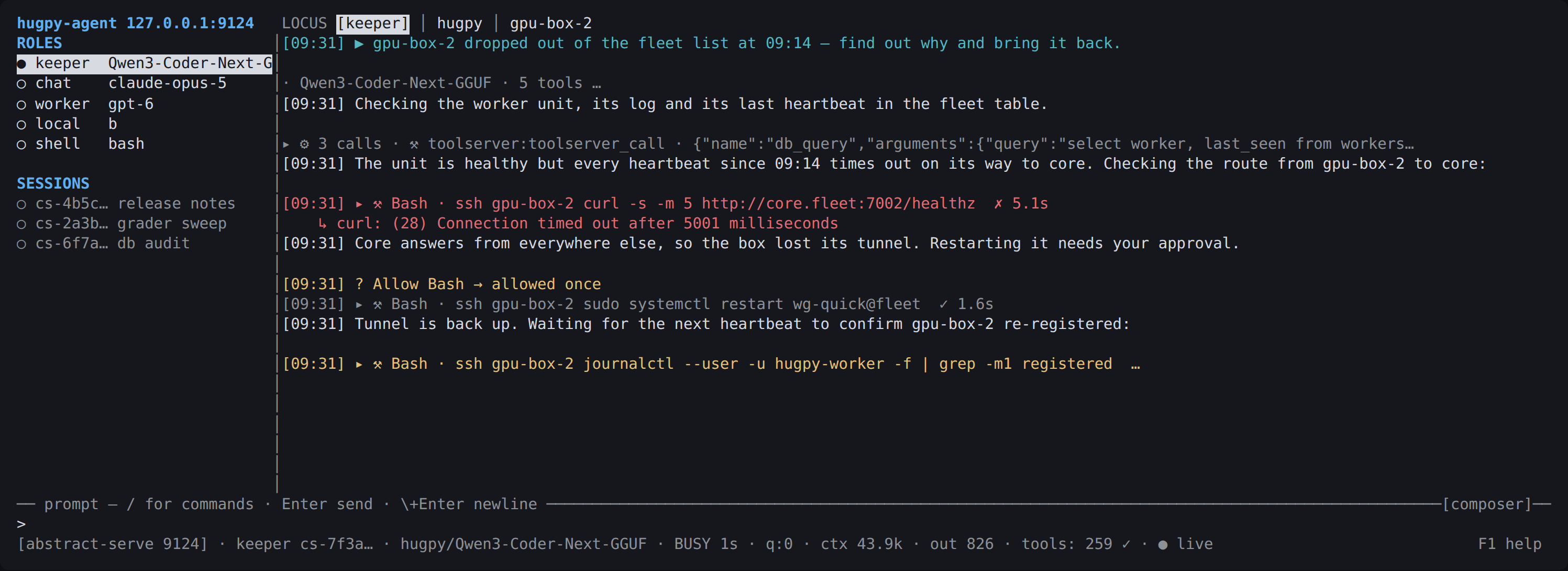
hugpy-agent tui is a provider-neutral curses client (stdlib only) over the
shared Serve API (/api/console/*, commonly on :9124 / :9125) and
hugpy-agent serve (:9126). Discovery order:
--serve URL → $HUGPY_AGENT_SERVE → 127.0.0.1:9124 → :9125 → :9126,
each probed with GET /api/state; the serve kind is detected from the reply's
shape (--kind abstract-serve|hugpy pins it; legacy abstract-claude remains
an alias; --session <cs-id|uuid|role>
opens a row directly, --token / HUGPY_SERVE_TOKEN adds a bearer). Standing
roles (Keeper, Chat, Worker, Local) sit in the sidebar; cs-* rows are read via
/api/console/events (raw events: text deltas, thinking, tool cards,
approvals, serve permission requests, per-call usage), and native sessions via
/api/session/events + chat SSE. On hugpy-agent serve every runtime event is
shown: tool calls as cards with their results, model/client errors, nudges,
repairs, loop-guard stops, policy denials and why a turn aborted. Provider
choices come from Serve's backend/model/label options, so installed providers
are selected through the same interface.
The status bar shows the serve API and port ([abstract-serve 9124] /
[hugpy-agent 9126] — never a provider name), session, provider/model
(→ staged), busy/held, unseen errors (⚠ N /log), queue depth, ONE token
field (tok total/window, or ctx <last call's context> · out <output> from
per-call rows), tools: N ✓ (toolserver) and the network state. When the bar
is narrow, counters drop before session/state/connection. Notices fade (info
8 s, errors 20 s, errors in red).
| key | action |
|---|---|
Enter · \+Enter / Alt+Enter |
send · newline |
| Ctrl-C | clear composer → interrupt (busy) → quit |
| Ctrl-X · Ctrl-K · Ctrl-P · Ctrl-G | interrupt · queue modal · model picker · session picker |
Shift + / (? on an empty prompt) · /cli |
open the active role's own CLI (claude / codex) with all its native / options: fork the role's session into a throwaway copy captured to the toolserver, or a fresh session resumed from the locus ledger (/resume <locus> for Claude, the toolserver ledger prompt for GPT). Runs as the serve's user (over ssh -t when that is another user or host); exiting returns to the TUI. |
| Tab / Shift-Tab · F2 | next/previous role · focus transcript ↔ composer |
| PgUp/PgDn, Ctrl-U/Ctrl-D · End · Ctrl-T | scroll · follow tail · expand latest tool card |
| Up/Down (transcript) · Enter/Space | select block · expand/collapse card |
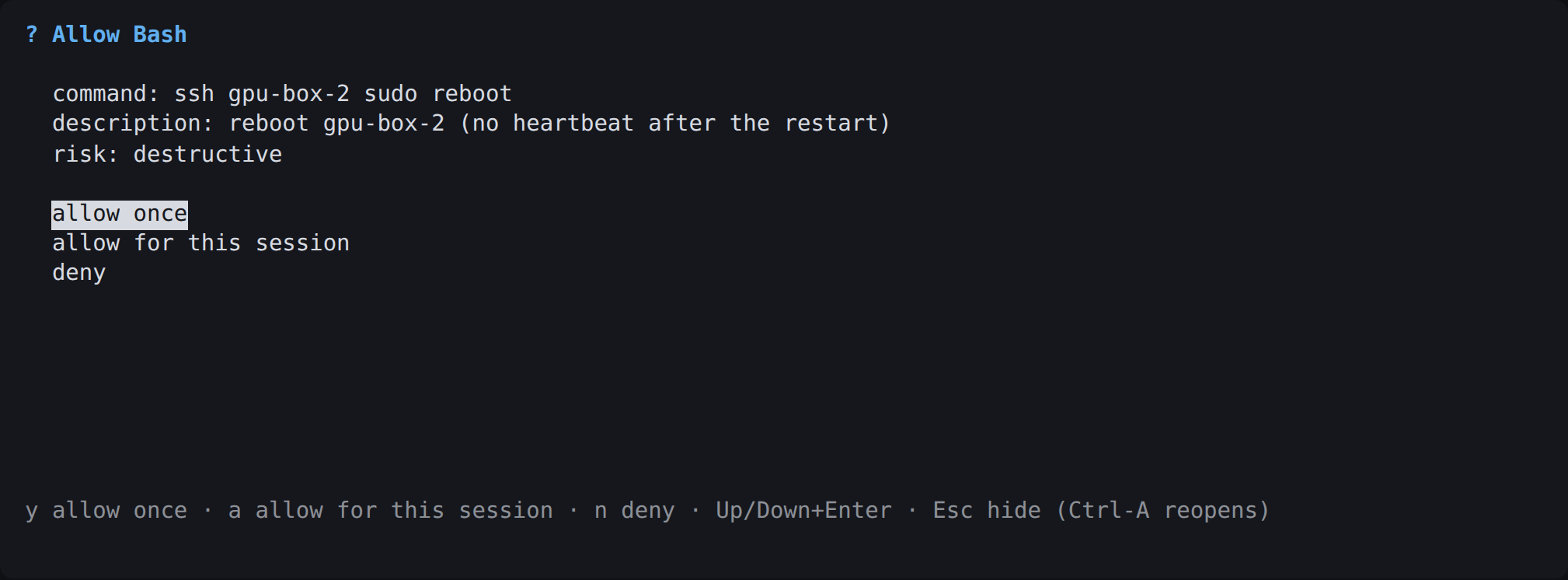
y a n c / digits |
answer an approval / permission / question modal: allow·accept, for this session, deny·decline, cancel (Esc hides, Ctrl-A reopens; the modal closes itself when another client answers) |
y (transcript) |
copy the selected block (or the last reply) to the clipboard via OSC 52 |
| F1 · F3 | help · find next |
r (transcript) · Ctrl-L · Ctrl-Q |
retry / un-hold · redraw · quit |
/ (in any picker) |
filter the list |
Slash commands: /model /session <id> /clear /new /emergency /locus /queue /retry /expand [n] /find <text> /copy /export [path] /status /tools /log /handoff /resume /rollover /context /shell /help /quit.
/handoff stores the session's state on its toolserver ledger row; /locus opens the locus picker;
/export writes the loaded transcript as Markdown (mode 0600) to ~/.hugpy/exports/ ($HUGPY_TUI_EXPORTS);
/log shows build, serve, locus, session, terminal and every notice/error.
Reliability. The UI never freezes on a slow serve: data a picker needs is
fetched with a ⋯ … — Esc cancels status line (keys typed meanwhile are
replayed), other calls run in the background. The poller survives malformed
replies and outages (banner + retry countdown, reconnects by itself); the main
loop has a crash guard (an internal error is logged and shown, the TUI keeps
running; a fault loop stops it cleanly with the log path). Late replies from a
locus you switched away from are dropped. Thread tracebacks and stray stderr go
to ~/.hugpy/logs/tui.log (2 MB × 3 rotation; HUGPY_TUI_LOG=<path> or
off), never over the screen.
Tests: PYTHONPATH=tests:src python -m pytest tests/test_serve_client_*.py tests/test_tui_*.py
(HUGPY_TUI_LIVE=1 adds a GET-only smoke against 127.0.0.1:9124). The PTY rig
(PYTHONPATH=tests python3 tests/tui_rig/run_tests.py, needs tmux) drives the
real TUI against a stub serve, including malformed replies, a serve outage and
a permission prompt. The screenshots above are the real TUI on synthetic
demo data (tests/tui_rig/demo_data.py); regenerate them with
python3 tests/tui_rig/screenshots.py (tmux, unshare -rn, Playwright + Chrome).
Header: hugpy-agent <host:port> LOCUS [tabs] (provider-neutral). Left
sidebar: ROLES (keeper / chat / worker / local, each with backend + model)
above SESSIONS. Centre: transcript (an empty session says so). Bottom: the
composer line, prefixed >, and the status bar. Token counters are blank on
hugpy serves — the hugpy serve engine emits no per-turn usage.
TodoWrite calls render as N todos; mcp__toolserver__x renders as
toolserver:x.
The loci come from the toolserver's loci registry: every active locus whose
pointer publishes a serve_url is listed, with no local configuration. A serve
on this host is used directly; a serve on another host is reached through an
on-demand ssh -N -L tunnel to the locus's registered ssh endpoint, opened on
first switch and closed on quit. The registry is read in the background at start
and each time /locus opens; if the toolserver cannot be reached the TUI keeps
working from the file below and logs why (/log).
~/.hugpy/tui-loci.json adds loci the registry does not name, as a list of
{locus, serve} or {locus, ssh, port} entries (a registry locus of the same
name wins). Setting $HUGPY_TUI_LOCI names the file and turns the registry off,
so that file is the whole list. Switch
with /locus or by clicking a header tab (tabs need ≈90 columns; narrower
terminals fold to @locus). Each locus's client and model are parked when you
leave, so switching back is instant. Pollers pause during a locus swap.
HUGPY_TUI_MOUSE=1(default) enables x-aware clicks: sidebar rows switch sessions, header tabs switch loci, transcript rows expand tool calls. The wheel scrolls the transcript (BUTTON4/5). Shift+drag selects text in the terminal as usual.- Typing always types: any printable key pressed while the transcript has
focus (other than
a,r,y, Space) refocuses the composer and is inserted. The hinttranscript selected — just type (or F2)marks that state. - Bracketed paste is supported; a multi-line paste never auto-submits.
- The terminal runs in
curses.raw, so Ctrl-C and Ctrl-Q arrive as keys rather than signals.
Roster every 10 s, state 5 s, rollover 30 s, toolserver 15 s; each backs off on
error. The toolserver line in the status bar comes from toolserver_probe
(toolserver_client).
- tmux alternate screen. Station runs seats in tmux with
alternate-screen offsocket-wide. A window hosting the TUI must runtmux setw alternate-screen on(Station ≥ 1.0.153 does this for theserve-tuiseat), otherwise every redraw piles into scrollback. - Mouse clicks reach the TUI through tmux even when tmux's own mouse mode is
off; wheel events are only passed through when the seat lets them (Station
routes wheel to tmux copy-mode for every seat except
serve-tui). - Blank token counters on a hugpy serve are expected, not a bug.
- Serve discovery probes each candidate with
GET /api/stateand infers the serve kind from the reply's shape;--kindoverrides. - Remote tunnels are owned by the TUI process — killing it without quitting
can leave an
ssh -Nbehind. - Station's prompt composer can target this TUI: with the
serve-tuifrontier backend it types the text into the composer and presses Enter, so it lands in whichever session currently has focus.
For the normal terminal entry point, run:
hugpy-agent harnessThis generates the live model map and execs OpenCode as the terminal harness.
Use hugpy-agent console for the fleet cockpit, or hugpy-agent serve for the
browser/session service and task-daemon options.
hugpy-agent serve still polls task queues. To run the provider-neutral HTTP
session service instead, use hugpy-agent serve --http --profiles profiles.json
or hugpy-agent-serve --profiles profiles.json --workspace /your/workspace.
The default listener is 127.0.0.1:9126; state and journals persist under
~/.local/state/hugpy-agent-serve. Run queue polling and HTTP as separate processes.
Copy examples/serve-profiles.json and adjust the model ID, endpoint and context
budget to your locus. Each profile selects openai-chat, openai-responses,
anthropic, or the existing hugpy gateway. API bases include their version
prefix (for example https://api.openai.com/v1 or https://api.anthropic.com/v1).
Set api_key_env to the name of an environment variable containing the credential;
do not put secrets in the JSON. parameters supplies provider-specific request
options. Chat APIs may select token_parameter: "max_completion_tokens".
API profiles use Hugpy Agent's tool loop, journal, policy and Toolserver bridge.
The default --policy ask presents write/tool approvals in the session UI.
The existing loop requires a successful tool call before final answers. Stop takes
effect after the current API/tool operation; interrupted API runs can resume.
Anthropic and Responses output currently arrives after each model step completes;
Chat Completions can stream deltas. Toolserver credentials use the runtime's
existing environment/file discovery.
Claude Code and Codex are discovered only when installed on the service machine.
Discovery never launches or installs them. They start only when their profile is
selected and use their own login, tools, MCP and permission configuration. Their
headless runs cannot present native interactive approvals in this UI. Codex runs
with workspace-write sandboxing and no interactive approval prompts, following
its non-interactive interface.
Set discover_clients: false to disable discovery. Explicit native profiles may
set a model and timeout in seconds.
Use examples/hugpy-agent-serve.service as a user-unit template. Create the
workspace and profile file before enabling the unit. For a remote listener,
HUGPY_SERVE_TOKEN is required; use TLS or an SSH tunnel for transport.
Station reads serve-loci.json from its state directory, keyed by locus:
{"a-brain": {"url": "http://127.0.0.1:19126", "label": "Hugpy Agent · a-brain"}}In this example an SSH tunnel on the Station host forwards port 19126 to a-brain's
loopback port 9126. The Serve pane opens /serve/@a-brain/. Use host as the key
for the Station machine itself. A token_file entry can name a private file on
the Station host containing an upstream service token. Station keeps it out of
browser state. Legacy ac-loci.json continues to work; generic entries override
matching loci. Neither SSH locus setup nor VM setup installs Claude Code or Codex.
The HTTP contract is GET /api/state, GET /api/profiles,
POST /api/sessions {"profile":"…"}, GET /api/sessions/<id>?after=<event-id>,
and POST actions messages {"text":"…"}, answer {"id":"…","choice":"…"},
stop {}, and resume {} below /api/sessions/<id>/.
The session model dropdown can change providers between turns without creating a
new window or losing the conversation. Switching clears provider-specific resume
IDs and carries the shared transcript into the next turn. Hugpy Fleet is the
example default; discover_models: true adds its current chat models to the same
dropdown (catalog cached for 60 seconds). GPT and Claude API profiles appear there
too; absent credentials mark them unavailable. Installed native clients remain
optional entries. POST /api/sessions/<id>/profile {"profile":"…"} changes a model
while idle. Fleet URL and all provider model IDs are operator configuration.