





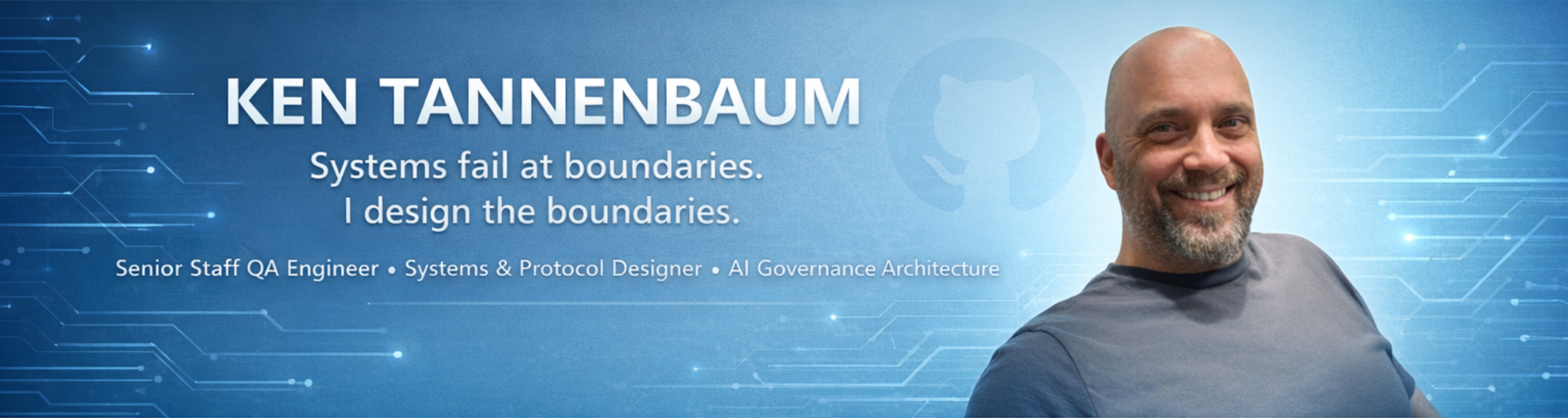
Ken Tannenbaum – Founder, AEGIS Initiative |
Senior Staff QA Engineer • Systems & Protocol Designer • AI Governance Architect
I am a Senior Staff Quality Assurance Engineer focused on structured engineering workflows, platform-scale quality architecture, and long-horizon systems design. I’m particularly interested in how systems, protocols, and clearly defined boundaries shape resilient software environments.
Beyond my core role, I am actively developing OS-adjacent AI mediation systems, civic drafting frameworks, investigative tooling prototypes, and production-grade publishing systems. These efforts formalize how governance, constraint, and human-centered design shape durable systems.
I am drawn to problems that demand structure, clarity, and long-horizon thinking, and I intentionally pursue work that operates at that scale.

- AEGIS Platform — hosted SaaS operator dashboard and governance API (beta demo at demo.aegis-platform.net)
- AIAM-1 — identity and access management protocol for AI agents (RFC-0019)
- AGAP-1 — automated governance attestation protocol (RFC-0018)
- ATX-1 v2.3 — next taxonomy release incorporating sub-techniques from the Adversarial Operations Center lab
- IEEE TNSE paper — architectural case for federated governance enforcement (resubmitted, under review)
- AEGIS Governance Federation Network — cross-domain trust protocol for governed AI networks

I develop open frameworks for AI governance, structured systems design, and deterministic engineering workflows.
If this work is valuable to you, consider supporting its continued development: https://github.com/sponsors/finnoybu

AEGIS is a governance architecture for constrained intelligence. It evaluates human intent, clarifies consequences, and enforces explicit boundaries before AI agents act. The initiative treats authority, constraint, and consequence-awareness as first-class architectural properties rather than reactive safeguards — systems remain accountable to clearly defined boundaries, even when explicitly permitted to act.
AEGIS spans a twelve-repository ecosystem at github.com/aegis-initiative. aegis-labs serves as the research sandbox where adversarial testing, novel threat discovery, and governance experiments run against live deployments before promotion to canonical specification.
Published assets:
- aegis-core — Python reference implementation of the AGP-1 governance runtime. Current release: v0.1.2 (DOI: 10.5281/zenodo.19355478)
- ATX-1 Threat Taxonomy — 10 tactics, 29 sub-techniques covering the AI governance threat surface. Current version: v2.2 (DOI: 10.21227/7c9p-6150)
- Governing the Action Boundary — 21-page category-definition paper on the architectural case for action-boundary governance (DOI: 10.5281/zenodo.19489150)
- AEGIS Platform — hosted SaaS product with operator dashboard and governance API, live at demo.aegis-platform.net
Public domains: aegis-initiative.com · aegis-docs.com · aegis-governance.com · aegis-constitution.com · aegis-federation.com
The initiative is grounded in a simple principle: *capability without constraint is not intelligence.*™

Forensickle is an investigative tooling initiative exploring how structured digital forensics workflows can begin locally and expand into broader analytical environments. The concept starts with accessible, script-driven data collection and offline review, designed for individual practitioners and small teams.
The longer-term vision is to extend this foundation into a web-based platform where collected artifacts can be uploaded, correlated, and analyzed across systems to provide deeper context and structured comparison while remaining open, transparent, and accessible.

AmericansForPropriety is a civic drafting and institutional clarity initiative focused on articulating jurisdictional boundaries, governance norms, and structural accountability in accessible language. The project provides policy context and structured drafting tools designed to support disciplined and informed civic participation.
At its core, the initiative examines how governance frameworks can be expressed as coherent systems. This makes institutional roles, authority boundaries, and procedural responsibility more visible and understandable to the public.

Beyond governance and investigative tooling, I build structured publishing and web architecture projects that apply systems discipline to content and user experience. This includes The Wellings, a production-grade children’s book series with defined canon and production governance, as well as long-form archival initiatives such as Memoirs, a digital preservation project documenting my great-grandfather’s experiences as a Norwegian Merchant Marine in the late 19th century.
These projects serve as execution laboratories, exploring how narrative platforms, content workflows, and static web infrastructure can be designed with clarity, consistency, and long-horizon maintainability.

Python • TypeScript • Static Web Architecture • Systems Design • Workflow & Governance Modeling
