




Gradient-free neural network training via optimal transport.
PolyStep evaluates finite-radius parameter perturbations and updates parameters through a weighted barycenter. It supports spiking networks, quantized layers, hard routing, and other models without useful gradients. For differentiable models, backpropagation is usually faster.
Paper · Interactive visualization · API reference
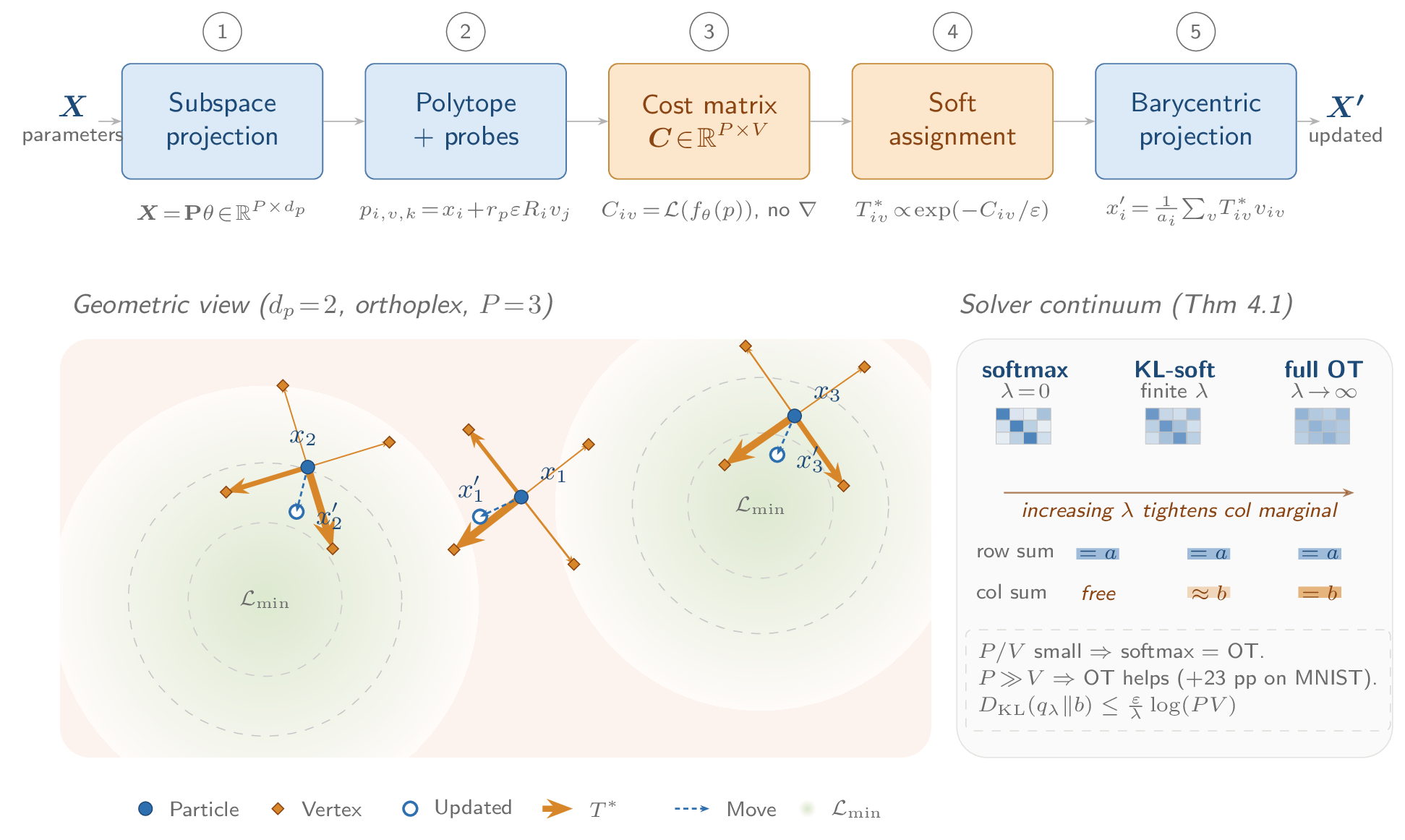
Want to play around with parameters? Viet T. Nguyen built a gorgeous interactive walkthrough that animates every step of the method -> explore the PolyStep visualization.
pip install polystep
pip install "polystep[examples]"  # optional demo dependencies
Python 3.11+ and PyTorch 2.8+ are required. Choose a CUDA build compatible with your
driver from the PyTorch installation guide.
For development, install pip install -e ".[dev]" from a checkout.
import torch
from torch import nn
from torch.utils.data import DataLoader, TensorDataset
from polystep import HybridSubspace, PolyStepOptimizer, TrainConfig, train
from polystep.transform import ParamLayout

model = nn.Sequential(nn.Linear(16, 32), nn.ReLU(), nn.Linear(32, 3))
loader = DataLoader(
    TensorDataset(torch.randn(256, 16), torch.randint(0, 3, (256,))),
    batch_size=32,
)
subspace = HybridSubspace.from_layout(
    ParamLayout.from_module(model), rank=4, max_subspace_dim=128,
)
optimizer = PolyStepOptimizer(model, subspace=subspace, solver="softmax")
train(model, loader, nn.CrossEntropyLoss(), optimizer, TrainConfig(epochs=5))
Replace the generated data with your dataset. Limit max_subspace_dim to control
the forward budget. In manual loops, call register_evaluator() before each batch;
train() does this automatically. See performance for
candidate paths, thread counts, compilation, and memory settings.
from polystep import PolyStepES

es = PolyStepES(dim=20, epsilon=0.1, step_radius=0.3)
for _ in range(300):
    candidates = es.ask()
    es.tell(candidates.square().sum(dim=1))
print(es.best_fitness, es.best_solution)from polystep import Ackley
from polystep.solver import PolyStep
solver = PolyStep.create(Ackley(dim=10), epsilon=0.5, max_iterations=50)
state = solver.run(torch.randn(100, 10))Each step samples a rotated polytope, evaluates its vertices, computes transport weights, and moves to their barycenter. Subspaces reduce the number of coordinates searched. Softmax treats blocks independently; Sinkhorn also constrains target mass.
Finite-radius probes can cross flat regions of discontinuous losses. Performance depends on the radius, representation, and evaluation budget. PolyStep's optional quadratic models and radius controllers are implementation heuristics; they do not inherit classical direct-search or trust-region guarantees.
polystep.baselines provides openai_es, spsa, mezo, random_search, eggroll,
and cma_es. One evaluation means one candidate scored, even when candidates are
batched:
from polystep.baselines import Objective, openai_es

objective = Objective(lambda x: x.square().sum(1), dim=64, budget=10_000)
result = openai_es(objective, sigma=0.05, lr=0.1, popsize=32)
The paper runners support --fair for matched search spaces and evaluation budgets.
EGGROLL uses a factored representation to retain matrix perturbations. See the
reproduction protocol for tuning and budget details.
Five-seed mean ± sample standard deviation. These architecture tables compare validation-tuned methods at matched optimizer steps. Evaluation- and time-matched studies are reported separately in the experiment index.
Test accuracy %. A dash means the cell is not in this release.
| Task | PolyStep | CMA-ES | OpenAI-ES | SPSA | Adam (surrogate) | Non-diff op |
|---|---|---|---|---|---|---|
| SNN/LIF (MNIST) | 93.0 ± 0.2 | 77.1 ± 13.3 | 79.6 ± 5.2 | 53.9 ± 3.0 | 86.3 ± 10.6 | threshold() |
| Int8 quantized | 97.0 ± 0.1 | 91.6 ± 0.4 | 94.4 ± 0.2 | 82.5 ± 0.5 | 97.8 ± 0.1 | round() |
| Argmax attention | 86.6 ± 0.4 | 79.5 ± 0.5 | 80.0 ± 0.4 | 67.4 ± 1.3 | 88.6 ± 0.1 | argmax() |
| Staircase activation | 94.3 ± 0.1 | 89.2 ± 0.4 | 88.9 ± 0.5 | 45.2 ± 4.2 | 97.5 ± 0.1 | floor() |
| Hard MoE routing | 90.6 ± 0.2 | 77.8 ± 1.5 | 82.5 ± 0.8 | 25.4 ± 3.5 | - | argmax() |
| Variables | PolyStep | CMA-ES | OpenAI-ES | probSAT | RC2 |
|---|---|---|---|---|---|
| 100 | 98.0 ± 0.7 | 99.0 ± 0.3 | 99.4 ± 0.1 | 99.8 | 99.8 |
| 5,000 | 98.1 ± 0.1 | 95.2 ± 0.2 | 92.9 ± 0.2 | 99.9 | timeout |
| 100,000 | 98.1 ± 0.0 | 90.7 ± 0.1 | 88.9 ± 0.0 | 99.6 | timeout |
| Task | PolyStep | Adam |
|---|---|---|
| MNIST (2-layer MLP) | 96.8 ± 0.1 | 97.7 ± 0.1 |
| ETTh1 (LSTM, MSE; lower is better) | 0.253 ± 0.023 | 0.247 ± 0.023 |
The SNN surrogate-gradient baseline varies substantially across seeds. Adam leads on the differentiable tasks, and specialized solvers lead on MAX-SAT. See limitations for unsupported configurations and comparison limits.
- API reference
- Performance
- Examples
- Experiments and reproduction
- Determinism
- Contributing and changelog
@article{le2026training,
  title={Training Non-Differentiable Networks via Optimal Transport},
  author={Le, An T},
  journal={arXiv preprint arXiv:2605.01928},
  year={2026}
}A huge thank you to Viet for building a beautiful interactive PolyStep visualization, it brings the method to life and makes every step click!