 A goroutine pool for Go
English | 中文
Important
This repository is an internal mirror of
panjf2000/ants. It keeps the /v2
module path under github.com/alkaid/ants/v2 and adds the fork-specific
PoolWithID API. Upstream CI, coverage, tags, and releases do not describe
this mirror. This mirror supports Go 1.19 and later.
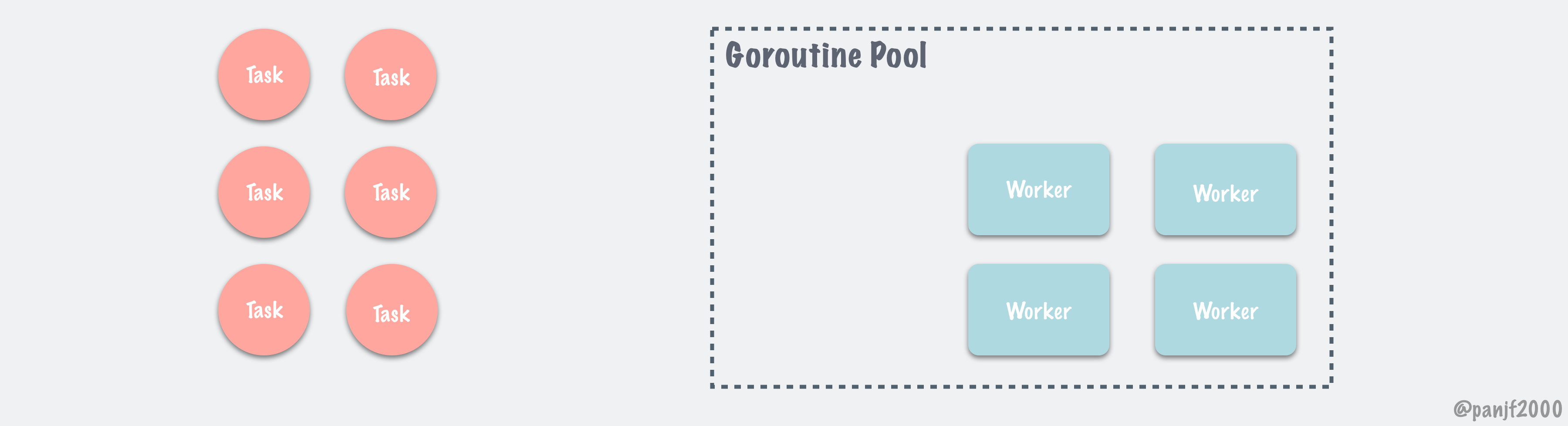
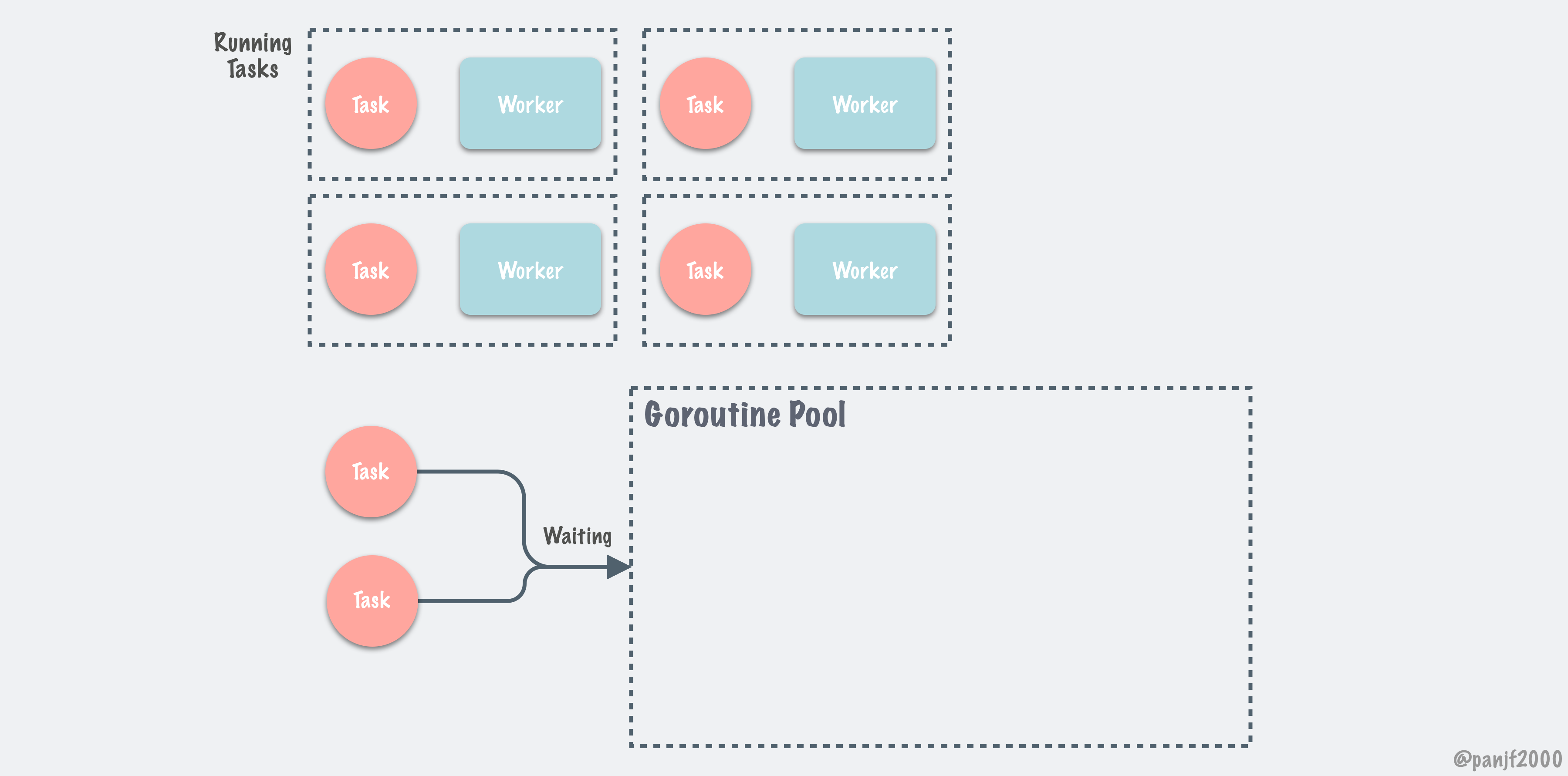
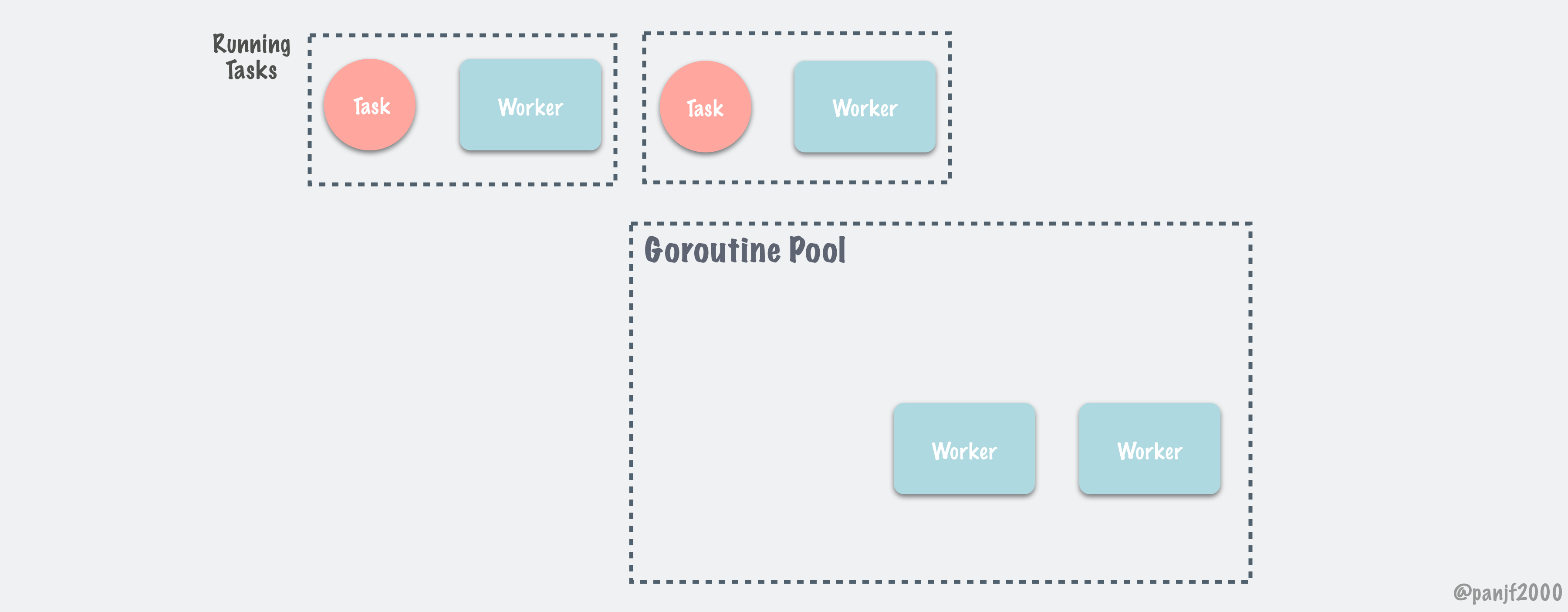
Library ants implements a goroutine pool with fixed capacity, managing and recycling a massive number of goroutines, allowing developers to limit the number of goroutines in your concurrent programs.
- Managing and recycling a massive number of goroutines automatically
- Purging overdue goroutines periodically
- Abundant APIs: submitting tasks, getting the number of running goroutines, tuning the capacity of the pool dynamically, releasing the pool, rebooting the pool, etc.
- Handle panic gracefully to prevent programs from crash
- Efficient in memory usage and it may even achieve higher performance than unlimited goroutines in Go
- Nonblocking mechanism
- Preallocated memory (ring buffer, optional)


go get -u github.com/panjf2000/antsgo get github.com/alkaid/ants/v2@INTERNAL_VERSIONReplace INTERNAL_VERSION with the exact version or commit exposed by the
organization-approved internal Git service or module proxy. The
v2.12.1-ak-3 delivery in this checkout is a local lightweight tag: it is not
pushed and cannot be resolved through the public Go module proxy. The internal
mirror requires Go 1.19 or later.
Read the local examples or run
go doc github.com/alkaid/ants/v2 against the approved internal version.
ants.Options contains the optional pool settings. Pass option functions when
calling NewPool, NewPoolWithFunc, or NewPoolWithFuncGeneric to customize
them.
See ants.Options and ants.Option for more details.
ants supports customizing the capacity of the pool. You can call the NewPool method to instantiate a Pool with a given capacity, as follows:
p, _ := ants.NewPool(10000)Tasks can be submitted by calling ants.Submit
ants.Submit(func(){})You can tune the capacity of ants pool at runtime with ants.Tune:
pool.Tune(1000) // Tune its capacity to 1000
pool.Tune(100000) // Tune its capacity to 100000
Don't worry about the contention problems in this case, the method here is thread-safe (or should be called goroutine-safe).
ants allows you to pre-allocate the memory of the goroutine queue in the pool, which may get a performance enhancement under some special certain circumstances such as the scenario that requires a pool with ultra-large capacity, meanwhile, each task in goroutine lasts for a long time, in this case, pre-mallocing will reduce a lot of memory allocation in goroutine queue.
// ants will pre-malloc the whole capacity of pool when calling ants.NewPool.
p, _ := ants.NewPool(100000, ants.WithPreAlloc(true))pool.Release()or
pool.ReleaseTimeout(time.Second * 3)// A pool that has been released can be still used after calling the Reboot().
pool.Reboot()PoolWithID is an extension in this internal fork. It uses the same public
Option type as the other constructors, including direct Option values,
expanded []Option slices, and WithOptions. The fork extends the shared
Options struct with TaskBuffer, DisablePurgeRunning,
RunningTaskTimeout, MaxEscapedWorkers, and MaxEscapedWorkersPerID.
Upstream unkeyed Options literals are therefore source-incompatible. Use
option functions or keyed literals. WithPreAlloc(true) is accepted but has no
effect because ID workers and their queues are allocated on demand and are not
reused.
The important defaults and limits are:
| Setting | Zero value | Positive value and limits |
|---|---|---|
ExpiryDuration |
30 seconds | Controls idle-owner expiry only. |
RunningTaskTimeout |
5 minutes | Controls running-task escape independently of idle expiry. Negative values are rejected. |
TaskBuffer |
DefaultTaskBuffer=100 |
Per-ID admission limit from 1 through MaxTaskBuffer=64*1024; the physical channel has 2*TaskBuffer slots. |
MaxEscapedWorkers |
Finite pools use min(64, max(1, Cap()/4)); infinite pools use 64. |
A positive limit stays fixed across Tune calls. Negative values are rejected. |
MaxEscapedWorkersPerID |
1 | Sets a fixed per-ID limit. Negative values are rejected. |
MaxBlockingTasks |
0 means unlimited. | Limits all currently blocked PoolWithID.Submit calls. |
MinTaskBuffer=10 remains exported only for source compatibility and is
deprecated. It is not the default. MaxTaskBuffer bounds one ID's queue, not
the sum of all active ID queues. See the
migration guide before choosing a large
buffer.
For one ID, successful non-concurrent submissions start in FIFO order and run
serially on the normal path. Concurrent Submit calls have no defined order.
RunningTaskTimeout starts when a task begins execution. When the timeout is
reached and both escape budgets have room, the managed owner escapes and a
replacement may run later tasks for that ID. The scheduler checks running
owners at intervals no longer than 30 seconds, so the transition can occur
after the configured threshold. Go cannot stop the escaped task. It may overlap
the replacement, keep resources alive, and produce late side effects.
| Submission path | Behavior |
|---|---|
New ID, Nonblocking=true |
Returns ErrPoolOverload if owner capacity is unavailable or another caller is allocating that ID. |
Existing ID, Nonblocking=true |
Rejects when the observed queue length reaches TaskBuffer; the final nonblocking send also rejects if the physical channel is full. |
New ID, Nonblocking=false |
Waits for owner capacity or an in-progress allocation, subject to MaxBlockingTasks. |
Existing ID, Nonblocking=false |
May use the full 2*TaskBuffer channel, then waits for queue space or pool closure, also subject to MaxBlockingTasks. |
Waiting() counts only submissions that are currently blocked across those
wait paths. A call moving directly from one wait path to another keeps one
waiter slot and is never counted twice. The nonblocking admission check and
send are not serialized, so concurrent calls may use the reserved half between
TaskBuffer and 2*TaskBuffer. A task that recursively submits to its own full
ID queue in blocking mode is not guaranteed to make progress.
WithDisablePurgeRunning(true) disables running-task escape while preserving
idle expiry. WithDisablePurge(true) disables both idle expiry and running-task
escape. Either setting can let a permanently blocked task block its ID forever.
Release() stops admission and starts the managed drain without waiting.
ReleaseContext and ReleaseTimeout wait for the current generation's
admission work, accepted queues, managed owners, and background loop. They do
not wait for escaped workers. A task accepted before closing may still escape
while the pool is draining; after a successful managed close, that generation
cannot start another escape transition. Reboot() waits for the managed close,
opens an empty registry, and does not wait for escaped workers. Escape permits,
counts, dropped-event totals, and the event stream remain continuous across
Release and Reboot.
EscapeEvents() is a best-effort channel with capacity 64. It reports worker
escape, escaped-worker exit, and budget exhaustion with generation and budget
fields. Publishing never blocks; DroppedEscapeEvents() and
EscapeSnapshot().DroppedEvents report full-channel drops. Use one direct
consumer and an application-owned context, then reconcile periodically with
the authoritative EscapeSnapshot(). Snapshot maps are caller-owned copies;
the full snapshot is O(K) in the number of observed IDs.
Escaped(), TotalWorkers(), EscapeBudgetStatus(id), and
DroppedEscapeEvents() provide O(1) totals for frequent monitoring.
Running() and Free() count managed owners only; TotalWorkers() is
Running()+Escaped(). An escape event must not trigger an automatic retry
because the original task can still complete and duplicate side effects.
The following external-package example is compiled as part of the test suite. It keeps per-ID state out of metric labels and exports only a low-cardinality total gauge:
package monitoring

import (
	"context"
	"log"
	"time"

	ants "github.com/alkaid/ants/v2"
)

func MonitorPoolWithID(
	ctx context.Context,
	pool *ants.PoolWithID,
	recordByID func(id, escaped int),
	setEscapedGauge func(total int),
) {
	knownIDs := make(map[int]struct{})
	ticker := time.NewTicker(10 * time.Second)
	defer ticker.Stop()

	for {
		select {
		case event := <-pool.EscapeEvents():
			recordByID(event.ID, event.ByID)
			if event.ByID == 0 {
				delete(knownIDs, event.ID)
			} else {
				knownIDs[event.ID] = struct{}{}
			}
			log.Printf("pool escape type=%d id=%d generation=%d reason=%d by_id=%d total=%d",
				event.Type, event.ID, event.Generation, event.BudgetReason,
				event.ByID, event.Total)
		case <-ticker.C:
			// Events notify promptly; the snapshot repairs missed notifications.
			snapshot := pool.EscapeSnapshot()
			for id := range knownIDs {
				if snapshot.ByID[id] == 0 {
					recordByID(id, 0)
					delete(knownIDs, id)
				}
			}
			for id, count := range snapshot.ByID {
				recordByID(id, count)
				knownIDs[id] = struct{}{}
			}
			setEscapedGauge(snapshot.Total)
			if snapshot.DroppedEvents != 0 {
				log.Printf("pool escape notifications dropped=%d", snapshot.DroppedEvents)
			}
		case <-ctx.Done():
			return
		}
	}
}All tasks submitted to ants pool will not be guaranteed to be addressed in order, because those tasks scatter among a series of concurrent workers, thus those tasks would be executed concurrently.
Please read our Contributing Guidelines before opening a PR and thank you to all the developers who already made contributions to ants!
The source code in ants is available under the MIT License.
- Goroutine 并发调度模型深度解析之手撸一个高性能 goroutine 池
- Visually Understanding Worker Pool
- The Case For A Go Worker Pool
- Go Concurrency - GoRoutines, Worker Pools and Throttling Made Simple
Trusted by the following corporations/organizations.

|

|

|

|

|

|

|
|

|

|

|

|

|

|

|

|

|

|

|

|

|
If you're also using ants in production, please help us enrich this list by opening a pull request.
The open-source projects below do concurrent programming with the help of ants.
- gnet: A high-performance, lightweight, non-blocking, event-driven networking framework written in pure Go.
- milvus: An open-source vector database for scalable similarity search and AI applications.
- nps: A lightweight, high-performance, powerful intranet penetration proxy server, with a powerful web management terminal.
- TDengine: TDengine is an open source, high-performance, cloud native time-series database optimized for Internet of Things (IoT), Connected Cars, and Industrial IoT.
- siyuan: SiYuan is a local-first personal knowledge management system that supports complete offline use, as well as end-to-end encrypted synchronization.
- BillionMail: A future open-source Mail server, Email marketing platform designed to help businesses and individuals manage their email campaigns with ease.
- WeKnora: An LLM-powered framework designed for deep document understanding and semantic retrieval, especially for handling complex, heterogeneous documents.
- coze-loop: A developer-oriented, platform-level solution focused on the development and operation of AI agents.
- osmedeus: A Workflow Engine for Offensive Security.
- jitsu: An open-source Segment alternative. Fully-scriptable data ingestion engine for modern data teams. Set-up a real-time data pipeline in minutes, not days.
- triangula: Generate high-quality triangulated and polygonal art from images.
- teler: Real-time HTTP Intrusion Detection.
- bsc: A Binance Smart Chain client based on the go-ethereum fork.
- jaeles: The Swiss Army knife for automated Web Application Testing.
- devlake: The open-source dev data platform & dashboard for your DevOps tools.
- matrixone: MatrixOne is a future-oriented hyper-converged cloud and edge native DBMS that supports transactional, analytical, and streaming workloads with a simplified and distributed database engine, across multiple data centers, clouds, edges and other heterogeneous infrastructures.
- bk-bcs: BlueKing Container Service (BCS, same below) is a container management and orchestration platform for the micro-services under the BlueKing ecosystem.
- trueblocks-core: TrueBlocks improves access to blockchain data for any EVM-compatible chain (particularly Ethereum mainnet) while remaining entirely local.
- openGemini: openGemini is an open-source,cloud-native time-series database(TSDB) that can be widely used in IoT, Internet of Vehicles(IoV), O&M monitoring, and industrial Internet scenarios.
- AdGuardDNS: AdGuard DNS is an alternative solution for tracker blocking, privacy protection, and parental control.
- WatchAD2.0: WatchAD2.0 是 360 信息安全中心开发的一款针对域安全的日志分析与监控系统,它可以收集所有域控上的事件日志、网络流量,通过特征匹配、协议分析、历史行为、敏感操作和蜜罐账户等方式来检测各种已知与未知威胁,功能覆盖了大部分目前的常见内网域渗透手法。
- vanus: Vanus is a Serverless, event streaming system with processing capabilities. It easily connects SaaS, Cloud Services, and Databases to help users build next-gen Event-driven Applications.
- trpc-go: A pluggable, high-performance RPC framework written in Golang.
- motan-go: Motan is a cross-language remote procedure call(RPC) framework for rapid development of high performance distributed services. motan-go is the golang implementation of Motan.
If you have ants integrated into projects, feel free to open a pull request refreshing this list of use cases.
ants has been being developed with GoLand under the free JetBrains Open Source license(s) granted by JetBrains s.r.o., hence I would like to express my thanks here.

Please be sure to leave your name, GitHub account, or other social media accounts when you donate by the following means so that I can add it to the list of donors as a token of my appreciation.

|

|

|
