Evaluate responses. Guard actions.
A Python toolkit for evaluating LLMs, RAG, and agents—with optional calibration against human labels.


Quickstart · Tool guards · Calibration · Examples & guides
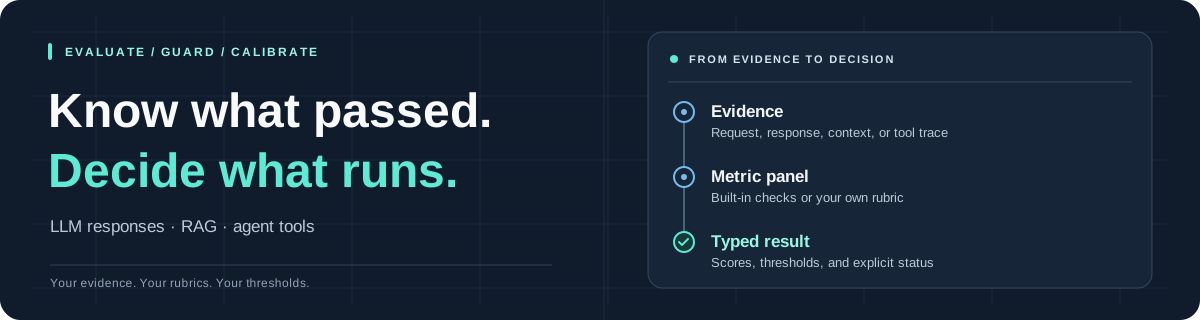
Use Jev, a System One model, to judge generated responses and recorded agent executions. Check proposed tool calls before they run. Start with a preset, then bring your own metrics, thresholds, or judge backend as your application grows.
Install with Python 3.11+ and set your TypeSafe API key:
python -m pip install typed-evals
export TYPESAFE_API_KEY='your-key'
Evaluate a response against the evidence used to generate it:
from typed_evals import evaluate

result = evaluate(
    input="What is the refund period?",
    response="You can request a refund within 30 days.",
    contexts=["Refunds are allowed within 30 days of purchase."],
    preset="rag",
)

print("All checks passed:", result.passed)
for name, metric in result.metrics.items():
    print(f"{name}: score={metric.score}, passed={metric.passed}")
That checks faithfulness, answer relevancy, and context relevance in one judge request. The default backend uses jev-1.13.0 through the official typesafe-sdk 0.7.x; live examples make API calls using your account.
Want to explore without an API key? Jump to the offline demo.
| Your workflow | What Typed Evals provides |
|---|---|
| Evaluate a RAG pipeline | Check whether answers address the query and stay grounded in the retrieved context. |
| Review agent runs | Judge task completion and claims about tool results against recorded execution evidence. |
| Guard tool calls | Evaluate proposed calls against your policy before executing the underlying function. |
| Run dataset checks | Evaluate JSON, JSONL, or Python samples; export structured reports and use the CLI in CI. |
| Define your own rubric | Compose nine built-in metrics or write custom binary, categorical, and ordered-score checks. |
| Calibrate thresholds | Fit per-metric curves to human pass/fail labels and inspect performance on held-out data. |
| Preset | Checks | Evidence to supply |
|---|---|---|
"response" · default |
Answer relevancy | input, response |
"rag" |
Faithfulness, answer relevancy, context relevance | input, response, contexts |
"agent" |
Task completion, tool grounding | input, response, trace, expected_outcome |
Presets use a 0.5 threshold for each metric. Supplying contexts alone does not enable RAG checks—choose preset="rag" explicitly. Missing evidence and judge errors raise by default. Use custom metrics to choose different checks or thresholds.
Save your samples as samples.jsonl, with one JSON object per line:
{"input":"Refund period?","response":"30 days.","contexts":["Refunds are allowed within 30 days of purchase."]}from typed_evals import evaluate
report = evaluate("samples.jsonl", preset="rag")
print(report.summary)
report.save("evaluation-report.json")You can also pass a dictionary, an EvaluationSample, or a list/tuple of either. A single sample returns SampleResult; a sequence or file returns EvaluationReport, even for one row. JSON files contain an array of samples.
Each sample's metrics share a judge request. Batches validate inputs first, run up to eight concurrent workers by default, and preserve input order.
In notebooks and async applications, use aevaluate with the same dataset:
from typed_evals import aevaluate

report = await aevaluate("samples.jsonl", preset="rag")
The synchronous API also works in notebooks, but blocks until evaluation finishes.
From the terminal or CI:
typed_evals evaluate samples.jsonl \
  --metrics faithfulness answer_relevancy context_relevance \
  --output evaluation-report.json \
  --fail-on-failure
The CLI returns a nonzero exit code for failed or unavailable evaluations when --fail-on-failure is set. See the evaluation guide for error policies, data formats, and report fields.
Add a policy check to a LangChain tool before registering it:
python -m pip install 'typed-evals[langchain]'from langchain.tools import ToolRuntime, tool
from typed_evals.adapters.langchain import guard_tool
@tool
@guard_tool(
policy="Only read tickets owned by the authenticated customer.",
contexts=lambda runtime: runtime.context["authorization_evidence"],
)
def read_ticket(ticket_id: str, runtime: ToolRuntime) -> str:
"""Read the complete text of a support ticket."""
return ticket_store.read_authorized(runtime.context["customer_id"], ticket_id)Here, ticket_store is your application's ticket service. Supply the current customer ID and application-owned authorization evidence through the agent's runtime context; the complete LangChain example shows the wiring.
The adapter captures the latest human request, proposed arguments, tool name, and call ID. By default, it checks ToolSafety at a 0.9 threshold and raises GuardrailViolation on a failed or unavailable judgment before the function runs. Successful calls preserve the tool's native return value. Keep deterministic authorization inside the tool, as shown above.
| Integration | Install | Import guard_tool from |
|---|---|---|
| Plain Python | pip install typed-evals |
typed_evals |
| LangChain | pip install 'typed-evals[langchain]' |
typed_evals.adapters.langchain |
| CrewAI | pip install 'typed-evals[crewai]' |
typed_evals.adapters.crewai |
| Microsoft Agent Framework | pip install 'typed-evals[agent-framework]' |
typed_evals.adapters.agent_framework |
The plain Python helper takes explicit input and contexts, as values or callbacks. The CrewAI adapter creates a native tool; the Microsoft adapter wraps a function under @agent_framework.tool. See the adapter guide for each framework's registration and evidence requirements, and the runtime guide for agent decorators and additional checkpoints.
Choose custom metrics instead of a preset to control the panel and thresholds:
from typed_evals import AnswerRelevancy, Faithfulness, evaluate

result = evaluate(
    input="Refund period?",
    response="30 days.",
    contexts=["Refunds are allowed within 30 days."],
    metrics=[Faithfulness(threshold=0.8), AnswerRelevancy(threshold=0.8)],
)
For reusable configuration, use Evaluator(preset="rag") or Evaluator(metrics=[...]).
Explore the nine built-in metrics
| Focus | Metrics |
|---|---|
| Responses and retrieval | answer_correctness, answer_relevancy, context_relevance, faithfulness |
| Recorded agent execution | task_completion, tool_grounding |
| Proposed tool calls | tool_accuracy, tool_safety |
| Content policy | policy_compliance |
from typed_evals import list_metrics

print(list_metrics())  # No API credentials needed.
PolicyCompliance and ToolSafety require policy=... when constructed. See the metric definitions for required evidence and score meanings.
Write a custom metric
Define an ordered rubric from least to most desirable. Higher scores pass the threshold, so the last level should describe your best outcome:
from typed_evals import Metric, evaluate

completeness = Metric(
    name="completeness",
    kind="score",
    instructions="How completely does `response` cover the details requested in `input`?",
    criteria=(
        "None of the requested details are supplied.",
        "Some details are supplied, but essential requested details are missing.",
        "All essential requested details are supplied.",
    ),
    pass_definition="All essential requested details are supplied.",
    required_fields=("input", "response"),
    threshold=0.8,
)

result = evaluate(
    input="What is the refund period, and how do I request one?",
    response="You have 30 days. Contact support with your order number.",
    metrics=[completeness],
)
An ordered score rubric produces a normalized expected level between 0 and 1; it is not automatically a probability of human acceptance. For binary and categorical rubrics, use kind="noul" and kind="choice". The custom metrics example shows all three formats.
Choose another model or implement a backend
Pass backend=JevBackend(model="...") to choose a different Jev model. Jev is the only bundled provider; custom providers implement the public Backend and JudgeSession protocols and can be passed as backend= to evaluation and tool guards.
An adapter supplies a model ID, an async session() context manager, and async judge(state, questions) returning a JudgeResponse. It must translate the TypeSafe SDK's Noul, Choice, and Score formats into provider requests and matching answers. The typesafe-sdk dependency remains required; the CLI uses JevBackend.
See the backend contract and synthetic backend example.
Make thresholds reflect your own acceptance criteria. A raw judge score of 0.8 does not necessarily mean humans would pass 80% of similar examples.
With typed-evals[calibration], use EvaluationPipeline to fit per-metric isotonic curves against representative human pass/fail labels. Inspect the held-out diagnostics, save the fitted artifact, and load it for later evaluations. Calibration is opt-in; improvements are measured on held-out data rather than assumed.
Read the calibration walkthrough for fitting, validation, and saved artifacts. The included labeled datasets are synthetic examples; replace them with human-reviewed labels for your application.
metric.score uses the raw score unless calibration is applied. metric.passed compares it with the threshold and is None for unavailable evaluations. Judge results can be wrong; individual checks do not establish a single probability that an entire answer is true.
Clone the repository to get the example scripts and datasets; they are not bundled in the installed package:
git clone https://github.com/TrustifAI/typed_evals.git
cd typed_evals
python -m pip install -e '.[calibration]'
python examples/offline_demo.py
This demo uses a deterministic synthetic judge: no API key and no network calls. It shows how a raw score, a calibrated probability, and a pass/fail decision relate.
From the same checkout, explore runtime enforcement:
python examples/runtime_guardrails.py
python examples/decorated_agent.py
The CrewAI and Microsoft Agent Framework demos also use synthetic judges; install the corresponding framework extra first.
| Start here | What you'll learn |
|---|---|
| Evaluation | Metrics, datasets, reports, custom checks, and CLI usage. |
| Runtime guards | Tool guards, agent decorators, and failure behavior. |
| Framework adapters | LangChain, CrewAI, and Microsoft Agent Framework integration. |
| Calibration | Human labels, held-out validation, and reusable artifacts. |
| Architecture | Package structure and the backend extension contract. |
| Runnable examples | RAG evaluation, agent traces, calibration, and guarded tools. |
| Introductory notebook | An interactive introduction to evaluation. |
| Advanced notebook | Custom metrics, calibration, and agent integrations. |
For notebooks, install the repository into the kernel's environment and run from the repository root. They use python-dotenv and make live requests with TYPESAFE_API_KEY. Calibration needs the calibration extra; the advanced agent sections also need agent-framework, langchain, langchain-google-genai, and Gemini credentials.
Found a confusing result, need an integration, or have a useful evaluation example? Open an issue or send a pull request. Include a minimal reproduction for bugs and tests for behavior changes.
From a repository checkout:
python -m pip install -e '.[calibration,dev,langchain,crewai,agent-framework]'
pytest -m "not live" --cov=typed_evals --cov-report=term-missing
ruff check .
ruff format --check .
python -m build
CI runs the framework integrations with fake judges. Tests for optional frameworks are skipped when those extras are absent. The separate live smoke test requires both TYPED_EVALS_LIVE=1 and TYPESAFE_API_KEY and makes a billable request. Maintainers can follow the publishing guide to cut a release.
Built by Aaryan Verma ·
MIT licensed
Useful for your next evaluation? Star the repo to keep it close.