

Pure Rust numeric kernels for P&C actuarial reserving and reserve-risk capital modeling.







Quick Start · Worked Example · Modules · Performance · Verification · Build & Test · Literature
reserving-kernels covers retrospective loss development, stochastic reserving, and the reserve risk module of capital modeling (1-year CDR, multi-line dependence, and capital allocation). For prospective ratemaking, reinsurance layering, and underwriting risk, see its sibling crate pricing-kernels. Every method is implemented from peer-reviewed actuarial literature (docs/SOURCES.md) and verified against published benchmark triangles (tests/source_benchmarks.rs).
- Zero heavy dependencies: Pure Rust with no BLAS, LAPACK, FFTW, or
ndarray. Linear algebra, IRLS, and FFT routines are built in and compile cleanly towasm32(--features wasm). - Validated flat triangles: Row-major
f64grids usingNaNfor unobserved cells, with explicit monotonicity validation and support for negative development in incurred or reinsurance triangles. - Deterministic by design: Fixed-seed PRNG streams and custom samplers keep ODP bootstraps, multi-line correlations, and Monte Carlo runs deterministic and reproducible on each target.
Add reserving-kernels to your Cargo.toml:
[dependencies]
reserving-kernels = "0.4"
Basic triangle reserving and aggregate loss convolution:
use reserving_kernels::{prelude::*, triangle};

fn main() -> Result<(), ValidationError> {
    // Build from upper-triangle rows (no manual NaN padding needed)
    let triangle = triangle![
        [100, 160, 195, 205],
        [120, 190, 232],
        [135, 218],
        [150],
    ]?;

    // Mack ultimate reserve & standard error
    let mack = triangle.mack(1.0)?;
    println!(
        "Mack reserve: {:.2} (SE: {:.2}, CV: {:.1}%)",
        mack.total_reserve,
        mack.total_standard_error,
        mack.total_cv * 100.0,
    );

    // Merz–Wüthrich 1-year Claims Development Result (Solvency II)
    let cdr = triangle.merz_wuthrich()?;
    println!("1-yr CDR SE:  {:.2}", cdr.total_cdr_standard_error);
    assert!(cdr.total_cdr_standard_error <= mack.total_standard_error);

    // Aggregate loss: Panjer recursion vs. FFT
    let freq = FrequencyDistribution::Poisson { lambda: 3.0 };
    let severity_pmf = [0.0, 0.5, 0.3, 0.2];
    let panjer = panjer_recursion(freq, &severity_pmf, 100.0, 128)?;
    let fft = fft_aggregate_loss(freq, &severity_pmf, 100.0, 128, None)?;
    assert!((panjer.mean - fft.mean).abs() < 1e-8);

    Ok(())
}reserving-kernels is organized into clean domain modules (deterministic, stochastic, capital, excess, preprocessing, diagnostics, subannual, datasets, types, validate, plus the zero-dep triangle! macro and optional wasm_exports behind --features wasm).
| Domain Module | Highlights |
|---|---|
deterministic |
Chain Ladder, Bornhuetter–Ferguson, Benktander, Cape Cod (standard & generalized), Berquist–Sherman, Munich & Double Chain Ladder, Schnieper, Separation, Credibility CL |
stochastic |
Mack (uni/multivariate & BF), Merz–Wüthrich 1-yr CDR, England–Verrall–Wüthrich 1-yr run-off, ODP/Gamma/Tweedie GLMs, ODP Bootstrap, Paid–Incurred Chain, Clark MLE, PTF, Kalman & micro-reserving |
capital |
Iman–Conover rank correlation, synchronized multi-line bootstrap, Panjer & FFT aggregate loss convolution, VaR/TVaR/RVaR, Euler & Myers–Read allocation |
excess |
Parametric severity & LEV/excess ratios, excess-layer simulation, and excess/limited loss development |
preprocessing & diagnostics |
Triangle transforms, ragged helpers, large-loss capping, trending, on-leveling, holdout LDF backtesting, roll-forwards, exhibits, and Mack diagnostic tests |
subannual |
Asymmetric grids (2:1/4:1/12:1), 7 sub-annual CDF/LDF interpolators (SWIMON, Spliced Weibull, IVF12), Bloom stubs, exact-age Clark & asymmetric ODP |
Full module directory
| Module | Capabilities |
|---|---|
types, validate |
Pure row-major Triangle / TriangleView, monotonicity policies, validation errors, and triangle! literal macro |
datasets |
Zero-I/O benchmark triangles (RAA, GenIns, Quarg & Mack, Friedland Auto) |
| Module | Capabilities |
|---|---|
deterministic::ldf |
Volume-weighted, simple, geometric, median, trimmed, last-N, and masked LDFs/CDFs |
deterministic::tail |
Bondy, Generalized Bondy, Exponential, Inverse Power, Weibull, Clark growth-curve, and Mack tail variance |
deterministic::chain_ladder |
Unchecked hot-path kernels and checked ChainLadderEngine |
deterministic::bf |
Bornhuetter–Ferguson reserve indications with scalar, vector, or a priori inputs |
deterministic::benktander |
Closed-form m-iteration credibility recursion and MSE-optimal weights |
deterministic::cape_cod, generalized_cape_cod |
Standard and decay-weighted Cape Cod ELR estimation |
deterministic::case_outstanding |
Paid-to-case and case-to-case development from aligned triangles |
deterministic::incremental_additive |
Exposure-weighted incremental loss ratios with optional trend |
deterministic::berquist_sherman |
Case-reserve adequacy restatement and paid disposal-rate interpolation |
deterministic::brosius, murphy |
Centered OLS credibility and generalized weighted-regression CL with exact MSE |
deterministic::separation |
Arithmetic and geometric separation of delay patterns and calendar inflation |
deterministic::credibility_cl |
Bühlmann–Straub shrinkage of LDFs toward collective priors with analytical MSEP |
deterministic::munich_chain_ladder |
Bivariate paid/incurred CL closing the paid-vs-incurred gap |
deterministic::schnieper |
Two-triangle True IBNR vs. IBNER separation with Mack-style MSEP |
deterministic::double_chain_ladder |
Paid + count deconvolution into reporting/payment delays, severity inflation, and RBNS/IBNR |
| Module | Capabilities |
|---|---|
stochastic::mack, multivariate_mack |
Distribution-free CL standard errors (single & correlated multi-line) with stochastic tails |
stochastic::mack_bf |
Analytical BF MSEP decomposing process, prior, pattern, and interaction variance |
stochastic::merz_wuthrich |
1-year Solvency II CDR analytical MSEP and multi-year run-off decomposition |
stochastic::reserve_runoff |
England–Verrall–Wüthrich (2019) fixed-history 1-year re-reserving simulation (Mack & ODP) |
stochastic::multivariate_cl |
Joint K-line Diagonal MCL and General GMCL with full cross-line covariance |
stochastic::paid_incurred_chain |
Bayesian log-normal joint paid/incurred model with closed-form posterior & MSEP |
stochastic::hertig |
Exact closed-form log-normal link-ratio moments and quantiles |
stochastic::kalman_reserving |
Recursive Kalman filter over calendar diagonals for dynamic inflation shifts |
stochastic::micro_reserving |
Individual-claim reserving (NHPP, reporting delay, multi-state RBNS + IBNR simulation) |
stochastic::clark_mle |
Loglogistic & Weibull growth-curve ODP MLE with Cramér–Rao standard errors |
stochastic::ptf_regression |
Probabilistic Trend Family log-linear regression for accident, dev, and calendar trends |
stochastic::glm_reserving |
Built-in Householder QR IRLS engine for ODP, Gamma, Tweedie, and Log-normal GLMs |
stochastic::bootstrap_odp |
ODP GLM bootstrap with hat-matrix leverages, process variance, and 1-year CDR re-reserving |
| Module | Capabilities |
|---|---|
capital::dependence |
Iman–Conover rank reordering and synchronized multi-line ODP bootstrap |
capital::reserve_distribution |
Empirical moments, VaR, coherent TVaR, and RVaR |
capital::aggregate_loss |
Panjer (a, b, 0) recursion, exponentially tilted FFT, and severity discretization |
capital::capital_allocation |
Euler allocation (TVaR, RVaR, SD) and Myers–Read marginal default-put allocation |
| Module | Capabilities |
|---|---|
excess::severity, excess_layers, excess_development |
Closed-form LEV/survival/PDF, excess layer simulation, and excess/limited development factors |
diagnostics |
Mack Spearman & calendar-year tests, actual vs. expected, leave-one-out fragility, and paid/incurred reconciliation |
subannual |
Asymmetric grids (2:1/4:1/12:1), 7 CDF/LDF interpolators (SWIMON, Spliced Weibull, IVF12), Bloom stubs, asymmetric CL/BF/Cape Cod/Clark/ODP, and parity checks |
preprocessing::triangle, triangle_algebra, ragged |
Cumulative/incremental transforms, ragged link selectors, and allocation-free slice kernels |
preprocessing::selection, reserve_rollforward, exhibit |
Holdout LDF backtesting, valuation roll-forwards, and JSON exhibit DTOs |
preprocessing::large_loss, trend, onlevel, count_development, apriori, aggregate |
Large-loss capping, trending, parallelogram on-leveling, count development, a priori builders, and aggregation |
Single-threaded benchmarks on an Intel Core i9-14900K comparing reserving-kernels (--release) against mages/ChainLadder 0.2.21 (R) and casact/chainladder-python 0.10.1 (Python) on identical triangles:
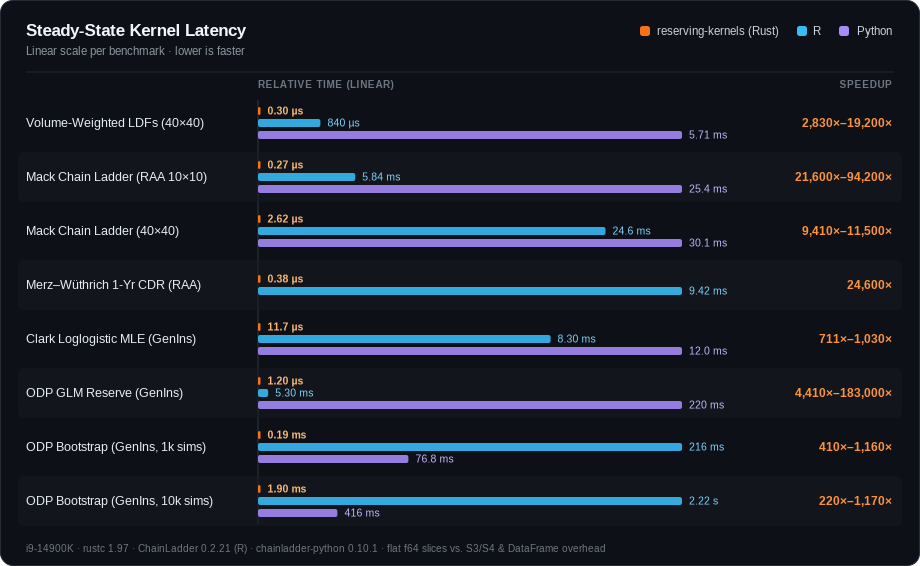
| Benchmark | reserving-kernels |
R ChainLadder |
chainladder-python |
vs. R | vs. Python |
|---|---|---|---|---|---|
| Volume-Weighted LDFs (40×40) | 0.30 µs | 840 µs | 5,710 µs | 2,830× | 19,250× |
| Mack Chain Ladder (RAA 10×10) | 0.27 µs | 5,840 µs | 25,446 µs | 21,620× | 94,200× |
| Mack Chain Ladder (40×40) | 2.62 µs | 24,650 µs | 30,077 µs | 9,410× | 11,480× |
| Merz–Wüthrich 1-Yr CDR (RAA) | 0.38 µs | 9,420 µs | — | 24,580× | — |
| Clark Loglogistic MLE (GenIns) | 11.7 µs | 8,300 µs | 12,026 µs | 711× | 1,030× |
| ODP GLM Reserve (GenIns) | 1.20 µs | 5,300 µs | 219.6 ms | 4,410× | 182,860× |
| ODP Bootstrap (GenIns, 1k sims) | 0.19 ms | 216.5 ms | 76.8 ms | 1,160× | 410× |
| ODP Bootstrap (GenIns, 10k sims) | 1.90 ms | 2,223 ms | 416.2 ms | 1,170× | 220× |
Additional i9-14900K Rust kernel latencies (20 more kernels in benches/kernels.rs)
| Kernel | Median (i9-14900K) |
Domain |
|---|---|---|
| Excess Layers Lookup (65k sims) | 34.6 ns | excess |
| ODP Fit (GenIns 10×10) | 0.73 µs | stochastic |
| General Multivariate CL (GMCL, 2-line 10×10) | 3.32 µs | stochastic |
| Merz–Wüthrich 1-Yr CDR (40×40) | 4.56 µs | stochastic |
| Paid–Incurred Chain (Friedland 10×10) | 6.94 µs | stochastic |
| Coherent TVaR (10k scenarios) | 9.83 µs | capital |
| Panjer Recursion (512 steps) | 13.9 µs | capital |
| Double Chain Ladder (40×40) | 15.4 µs | deterministic |
| PTF Log-Linear Regression (GenIns 10×10) | 16.9 µs | stochastic |
| Reserve Distribution Summary (10k scenarios) | 19.3 µs | capital |
| Multivariate Mack (2-line 40×40) | 22.3 µs | stochastic |
| Clark Weibull MLE (GenIns 10×10) | 25.9 µs | stochastic |
| Kalman State-Space Filter (GenIns 10×10) | 26.7 µs | stochastic |
| Gamma GLM Reserve (GenIns 10×10) | 87.3 µs | stochastic |
| Tilted Radix-2 FFT Aggregate Loss (4,096 pts) | 122 µs | capital |
| Euler TVaR Capital Allocation (10k × 5 lines) | 129 µs | capital |
| Myers–Read Allocation (10k × 5 lines) | 168 µs | capital |
| Synchronized Multi-Line ODP Bootstrap (2-line, 500 sims) | 191 µs | capital |
| ODP 1-Yr CDR Bootstrap (GenIns, 1k sims) | 226 µs | stochastic |
| Iman–Conover Rank Correlation (2k × 3 lines) | 314 µs | capital |
| Individual-Claim Micro-Reserving (1k sims) | 1.57 ms | stochastic |
Note: reserving-kernels operates directly on validated f64 slices with reusable scratch space, whereas the R and Python libraries carry DataFrame and S3/S4 object overhead. All point estimates and Mack / Merz–Wüthrich standard errors were verified for numerical parity before timing.
Kernels are tested against published actuarial datasets and closed-form mathematical identities:
- Worked example: Mack Chain-Ladder in Rust: A Worked Example reproduces Mack (1993) Table 2 on the RAA 10×10 triangle cell-for-cell (
cargo run --example mack_raa). - Benchmark triangles: Mack (1993) RAA, Taylor & Ashe / England & Verrall GenIns, Friedland US Industry Auto, and Quarg & Mack (2004).
- 1-Year Solvency & Sub-Annual Parity: England, Verrall & Wüthrich (2019) Table 2 fixed-history 1-year re-reserving (
stochastic::reserve_runoff) and Robbin (2018) SWIMON equilibrium IBNR monotonicity (subannual). - Exact identities: Merz–Wüthrich multi-year run-off summing to Mack ultimate MSEP; ODP GLM matching exact analytical leverages and dispersion; Panjer vs. FFT aggregate loss agreement; and full-allocation conservation for Euler TVaR and Myers–Read.
Full citations and equation mappings live in docs/SOURCES.md; parity tests live in tests/source_benchmarks.rs.
# Run unit, integration, doctest, and benchmark-parity tests
cargo test --all-targets --all-features
cargo test --doc --all-features

# Run the Mack (1993) RAA worked example or JSON exhibit example
cargo run --example mack_raa
cargo run --example export_exhibit

# Run Criterion benchmarks (benches/kernels.rs & benches/triangle_algebra.rs)
cargo bench --bench kernels -- --save-baseline main
cargo bench --bench kernels -- --baseline main

# Profile a specific kernel under release optimization (requires samply)
samply record cargo bench --bench kernels -- glm_odp_genins --profile-time 5

# Build for WebAssembly
cargo build --release --target wasm32-unknown-unknown --features wasmLicensed under either of MIT or Apache-2.0 at your option.