一个面向 Codex CLI 工作流的 Remote Notifier 非官方增强分支。
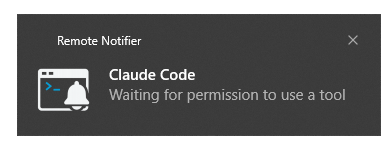
核心使用场景:Codex 可以运行在 Remote SSH 连接的 Linux 服务器上,但“任务完成”、 “等待回答”、“计划完成”和“等待授权”等提醒会通过 VS Code Router 回传,并显示在你正在使用的 本机 Windows 10/11 上。即使 VS Code 被浏览器或其他窗口遮挡,也能收到持续显示的 Windows 系统通知,不需要一直盯着远端终端。同时也支持完全在本机使用:Codex、Router 和通知扩展 都运行在同一台 Windows 电脑上,无需配置 SSH。通知不只是提醒:点击后会返回产生通知的 VS Code 窗口,并聚焦原本已经存在的 Codex session,不会另开一个对话。
本项目 fork 自 ripper37/remote-notifier,
当前增强工作基于上游 v1.0.1。项目保留了上游的 MIT 许可证、完整 Git 历史,
以及本机 Presenter + 工作区 Router 的核心架构。
特别感谢原作者 Damian Dyńdo (@ripper37) 创建并开源 Remote Notifier。其跨本机、Remote SSH、WSL 和容器的通知路由设计,为本 fork 的 Codex 特化提供了可靠基础。
本 fork 由社区独立维护,与原作者及 OpenAI 均无隶属关系。上游项目的原始功能和 完整说明请参阅原仓库。
本 fork 不修改 Codex 本体,而是在用户级安装 Hook,将需要注意的生命周期事件通过 Remote Notifier 显示为本机系统通知。
| Codex 场景 | 通知标题 | 触发条件 |
|---|---|---|
| 普通回答结束 | [任务完成] |
Default 模式中的 Stop |
| 等待用户回答 | [等待回答] |
PreToolUse(request_user_input) |
| Plan 模式暂时停止 | [计划继续] |
Plan 模式停止,但尚未产生完整结构化计划 |
| 完整计划生成 | [计划完成] |
检测到结构化 Plan item 或 <proposed_plan> |
| 等待工具授权 | [等待授权] |
PermissionRequest |
此外还增加了以下能力:
- 根据
session_id从 Codex 状态数据库或session_index.jsonl读取重命名后的会话名。 - 通知正文显示主机名、会话名和回答摘要;未重命名时直接显示回答摘要。
- 可配置摘要长度,默认截取前 16 个可见字符,并正确处理中文和组合字符。
- 从 transcript 中识别结构化计划,避免把完整计划误判成普通任务完成。
- Codex 事件按 session、turn 和事件类型去重,不受通用突发通知限流影响。
- Hook 最多运行 3 秒;Codex 事件通过 Router 的异步确认端点发送,Windows Toast 在后台继续处理, 通知失败仍以成功状态退出,不阻塞 Codex,也不改变授权结果。
- Windows 上使用原生 reminder 场景,通知会保留到用户点击或关闭为止。
- 点击通知会回到产生该通知的 VS Code 窗口,并聚焦承载该 Codex session 的既有集成终端; 不会创建新对话。
- 多个 VS Code 窗口各自保存工作区 Router 记录;即使旧终端仍持有重载前的端口,Helper 也会按
Hook 的
cwd找回对应工作区,不会把通知回退给最近打开的其他窗口。 - 主扩展和 Router 使用独立扩展 ID,避免被 Marketplace 上游版本自动覆盖。
- Hook 仅执行本地脚本和本地路由,不增加模型上下文,也不消耗额外模型 token。
这是本 fork 的核心增强之一。 Windows 通知不仅告诉你 Codex 已经停下来,还保存了产生通知的
VS Code 窗口、工作区、session_id 和集成终端映射。无论 Codex 在本机 Windows 运行,还是在
VS Code Remote SSH 连接的 Linux 服务器运行,点击通知都会尝试:
- 将产生通知的 VS Code 窗口切回前台。
- 找到该
session_id原本所在的集成终端。 - 显示并聚焦这个已有终端,不启动新的 Codex 对话。
会话 rename 只影响通知中的显示名称,不影响跳转依据。多个 VS Code 窗口使用独立 Focus Broker 和 Router 命令;窗口重载后,Helper 还会通过工作区会话文件恢复到新的 Router 端口,避免把点击 送到最近打开但不相关的窗口。如果原窗口或终端已经真正关闭,扩展会明确提示无法定位,不会静默 打开错误的 session。
- Windows 10/11 本机工作流已经完成自动化测试和手动端到端验证。
- Linux Remote SSH 到本机 Windows 的通知、三秒 Hook、已有终端映射和点击聚焦已经完成实机 端到端验证;点击后服务器 Router 日志确认聚焦到通知对应的命名 Codex 终端。
- 精确终端跳转已经实现:Hook 采集父进程链,Router 将
session_id映射到对应终端, 每个 VS Code 窗口使用独立的本机回环 broker 接收点击事件;每个 Router 实例还会生成 唯一的聚焦命令,避免多窗口中的同名命令被路由到错误工作区。 - 原窗口或终端已经关闭且无法恢复映射时,会聚焦当前 VS Code 并明确提示无法定位, 不会静默跳到错误终端。
- 不同 SSH 主机和复杂多窗口组合仍建议在首次安装后各做一次点击验证;核心 Remote SSH 链路 已不再只是自动化测试状态。
Remote Notifier Codex 包含两个 VS Code 扩展和一个轻量 Hook:
Codex CLI
  -> ~/.local/bin/codex-attention-hook
  -> 工作区侧 Remote Notifier Codex Router
  -> 本机侧 Remote Notifier Codex
  -> Windows 系统通知

点击 Windows 通知
  -> 顶层 VS Code URI Handler
  -> 产生通知的窗口侧 127.0.0.1 Focus Broker
  -> 通知指定的唯一工作区 Router 命令
  -> 对应的既有集成终端
- Remote Notifier Codex:UI 扩展,在本机显示 VS Code 或系统通知。
- Remote Notifier Codex (Router):工作区扩展,在本地或远端接收 Hook 请求并路由通知。
- codex-attention-hook:Python helper,读取 Codex Hook JSON、解析会话信息并发送通知。
上游提供的 code-notify CLI、HTTP 通知接口、图标映射、自定义声音以及
Claude Code/Gemini CLI 自动配置仍然保留。
- Windows 10/11 用于本机系统通知。
- VS Code
1.85.0或更高版本。 - Node.js 20+ 与 npm 10+,仅在参与项目开发时需要。
- Codex CLI
0.144.3或更高版本。 - Remote SSH 场景中的远端 Linux 需要 Python 3。
本项目是 VS Code 扩展,不是 npm 命令行包。目前尚未发布到 VS Code Marketplace,
因此其他用户应安装构建好的 VSIX,而不是执行 npm install:
- 从本仓库的 Releases
下载同一版本中的两个文件:
remote-notifier-codex-*.vsixremote-notifier-codex-router-*.vsix
安装位置取决于使用场景:
| 场景 | Remote Notifier Codex(Presenter) | Codex Router |
|---|---|---|
| 纯本机使用 | 安装在 Local |
安装在 Local |
| Remote SSH | 安装在本机 Windows 的 Local |
安装在 SSH: <服务器名> 的远端 |
Remote SSH 场景下,Router 和 Hook 在服务器侧接收 Codex 事件;Presenter 留在本机 Windows, 负责显示系统通知。两端缺少任意一个扩展都无法完成服务器到 Windows 的通知链路。
先在 PowerShell 中进入两个 VSIX 文件所在的下载目录。纯本机场景只需执行:
code --install-extension .\remote-notifier-codex-1.0.4.vsix --force
code --install-extension .\remote-notifier-codex-router-1.0.10.vsix --force
Remote SSH 场景使用下面两条命令。将 YOUR_SSH_HOST 替换为 Windows
%USERPROFILE%\.ssh\config 中的 Host 别名,例如 public_jclou_4090_server:
# Presenter 安装到 Windows 本机
code --install-extension .\remote-notifier-codex-1.0.4.vsix --force

# Router 安装到指定 SSH 主机
code --remote ssh-remote+YOUR_SSH_HOST --install-extension `
  .\remote-notifier-codex-router-1.0.10.vsix --force
普通的 code --install-extension 安装到本机;增加
--remote ssh-remote+YOUR_SSH_HOST 后,扩展才会安装到对应服务器。--force 可以覆盖已经安装的
同版本 VSIX,适合安装修复后但版本号未变化的构建。第一次使用某个 SSH 主机时,请先在 VS Code
中成功连接一次,再执行远端安装命令。
两条命令执行成功后:
- 打开对应的本机或 Remote SSH 窗口。
- 按
Ctrl+Shift+P,执行Developer: Reload Window(中文界面为开发人员: 重新加载窗口)。Remote SSH 窗口需要等待重新连接服务器;不要刷新 浏览器页面。 - 关闭安装前打开的旧终端,执行
Terminal: Create New Terminal,再从新终端启动 Codex。
不方便使用命令行时,可以按以下简化流程安装:
- 按
Ctrl+Shift+P,执行Extensions: Install from VSIX...。纯本机使用时在本机窗口安装两个 VSIX;Remote SSH 使用时在本机窗口安装 Presenter,再在SSH: <服务器名>窗口安装 Router。 - 检查扩展位置:Presenter 应为
Local,Router 应为Local或当前的SSH: <服务器名>。 - 在最终使用的窗口中按
Ctrl+Shift+P,执行Developer: Reload Window。 - 窗口重新打开后新建集成终端,再继续配置 Codex 通知。
- 确认已经按上一节重新加载 VS Code 窗口,并在重新加载后新建了集成终端。
- 按
Ctrl+Shift+P打开命令面板,输入并执行Remote Notifier: Auto-configure notifications in current workspace for...。 - 选择
Codex。 - 如果 Codex 是在配置 Hook 之前启动的,请退出并从新终端重新启动或恢复 Codex session。
- Codex 首次检测到新 Hook 时,核对命令路径后进行一次信任审核。
Router 会把 helper 安装到:
~/.local/bin/codex-attention-hook
并在 $CODEX_HOME/hooks.json 中幂等添加 Stop、PreToolUse 和
PermissionRequest Hook。默认 CODEX_HOME 为 ~/.codex。
已重命名的会话:
主机名 · 会话名 · 回答前 16 个可见字符
未重命名的会话:
主机名 · 回答前 16 个可见字符
| 设置 | 默认值 | 说明 |
|---|---|---|
remoteNotifier.systemNotifications |
always |
Codex 增强构建默认始终使用系统通知 |
remoteNotifier.codexPersistentNotifications |
true |
Windows Codex 通知持续显示到点击或关闭 |
remoteNotifier.codexPreviewLength |
16 |
会话名和回答摘要的最大可见字符数 |
remoteNotifier.notificationSound |
true |
是否播放系统通知声音 |
remoteNotifier.notificationSoundPath |
"" |
可选的自定义声音路径 |
remoteNotifier.iconMappings |
{} |
将通知图标键映射到本地图片路径 |
| 命令 | 用途 |
|---|---|
Remote Notifier: Auto-configure notifications in current workspace for... |
安装或更新 Codex Hook |
Remote Notifier: Remove Codex notification hooks |
干净移除本 fork 管理的 Hook 和 helper |
Remote Notifier: Test system notifications |
测试系统通知 |
Remote Notifier: Test VS Code notifications |
测试 VS Code 内通知 |
Remote Notifier: Show Session Info |
查看 Router 地址和脱敏 token |
仍可使用上游的 code-notify 命令发送任意通知:
code-notify "Build completed"
code-notify "Build" "Completed successfully"
code-notify -i ICON_CI -d system "CI" "Pipeline passed"
Router 只监听 127.0.0.1,使用随机 bearer token 验证请求。会话信息保存在
~/.remote-notifier/sessions/ 下的工作区独立文件中,并保留
~/.remote-notifier/session.json 作为旧版本兼容入口;这些信息不会经过外部通知服务。
npm run format:check
npm run lint
npm run typecheck
npm test
npm run package
当前测试基线为 243 项全部通过。
本项目遵循 MIT License。再次感谢 ripper37/remote-notifier 原作者及贡献者的工作。
An unofficial Remote Notifier fork specialized for Codex CLI workflows.
Primary use case: Codex may run on a Linux server through VS Code Remote SSH, while task-completed, answer-needed, plan-completed, and permission notifications are routed back to the local Windows 10/11 desktop. Persistent Windows notifications remain visible even when a browser or another window covers VS Code, so the remote terminal does not require constant attention. The extension also supports a fully local setup, with Codex, the Router, and notifications all running on the same Windows machine without SSH.
Notifications are actionable, not display-only: clicking one returns to the VS Code window that produced it and focuses the existing Codex session instead of opening a new conversation.
This project is forked from
ripper37/remote-notifier, with the
current enhancements based on upstream v1.0.1. It preserves the upstream MIT
license, complete Git history, and the local Presenter + workspace Router
architecture.
Special thanks to Damian Dyńdo (@ripper37) for creating and open-sourcing Remote Notifier. Its routing design across local workspaces, Remote SSH, WSL, and containers provides the foundation for the Codex-specific features in this fork.
This is an independently maintained community fork and is not affiliated with the upstream author or OpenAI. See the upstream repository for the original project and documentation.
This fork does not modify Codex. It installs user-level hooks that route attention-worthy lifecycle events through Remote Notifier.
| Codex scenario | Notification | Trigger |
|---|---|---|
| Normal response completed | [任务完成] |
Stop in Default mode |
| Waiting for an answer | [等待回答] |
PreToolUse(request_user_input) |
| Plan paused without a final plan | [计划继续] |
Stop in Plan mode without a structured plan |
| Complete plan produced | [计划完成] |
Structured Plan item or <proposed_plan> detected |
| Waiting for tool permission | [等待授权] |
PermissionRequest |
Additional enhancements include:
- Resolving renamed Codex sessions from the state database or
session_index.jsonlusingsession_id. - Showing the host, renamed session, and final-answer preview in each notification, with a direct answer preview for unnamed sessions.
- Configurable Unicode-aware preview truncation, defaulting to 16 visible characters.
- Transcript-based structured Plan detection.
- Deduplication by session, turn, and event without the generic burst limit.
- A three-second hook timeout backed by an asynchronous Router acknowledgement, so Windows presentation continues in the background and notification failures never block Codex or affect permission decisions.
- Persistent Windows reminder notifications that remain until opened or dismissed.
- Notification clicks that return to the originating VS Code window and focus the existing integrated terminal that owns the Codex session, without creating a new conversation.
- Workspace-scoped Router records for multi-window recovery. If an existing
terminal still has a pre-reload port, the helper matches the hook
cwdto the correct workspace instead of falling back to the most recently opened window. - Independent extension IDs that cannot be overwritten by the Marketplace versions.
- Local-only hook processing with no additional model context or token usage.
This is a core enhancement in this fork. A Windows notification retains
the originating VS Code window, workspace, session_id, and integrated
terminal mapping. Whether Codex runs locally on Windows or on Linux through VS
Code Remote SSH, clicking the notification attempts to:
- Bring the originating VS Code window to the foreground.
- Locate the integrated terminal that already owns the
session_id. - Reveal and focus that terminal without starting a new Codex conversation.
Renaming a session changes only its displayed label, not its routing identity. Per-window focus brokers and unique Router commands prevent another VS Code window from claiming the click. After a window reload, workspace-scoped session files lead existing terminals to the refreshed Router port. If the originating window or terminal is genuinely closed, the extension reports that it cannot be located instead of silently opening the wrong session.
- The Windows 10/11 local workflow has automated coverage and manual end-to-end testing.
- The Linux Remote SSH to local Windows path has completed live end-to-end validation, including the three-second hook, existing-terminal mapping, and a notification click confirmed by the server Router to focus the matching named Codex terminal.
- Exact terminal navigation is implemented by matching the hook's process
ancestry to a VS Code terminal process and mapping it to
session_id. A per-window loopback broker routes clicks back to the originating window, and a unique command generated by each Router instance prevents multi-window command dispatch from selecting another workspace. - If the original window or terminal is already closed and its mapping cannot be restored, the extension focuses the current VS Code window and reports that the terminal could not be located instead of selecting the wrong one.
- New SSH hosts and complex multi-window combinations should still receive one click-through check after installation, but the core Remote SSH path is no longer validated only by automated tests.
Codex CLI
  -> ~/.local/bin/codex-attention-hook
  -> Remote Notifier Codex Router in the workspace
  -> Remote Notifier Codex on the local UI side
  -> Windows system notification

Windows notification click
  -> topmost VS Code URI handler
  -> 127.0.0.1 focus broker in the originating window
  -> unique command for the originating workspace Router
  -> matching existing integrated terminal
- Remote Notifier Codex is the local UI extension that presents VS Code or operating-system notifications.
- Remote Notifier Codex (Router) runs with the workspace, locally or remotely, and routes hook requests.
- codex-attention-hook is a Python helper that parses Codex hook JSON, resolves session metadata, and sends the notification.
The upstream code-notify CLI, HTTP endpoint, icon mappings, custom sounds,
and Claude Code/Gemini CLI auto-configuration remain available.
- Windows 10/11 for local system notifications.
- VS Code 1.85.0 or later.
- Node.js 20+ and npm 10+ only for project development.
- Codex CLI 0.144.3 or later.
- Python 3 on a remote Linux host when using Remote SSH.
This project contains VS Code extensions, not npm command-line packages.
It has not yet been published to the VS Code Marketplace, so users should
install built VSIX packages rather than run npm install:
- Download both files from the same entry under this repository's
Releases:
remote-notifier-codex-*.vsixremote-notifier-codex-router-*.vsix
Install each extension in the appropriate location:
| Scenario | Remote Notifier Codex (Presenter) | Codex Router |
|---|---|---|
| Local only | Install under Local |
Install under Local |
| Remote SSH | Install under Windows Local |
Install under SSH: <host> |
With Remote SSH, the Router and hook receive Codex events on the server, while the Presenter remains on the Windows machine and displays the system notification. Both sides are required for the server-to-Windows path.
First, change to the download directory containing both VSIX files. For a local-only setup, run:
code --install-extension .\remote-notifier-codex-1.0.4.vsix --force
code --install-extension .\remote-notifier-codex-router-1.0.10.vsix --force
For Remote SSH, replace YOUR_SSH_HOST with a Host alias from the Windows
%USERPROFILE%\.ssh\config file, such as public_jclou_4090_server:
# Install the Presenter on Windows
code --install-extension .\remote-notifier-codex-1.0.4.vsix --force

# Install the Router on the specified SSH host
code --remote ssh-remote+YOUR_SSH_HOST --install-extension `
  .\remote-notifier-codex-router-1.0.10.vsix --force
Plain code --install-extension installs locally. The
--remote ssh-remote+YOUR_SSH_HOST argument is what installs the Router on the
server. --force replaces an already installed VSIX with the same version,
which is useful for patched builds that do not change their version number. If
this is the first time the host is used, connect to it successfully from VS
Code once before running the remote installation command.
After both commands succeed:
- Open the relevant local or Remote SSH window.
- Press
Ctrl+Shift+Pand runDeveloper: Reload Window. Wait for a Remote SSH window to reconnect; do not refresh a browser page. - Close terminals opened before installation, run
Terminal: Create New Terminal, and start Codex from the new terminal.
If the command line is unavailable, use this shorter interface workflow:
- Press
Ctrl+Shift+Pand runExtensions: Install from VSIX.... For local use, install both files in the local window. For Remote SSH, install the Presenter in a local window and the Router in theSSH: <host>window. - Verify that the Presenter is under
Localand that the Router is under eitherLocalor the intendedSSH: <host>. - In the window that will be used, press
Ctrl+Shift+Pand runDeveloper: Reload Window. - Create a new integrated terminal after the window reloads, then configure Codex notifications.
- Confirm that the VS Code window has been reloaded and that a new integrated terminal was created after the reload.
- Press
Ctrl+Shift+Pand runRemote Notifier: Auto-configure notifications in current workspace for.... - Select
Codex. - If Codex was running before the hook was configured, exit it and start or resume the session from the new terminal.
- Review and trust the hook once when Codex first detects it.
The Router installs the helper at:
~/.local/bin/codex-attention-hook
It idempotently adds Stop, PreToolUse, and PermissionRequest hooks to
$CODEX_HOME/hooks.json. CODEX_HOME defaults to ~/.codex.
Renamed session:
host · session name · first 16 visible characters of the answer
Unnamed session:
host · first 16 visible characters of the answer
| Setting | Default | Description |
|---|---|---|
remoteNotifier.systemNotifications |
always |
Always use system notifications in this enhanced build |
remoteNotifier.codexPersistentNotifications |
true |
Keep Windows Codex notifications visible until opened or dismissed |
remoteNotifier.codexPreviewLength |
16 |
Maximum visible characters for session names and answer previews |
remoteNotifier.notificationSound |
true |
Play the system notification sound |
remoteNotifier.notificationSoundPath |
"" |
Optional custom sound path |
remoteNotifier.iconMappings |
{} |
Map notification icon keys to local image paths |
| Command | Purpose |
|---|---|
Remote Notifier: Auto-configure notifications in current workspace for... |
Install or update Codex hooks |
Remote Notifier: Remove Codex notification hooks |
Remove hooks and the helper owned by this fork |
Remote Notifier: Test system notifications |
Test operating-system notifications |
Remote Notifier: Test VS Code notifications |
Test in-app notifications |
Remote Notifier: Show Session Info |
Show the Router URL and masked token |
The upstream code-notify command remains available:
code-notify "Build completed"
code-notify "Build" "Completed successfully"
code-notify -i ICON_CI -d system "CI" "Pipeline passed"
The Router binds only to 127.0.0.1 and authenticates requests with a random
bearer token. Session information remains in workspace-scoped files under
~/.remote-notifier/sessions/, with ~/.remote-notifier/session.json retained
for backward compatibility, and is not sent through an external notification
service.
npm run format:check
npm run lint
npm run typecheck
npm test
npm run package
The current test baseline is 243 passing.
This project is distributed under the MIT License. Thanks again to the authors and contributors of ripper37/remote-notifier.