



I design PCBs, embedded systems, and modular server hardware in Norfolk, UK.


|
|
|
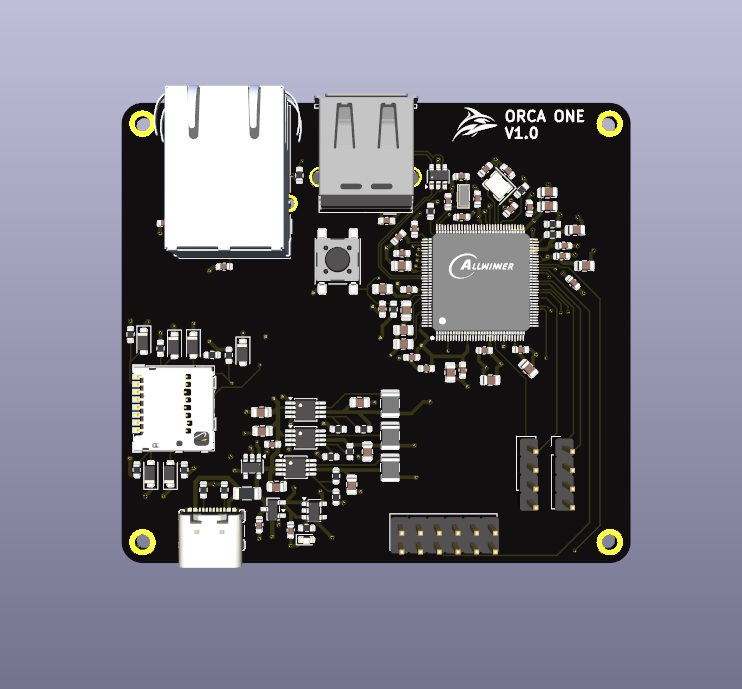
Orca One V1.0 Custom Allwinner V3s Linux SBC |
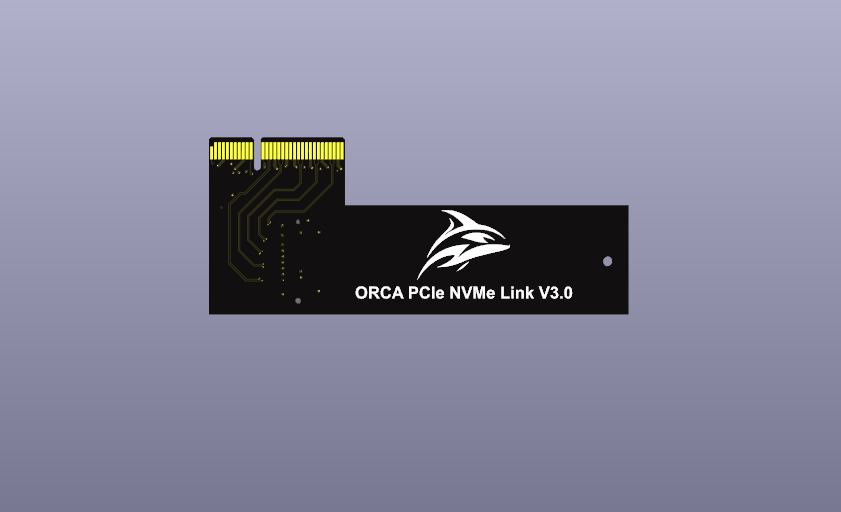
ORCA PCIe NVMe Link V3.0 Custom PCIe x4 to M.2 NVMe expansion board |
Orca One is my custom Linux single-board computer built around the Allwinner V3s. I designed the schematic, four-layer PCB, power system, external interfaces, and manufacturing package from scratch as the first complete board in the ORCA hardware platform.
| Processor | Allwinner V3s ARM SoC |
| Board | Custom four-layer PCB designed in KiCad 9 |
| Connectivity | Ethernet, USB-A 2.0, MicroSD, UART, GPIO, and fan control |
| Power | USB-C input with onboard 3.3 V, 3.0 V, 1.8 V, 1.2 V, and 1.1 V rails |
| Current stage | Design complete; preparing for fabrication and bring-up |
Explore the complete Orca One project →
The PCIe NVMe Link is a compact storage-expansion board that connects an M.2 NVMe drive through a custom PCIe x4 edge interface. It is an early ORCA storage module and a practical test platform for PCIe routing, M.2 connectivity, and modular expansion.
| Host interface | PCIe x4 PCB edge connector |
| Storage | M.2 M-key NVMe socket |
| Design | Custom schematic and PCB layout |
| Current stage | Design and 3D review complete; preparing for prototyping |
Explore the ORCA PCIe NVMe Link project →
ORCA is a growing family of custom computing hardware designed as interoperable modules rather than one fixed motherboard.
Compute ─┐
Compute ─┼── Backplane ─── I/O
Storage ─┤       │
Fabric  ─┘    Control
                │
              Power
| Project | Purpose | Stage |
|---|---|---|
| Orca One | Complete V3s Linux SBC and hardware bring-up platform | Preparing for fabrication |
| ORCA PCIe NVMe Link | PCIe x4 to M.2 NVMe storage expansion board | Design and 3D review complete |
| ORCA OS | Linux software and board-support work for ORCA hardware | Early development |
| ORCA modular server | Compute, control, power, I/O, backplane, fabric, and storage architecture | Architecture and prototyping |
- Schematic capture and PCB layout
- Power distribution and multi-rail board design
- High-speed storage and interconnect hardware
- Embedded Linux board support and bring-up
- Modular compute and server architecture
- Manufacturing outputs, BOM preparation, and prototype testing
Orca One
├── Schematic and PCB       complete
├── Manufacturing package  complete
├── Prototype fabrication  next
├── Assembly and power-up   pending
├── Linux boot              pending
└── Interface validation    pending
I document ORCA as it develops—from design decisions and PCB revisions to fabrication, assembly, and Linux bring-up.
Support is voluntary and goes toward PCB fabrication, components, assembly, engineering review, and hardware testing. It is not a pre-order or investment.
ORCA design files are made public for project review and funding requirements. Individual repositories state their applicable licensing terms; Orca One is proprietary and all rights are reserved.