
UNIVERSITY OF WEST ATTICA
SCHOOL OF ENGINEERING
DEPARTMENT OF COMPUTER ENGINEERING AND INFORMATICS
University of West Attica · Department of Computer Engineering and Informatics
Computer Networks II
Vasileios Evangelos Athanasiou
Student ID: 19390005
Supervision
Supervisor: Adonis Bogris, Professor
Co-supervisor: Rania Garofalaki, Laboratory Teaching Staff
Athens, May 2022
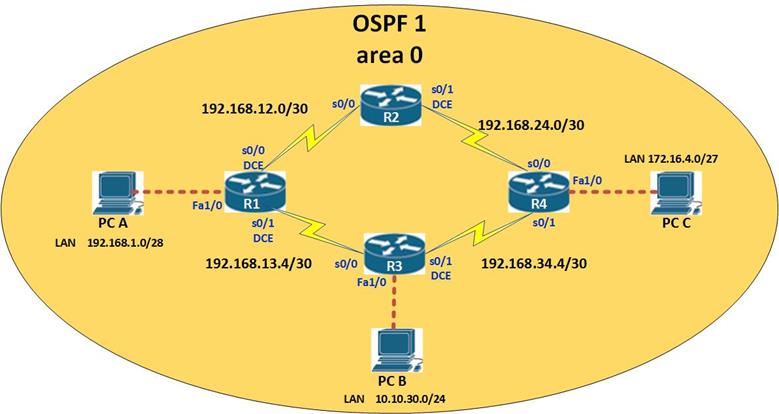
The primary objective of this project was to establish full IP connectivity within Autonomous System (AS) 20 using the OSPF routing protocol.
The network architecture was designed using multiple OSPF areas:
- Area 0 (Backbone Area)
- Area 10
- Area 20
These areas are interconnected through Area Border Routers (ABRs), ensuring proper inter-area routing and adherence to OSPF hierarchical design principles.
| Section | Folder / File | Description |
|---|---|---|
| 1 | assign/ |
Assignment material |
| 1.1 | assign/OSPF - homework_NetworksII.pdf |
Assignment description in English |
| 1.2 | assign/OSPF - homework_ΔίκτυαΙΙ.pdf |
Assignment description in Greek |
| 2 | docs/ |
Project documentation |
| 2.1 | docs/OSPF_Routing.pdf |
OSPF routing analysis and configuration (English) |
| 2.2 | docs/OSPF_Δρομολόγηση.pdf |
OSPF routing analysis and configuration (Greek) |
| 3 | src/ |
Source files |
| 3.1 | src/OSPF.pkt |
Cisco Packet Tracer topology and OSPF configuration |
| 4 | README.md |
Project documentation |
| 5 | INSTALL.md |
Usage instructions |
OSPF was configured on each router by defining:
- A process ID
- A unique Router ID
- The participating subnets and their corresponding OSPF areas
- R1:
1.1.1.1 - ABR2:
2.2.2.2 - ABR3:
3.3.3.3 - R4:
4.4.4.4 - R5:
5.5.5.5
The following Cisco IOS CLI commands were used during router configuration:
-
router ospf <process-id>
Initiates the OSPF routing process. -
router-id <address>
Assigns a unique identifier to the router. -
network <ip-address> <wildcard-mask> area <area-id>
Specifies which interfaces and subnets participate in OSPF and assigns them to the appropriate area. -
passive-interface <interface>
Configured on R4 and R5 (interfaceFastEthernet0/1) to prevent the transmission of OSPF updates toward non-router end devices.
To improve routing efficiency and reduce the size of routing tables, inter-area route summarization was implemented on the ABRs.
-
Area 10 Summary:
172.16.32.0/23
(Summarizes172.16.32.0/24and172.16.33.0/24) -
Area 20 Summary:
174.18.30.0/23
(Summarizes174.18.30.0/24and174.18.31.0/24) -
Area 0 Summary:
173.17.36.0/22
(Summarizes173.17.37.0/24,173.17.38.0/24, and173.17.39.0/24)
The following commands were used to verify the correct operation of OSPF:
-
show running-config
Confirms the applied OSPF configuration. -
show ip route
Displays the routing table and verifies inter-area (O IA) routes. -
show ip ospf neighbor
Examines OSPF neighbor relationships and adjacency states (e.g., FULL/DR, FULL/BDR). -
show ip ospf database
Inspects the Link State Database (LSDB) and the different LSA types.