






- Table of contents
- Changelog
- Highlights
- Quick Start
- Configure your first provider
- Example: write a Skill
- Reusable roles and progressive Skill discovery
- Interactive prompts with
ask_user - AGUI — Inline Interactive Components
- Sidebar browser
- Memory file format
- Agent memory controls
- Architecture at a glance
- Project structure
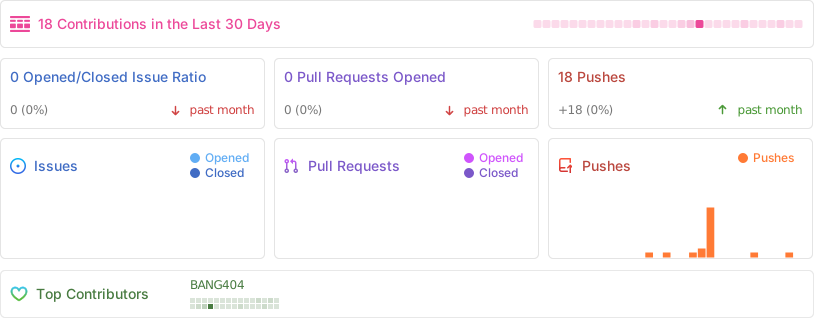
- Repository activity
- Contributors
- Contributing
- Observability (optional)
- Agent runtime real-model tests
- Further reading
- License
See CHANGELOG.md for release history and fixes.
- Multi-Agent & Flash Agents Architecture — A primary streaming Chat Agent for main conversations, and a suite of dedicated async Flash Agents (including Memory Agent for long-term memory synthesis, Title Agent for dynamic conversation renaming, and Hook Agent for background scheduled tasks).
- Sub-Agent Delegation — The Chat Agent can call
spawn_agentto delegate tasks to nested sub-agents; progress streams in real-time into a sub-conversation shown nested under the parent in the sidebar. - Reusable Agent Roles — Create global role workflows, discover them with hybrid search, and dispatch them as specialized child agents. Roles can be created automatically on first use or managed from the Roles panel.
- Goal & Graph Loops (Autonomous Execution) — Type
/goalin the chat to run a self-correcting loop directly aiming at the objective. Type/graphto first plan a structured DAG task graph (create_goal_graph_config) and execute nodes asynchronously with parallel processing. The selected branch's durable checkpoint drives an auto-opening, resizable right panel for Goal to-dos and Graph node dependencies. - Hybrid Long-Term Memory — SQLite + FTS5 + bundled, offline 384-dim embeddings (fastembed
AllMiniLML6V2Q) blended with time decay for cross-session recall. Before retrieval, an optional Flash task rewrites the latest message into a focused semantic query, so stored memories are matched to intent rather than just wording. - Interactive User Prompts (
ask_user) — The agent can pause mid-task and surface a structured form to the user —text,select,checkbox_group,confirm,date, and more. The agent blocks until the user responds, then continues with the collected values. No more one-shot guessing on ambiguous instructions.
- AGUI — Inline Interactive Components — The agent can embed file and URL capsules, ECharts visualisations, source-line previews, and image/video media directly in its prose — all rendered live by the streamdown engine.
- Sidebar Browser — Open the right sidebar to visit HTTP(S) websites with an address bar, back/forward navigation, refresh, and a system-browser shortcut without adding webpage tool cards to the transcript.
- Validated Mermaid Rendering — A dedicated render tool validates Mermaid source before presenting the diagram, while keeping the source available and supporting fullscreen inspection.
- MCP-Native — Connect external MCP servers over HTTP or stdio; tools are injected into the agent at call time.
- First-class Dev Tools — Built-in file, search, and terminal tools. Managed terminal sessions support interactive or long-running background processes.
- Independent Approval & Runtime Permissions — Choose when tool calls pause for review separately from the managed filesystem and network sandbox.
- Skills System — Drop a
SKILL.mdinto~/.agents/skills/or<workspace>/.agents/skills/. Category-based progressive discovery keeps large global and project catalogs compact, with optional Flash classification for uncategorized Skills. - Messaging Channels — Connect Feishu/Lark, Telegram, QQ, WeChat, Discord, or Slack from Settings → Channels. Each peer keeps its own workspace, model, role, and durable conversation, with commands for switching scope and replying to questions or approvals. See the channel integration skill.
- Checkpoints & File-Change Rollback — Every turn is a checkpoint with reverse diffs; undo a single file or rewind the whole agent.
- Pluggable LLMs & Multimodal — Support multi-model selection and durable image, PDF, and text attachments with drag/paste, rich previews, checkpoint restoration, and branch editing across Anthropic, OpenAI, and compatible providers.
- Context Compaction & Tree Conversations — Automatically or manually compact long conversations into tree structures to save tokens, preserving history lineage via search-based message recall.
- Responsive Conversation History — Search and paginate the sidebar, queue follow-up messages during a run, and navigate virtualized transcripts without loading the entire history into the DOM.
- Scheduled Chat Hooks — Define recurring or one-off tasks triggered in the background. Hooks are fully persistent, auto-restored on startup, and supported by system tray notifications.
- Project Drafts & Global/Local Scopes — Keep drafts, memory, and skills scoped globally (in
~/.openagent) or locally to your active workspace (in.agents/). - DESIGN.md & MDX Editor — Dedicated edit panel for
DESIGN.mdin your workspace, plus a rich markdown editor (MdxMarkdownEditor) integrated into memory and skill management. - Multi-Workspace Desktop Integration — Repeated app launches restore and focus the existing primary window instead of starting another primary instance. Open each workspace in a dedicated window, focus existing workspace windows instead of duplicating them, launch on startup, minimize to the system tray, and reveal workspace locations in the native file manager.
- Observability — Optional Langfuse tracing via OpenTelemetry (
gen_ai.*attributes). - Polished UI — Apple-style design language, streaming markdown, Mermaid & ECharts rendering, light/dark themes, i18n (zh / en).
Download the latest installer or app bundle from GitHub Releases. New users should choose the full bundle, which carries the local embedding seed; lightweight bundles download and verify it in the welcome window. Later automatic updates always use the lightweight application artifact and preserve the installed model. OpenAgent publishes separate beta, RC, and stable update channels; you can also check for updates manually from Settings.
To build from source instead, continue below.
| Tool | Version | Notes |
|---|---|---|
| Bun | latest | Package manager — used instead of npm / yarn |
| Rust | 1.70+ | Required for the Tauri backend |
| Node | 18+ | Used by the SvelteKit toolchain |
On Windows the Tauri prerequisites also include WebView2 and the MSVC build tools. See the official Tauri prerequisites for platform-specific setup.
git clone --recurse-submodules https://github.com/BANG404/openagent.git
cd openagent
bun install
The runtime SDK is a private submodule. Source builds require access to
BANG404/openagent-sdk and an SSH key accepted by GitHub. For an existing
checkout, initialize it with git submodule update --init --recursive before
installing or building.
The desktop Cargo workspace also pins the proxy-capable WebSocket forks
required by the audited Codex Windows sandbox revision used by the SDK. Keep
those root-level patches and the compatible blake3 lock aligned when
advancing the SDK gitlink; Cargo does not inherit patches from a transitive
workspace, and the sandbox policy parser requires its exact hashing version.
# Full Tauri desktop app (frontend + Rust backend)
bun tauri dev

# OR — frontend only (selects an available port, no Rust)
bun run dev
Development commands select an available loopback port. bun tauri dev passes that port to Vite so the desktop host and frontend always agree.
Debug desktop builds use ~/.openagent-dev by default, keeping development
configuration and data separate from an installed release. Set
OPENAGENT_HOME explicitly to use another development root.
bun run tauri:build       # lightweight installer and updater artifact
bun run tauri:build:full  # first-install bundle with embedding seed
The built installers / app bundle land in src-tauri/target/release/bundle/.
Windows builds produce the NSIS installer only; Linux and macOS retain their
native bundle targets. The release workflow signs and publishes the lightweight
build as the sole automatic updater input and uploads the full build under a
-full filename for manual first installation.
On Linux this command builds the pinned Codex Bubblewrap sidecar, strips it,
embeds its SHA-256 in the release binary, and packages the same bytes. Linux
source builds therefore also require libcap development headers, pkg-config,
and GNU strip (usually provided by binutils).
On first launch OpenAgent creates config.toml in its cross-platform user data root (~/.openagent on Linux, macOS, and Windows). Set OPENAGENT_HOME to override the complete root. Open Settings → Providers and add a provider, or edit the file directly; valid external edits hot-reload. See the configuration skill for atomic-save, backup, migration, and conflict behavior. Until an available model is configured, the composer keeps sending disabled and provides a Configure models shortcut to Settings.
config_version = 1

[[providers]]
id = "anthropic-main"
name = "Anthropic"
provider = "anthropic"
api_key = "sk-ant-..."
base_url = "https://api.anthropic.com"
enabled = true

[defaults]
chat_model   = { provider_id = "anthropic-main", model = "claude-sonnet-4-6" }
flash_model  = { provider_id = "anthropic-main", model = "claude-haiku-4-5" }
OpenAI-compatible endpoints (DeepSeek, OpenRouter, local Ollama, etc.) work the same — just point base_url at the right host and set provider = "openai". You may enter a host, a /v1 API root, or a full /chat/completions URL; OpenAgent normalizes it to the API root.
Use the approval selector in the conversation composer, or open Settings → General → Approval Mode, to control when agent tool calls pause for review. Approval defaults to Off and is independent from runtime permissions: approving a call never expands its filesystem or network capabilities.
| Mode | Behavior |
|---|---|
| Manual | Ask you to approve every tool call. |
| Automatic | A Flash task assesses the impact; important or uncertain calls still come to you for review. |
| Off | Run all tool calls without the approval flow. |
Use Settings → General → Execution Permissions & Sandbox for the actual confinement policy. The recommended managed profile offers workspace-writable, read-only, and advanced path-rule presets plus restricted or enabled networking. The default grants host-wide reads and workspace-scoped writes, keeps .git, .agents, and .codex read-only beneath broad writable roots, and restricts network access. External mode delegates isolation to the embedding host; disabled mode explicitly uses ambient process access and displays a warning. Managed terminal processes are isolated with Bubblewrap on Linux, Seatbelt on macOS, and the pinned Codex sandbox on Windows. Missing helpers or failed setup abort the command without falling back to ambient access, and built-in file tools enforce the same canonical filesystem policy independently of the terminal backend.
Create ~/.agents/skills/python-review/SKILL.md:
---
name: python-review
description: Review Python diffs for type-hint coverage, error handling, and PEP 8 compliance.
---

When asked to review Python code:

1. Check that public functions have type hints.
2. Flag bare `except:` clauses and silent failures.
3. Suggest more idiomatic stdlib alternatives where appropriate.
That's it — OpenAgent picks it up on the next message and lists it in the agent's system prompt. The agent reads the full body on demand via read_file.
OpenAgent also installs the bundled find-skills Skill into this global directory when it is missing.
When that Skill is available, the agent receives an explicit reminder to use it proactively for material capability gaps in specialized, complex, or deep work. It reuses installed Skills first, reviews third-party candidates before installation, defaults repository-specific additions to <workspace>/.agents/skills/, and reserves ~/.agents/skills/ for capabilities intended to work across unrelated projects.
Open Roles in the sidebar to create and manage specialized workflows such as a code reviewer, release manager, or research assistant. A role contains a stable name plus the responsibilities, boundaries, workflow, and delivery standards appended to the delegated agent's system prompt.
- Roles are global and reusable in every workspace.
- Role-specific Skill and MCP associations are exhaustive: a role runs with the global Skills and MCP servers you select for it, and with none of them until you select any. Project Skills and plugin capabilities such as Cua Driver stay available to every role. Each resource column selects or clears all of its listed rows at once.
- The main agent can create a role on first dispatch, find saved roles by name or responsibility, and reuse them in child conversations. The Roles panel shows usage count and last-used time.
For a large Skill catalog, add a category under the frontmatter metadata map:
---
name: python-review
description: Review Python diffs for correctness and maintainability.
metadata:
  category: code-quality
---
OpenAgent initially exposes compact category summaries and loads the matching Skill descriptions on demand. When the optional Settings → Flash Tasks → Skill Category Task is enabled, the app categorizes ungrouped Skills in the background after startup or a workspace switch and persists the result to metadata.category in each SKILL.md.
When the agent needs a decision before continuing — ambiguous instruction, technology choice, destructive operation, missing parameter — it calls ask_user to surface a structured form in the chat panel. The agent blocks until you respond; everything in the form is typed, so you can select from dropdowns, tick checkboxes, confirm a boolean, or pick a date without typing a sentence.
Supported field types:
| Type | Use case |
|---|---|
text |
Short free-form input |
textarea |
Multi-line text |
select |
Single choice from a list |
checkbox |
Single on/off toggle |
checkbox_group |
Multiple choices from a list |
date |
Date picker |
confirm |
Yes / No decision |
The agent is guided to ask once, ask clearly, and prefer structured fields over open text boxes.
Beyond markdown, the agent can embed interactive components directly in its responses. The frontend's streamdown renderer picks them up and renders them as rich, clickable elements — no copy-pasting paths or URLs needed.
Syntax: ComponentName(prop: value, prop2: "string")
| Component | Example | Renders as |
|---|---|---|
File |
File(path: "src/tools.rs", lines: "120-140") |
Clickable chip that opens the file at the given lines |
Url |
Url(href: "https://docs.rs/rig", title: "rig docs") |
Capsule that opens the link in the browser |
Chart |
Chart(type: "bar", labels: ["A","B"], data: [10,20]) |
ECharts bar / line / pie chart |
Image |
Image(src: "assets/result.png", caption: "Result") |
Workspace path, file://, data:image, or HTTP(S) image |
Video |
Video(src: "assets/demo.mp4", controls: true) |
Workspace-local or HTTP(S) video with playback controls |
Multi-series charts use series: [{name, data}, ...].
Open the right sidebar from the title bar and select Browser. Enter a hostname or HTTP(S) address to navigate inside the panel, use the browser controls to move through submitted addresses or refresh the current page, and open the same address in the system browser when needed. A website can still refuse embedded display through its CSP or X-Frame-Options policy.
Memory files have two zones. The Memory Agent only writes below the marker comment:
## [User] Personal habits

<!-- You edit freely here; the agent never touches this section -->

## [Agent] Recent context summary

<!-- Memory Agent only operates below this comment -->- Global memory →
~/.openagent/memory.md(every conversation) - Local memory →
<workspace>/.agents/memory.md(workspace-scoped)
Open Settings → Flash Tasks → Memory Task to configure the long-term-memory workflow:
- Automatic agent memory retrieval is disabled by default, leaving the chat agent to decide when a turn needs the
search_agent_memorytool. Enabling it adds a preflight to every turn that uses the Flash model to turn the current message into a focused query, retrieves relevant structured memory, and adds the results to the chat agent's system prompt.
Disabling the Memory Agent stops its post-conversation extraction task; automatic retrieval remains independently configurable. New conversations use fixed localized greeting copy and never generate it from memory.
The independent Follow-up Suggestions Flash task generates three actionable messages after each completed Agent turn. It also refreshes three new-conversation suggestions from up to the five most recently updated conversation titles after a title task completes. Selecting a suggestion sends it immediately as the next user message.
┌──────────────────────────────┐    typed client/events    ┌──────────────────────────────┐
│   SvelteKit Webview (src/)   │  ◄────────────────────►  │  Private SDK submodule       │
│   components · interaction   │                          │  runtime · backend · transport│
└──────────────────────────────┘                          └──────────────────────────────┘
                 │                                                     │
                 └──────────── thin Tauri host (src-tauri/) ───────────┘
See AGENTS.md for the public host/frontend contributor guide.
SDK internals and their contributor documentation are maintained in the
private submodule.
.
├── src/                      # SvelteKit frontend (Svelte 5 · TypeScript)
│   ├── routes/               # Page components
│   └── lib/                  # Components, stores, streamdown, types
├── src-tauri/                # Tauri adapters, build config, and packaging
├── sdk/                      # Pinned private SDK Git submodule
└── .agents/skills/           # Focused architecture and contributor guidance
Thanks goes to these wonderful people:
Contributions are very welcome — feature ideas, bug fixes, and docs improvements alike.
- Fork the repo and create a branch from
master. - Follow the Conventional Commits style — see existing log for the scopes we use (
feat(toast):,fix(mermaid):,refactor(ui):, etc.). - Run
bun run check,bun run lint:actions, andcargo check --manifest-path src-tauri/Cargo.tomlbefore opening a PR. - Open a PR — describe why, not just what.
Project conventions live in AGENTS.md; the UI/UX spec is routed by the design-system skill.
OpenAgent writes daily structured application logs under
<OPENAGENT_HOME>/logs and retains the latest 15 files. Privacy-filtered error
diagnostics are sent to the OpenAgent OTLP endpoint by default and can be
disabled immediately in Settings → General → Privacy & diagnostics. Remote
logs never include conversations, model output, tool arguments, configuration
values, secrets, raw frontend error messages, or stack traces.

Langfuse model tracing remains optional and separate from application logs.
Drop a .env in the project root to enable Langfuse tracing:
LANGFUSE_PUBLIC_KEY=pk-...
LANGFUSE_SECRET_KEY=sk-...
LANGFUSE_HOST=https://cloud.langfuse.com
When keys are present, Chat & Memory agent calls are instrumented with gen_ai.* OpenTelemetry attributes and exported via batch processor.
The SDK software test suite includes ignored real-provider tests for both the canonical Chat agent runtime and Flash structured-output tasks. Put the local test-model settings in the repository root .env:
OPENAGENT_TEST_MODEL=your-model
OPENAGENT_TEST_API_KEY=your-api-key
OPENAGENT_TEST_BASE_URL=https://your-provider.example/v1
# OPENAGENT_TEST_PROVIDER=openai

# Optional Langfuse tracing
LANGFUSE_PUBLIC_KEY=pk-...
LANGFUSE_SECRET_KEY=sk-...
LANGFUSE_HOST=https://cloud.langfuse.com
Then run:
cd sdk
bun scripts/test-agent-runtime-model.mjs --base origin/main
See .env.example for a copyable template. The script checks the diff first: when no file under rust/openagent-runtime/ changed, it prints a skip and makes no model calls. When the runtime changed, it runs the Chat runtime smoke plus Flash structured-output coverage with the same local model. The test defaults to the OpenAI-compatible provider.
For Anthropic, set OPENAGENT_TEST_PROVIDER=anthropic and provide OPENAGENT_TEST_API_KEY or ANTHROPIC_API_KEY.
AGENTS.md— Public host and frontend contributor guideCHANGELOG.md— Full release history- Agent Plugin skill — installation, validation, components, and data boundaries
- Channel integration skill — platform setup, scoped commands, remote gateway, persistence, and security
- Release engineering skill — versioning, beta/RC/stable channels, CI, and publishing
- Embedding resource skill — bundled model provenance, size, verification, and activation
- Harness SDK skill — headless third-party integration without publishing the core runtime
- Update delivery skill — frontend HMR, independent Runtime binaries, reloads, and desktop boundaries
- Design-system skill — visual language, components, responsiveness, and
DESIGN.md - Tauri docs · SvelteKit docs · rig (Rust LLM)
OpenAgent is dual-licensed:
- Open-source option: GNU GPL v3.0 or later (
GPL-3.0-or-later). If you distribute OpenAgent or a derivative work under this option, the GPL requires the corresponding source and GPL freedoms to be provided under its terms; it does not allow a derivative work to be distributed as proprietary. - Commercial option: a separate commercial license is available for organizations that need to distribute a proprietary derivative work or otherwise need rights outside the GPL.
Commercial licensing is provided only through a separate written agreement. The OpenAgent name and branding remain subject to TRADEMARKS.md.