



TransferQueue is a high-performance data storage and transfer module with panoramic data visibility and streaming scheduling capabilities, optimized for efficient dataflow in post-training workflows.

TransferQueue offers fine-grained, sub-sample-level data management and load-balancing capabilities. It serves as a data gateway that decouples explicit data dependencies across computational tasks, enabling a divide-and-conquer approach that significantly simplifies algorithm controller design.

- Feb 8, 2026: 🔥 Initialization and usage are greatly simplified by high-level APIs PR#26, PR#28. You can now use a Redis-style API to take advantage of most of the advanced features provided by TransferQueue!
- Jan 28, 2026: We experimentally introduce the
StreamingDataLoaderinterface for a fully-streamed production-consumption pipeline. Refer to our tutorials/06_streaming_dataloader.py for details. - Dec 30, 2025: TransferQueue x verl integration has been tested with the DAPO algorithm at scale (64 nodes, 1024 cards). It significantly optimizes host memory utilization and accelerates data transfers. Stay tuned for more details!
- Dec 20, 2025: 🔥 The official tutorial is released! Feel free to check it out.
- Nov 10, 2025: We disentangled the data retrieval logic from TransferQueueController PR#101. Now you can implement your own
Samplerto customize data consumption. - Nov 5, 2025: We provide a
KVStorageManagerthat simplifies the integration with KV-based storage backends PR#96. The first available KV-based backend is Yuanrong. - Nov 4, 2025: Data partitioning capability is available in PR#98. Now you can define logical data partitions to manage your train/val/test datasets.
- Oct 25, 2025: Storage backends are now pluggable in PR#66. You can try to integrate your own storage backend with TransferQueue now!
- Oct 21, 2025: Official integration into verl is ready verl/pulls/3649. Following PRs will optimize the single controller architecture by fully decoupling data & control flows.
- July 22, 2025: We published a series of Chinese blog posts on Zhihu 1, 2.
- July 21, 2025: We initiated an RFC in the verl community verl/RFC#2662.
- July 2, 2025: We published the paper AsyncFlow.
In the control plane, TransferQueueController tracks the production status and consumption status of each training sample as metadata. Once all required data fields are ready (i.e., written to the TransferQueueStorageManager), the data sample can be consumed by downstream tasks.
We also track the consumption history for each computational task (e.g., generate_sequences, compute_log_prob, etc.). Therefore, even when different computational tasks require the same data field, they can consume the data independently without interfering with each other.

To make the data retrieval process more customizable, we provide a Sampler class that allows users to define their own data retrieval and consumption logic. Refer to the Customize section for details.
load-balancing capabilities are experimentally supported in the control plane. This design enables us to offload some data management capabilities from single controller. Refer to #PR70 for details.
In the data plane, we utilize a pluggable design, enabling TransferQueue to integrate with different storage backends based on user requirements.
Specifically, we provide a TransferQueueStorageManager abstraction class that defines the core APIs as follows:
async def put_data(self, data: TensorDict, metadata: BatchMeta) -> Noneasync def get_data(self, metadata: BatchMeta) -> TensorDictasync def clear_data(self, metadata: BatchMeta) -> None
This class encapsulates the core interaction logic within the TransferQueue system. You only need to write a simple subclass to integrate your custom storage backend. Refer to the Customize section for details.
Currently, we support the following storage backends:
- SimpleStorage: A basic CPU memory storage with minimal data format constraints and ease of use.
- Yuanrong (beta, #PR107, #PR96): An Ascend native data system that provides hierarchical storage interfaces including HBM/DRAM/SSD.
- MooncakeStore (beta, #PR162): A high-performance, KV-based hierarchical storage that supports RDMA transport between GPU and DRAM.
- RayRDT (alpha, #PR167): Ray's new feature that allows Ray to store and pass objects directly between Ray actors.
Among them, SimpleStorageUnit serves as our default storage backend, coordinated by the AsyncSimpleStorageManager class. Each storage unit can be deployed on a separate node, allowing for distributed data management.
SimpleStorageUnit employs a 2D data structure as follows:
- Each row corresponds to a training sample, assigned a unique index within the corresponding global batch.
- Each column represents the input/output data fields for computational tasks.
This data structure design is motivated by the computational characteristics of the post-training process, where each training sample is generated in a relayed manner across task pipelines. It provides precise addressing capabilities, enabling fine-grained, concurrent data read/write operations in a streaming manner.

| Level | Tier | Style | Fine-Grained Access | Streaming | Sampler | Multiple-Backends |
|---|---|---|---|---|---|---|
| High | KV Interface (PR#28) | Put/Get/List/Clear | ✓ | ○ | ✗ | ✓ |
| High | StreamingDataLoader (PR#23) | PyTorch DataLoader | ✓ | ✓ | ✓ | ✓ |
| Low | TransferQueueClient | Metadata-based | ✓ | ✓ | ✓ | ✓ |
To simplify the usage of TransferQueue, we provide a Redis-style high-level API that exposes most of its advanced features (PR#28).
Methods
- (async_)kv_put: Insert/Update a multi-column sample by key, with an optional metadata tag.
- (async_)kv_batch_put: Put multiple key-value pairs efficiently in batches.
- (async_)kv_batch_get: Retrieve samples (by keys), supporting column selection (by fields).
- (async_)kv_list: List keys and tags (metadata) in a partition.
- (async_)kv_clear: Remove key-value pairs from storage.
Key Features
- Redis-style Semantics: Familiar KV interface (Put/Get/List) for a zero learning curve.
- Fine-grained Access: Update or retrieve specific fields (columns) within a key (row) without requiring a full-row operation.
- Partition Isolation: Logical separation of storage namespaces.
- Metadata Tags: Lightweight metadata for status tracking.
- Pluggable Backends: Supports multiple backends.
Refer to tutorials/basic.ipynb and tutorials/02_kv_interface.py for detailed usage examples.
Designed as a drop-in replacement for the standard PyTorch DataLoader, this API allows each rank to automatically consume data without single-controller intervention.
In this scenario, TransferQueueController serves as a side-controller for data dispatching, with a user-defined Sampler class to organize the dataflow.
It encapsulates the complex scheduling and data transfer logic required for various parallelism strategies, seamlessly integrating TransferQueue into existing training workflows and simplifying the development of disaggregated frameworks.
See the Roadmap and tutorials/06_streaming_dataloader.py for more details.
The native interfaces of TransferQueue are implemented in TransferQueueClient. It offers maximum flexibility through native, atomic operations.
Developers can leverage TransferQueueClient directly to implement advanced features that require fine-grained control and fully streamed data scheduling, as illustrated in the following tutorials:
- tutorial/03_metadata_concepts.py
- tutorial/04_understanding_controller.py
- tutorial/05_custom_sampler.py
The primary motivation for integrating TransferQueue into verl is to alleviate the data transfer bottleneck of the single controller RayPPOTrainer. Currently, all DataProto objects must be routed through RayPPOTrainer, resulting in a single-point bottleneck for the entire post-training system.
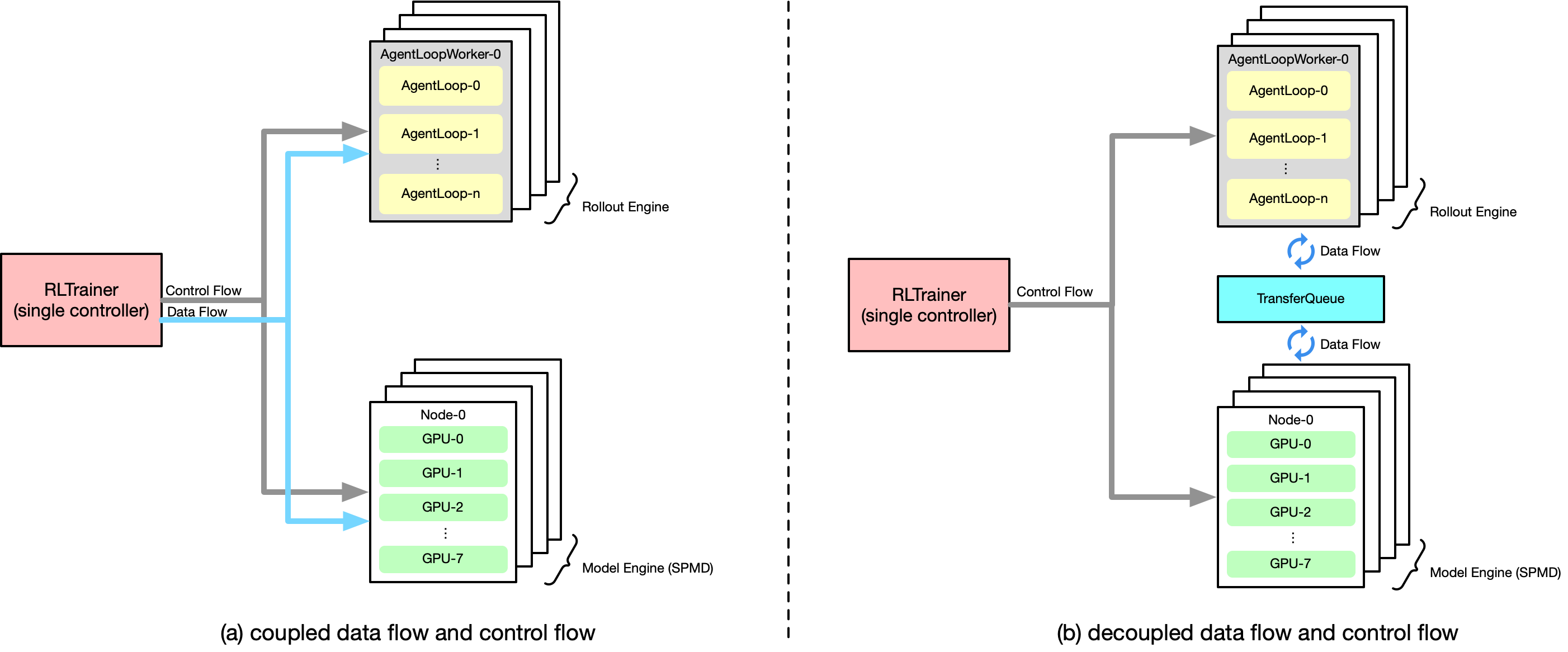
Official integration with verl is available at verl/pulls/5401, with the design doc at [RFC] PPOTrainer with TransferQueue Integration. You may also refer to our recipe, where we mimic verl usage in a high-level manner.
We have experimentally implemented a standardized, fully-streamed distributed workflow via TransferQueue.
By leveraging the RankAwareSampler and StreamingDataLoader interfaces, we achieve a streamlined micro-batch-level producer-consumer pipeline. This design eliminates the need to manually determine data dispatching logic across varying parallelism strategies—a typical complexity in the single-controller paradigm—thereby greatly simplifying framework design.
Please refer to our Roadmap and tutorials/05_streaming_dataloader.py for more details.

pip install TransferQueue-
Clone the source code from the GitHub repository
git clone https://github.com/Ascend/TransferQueue/ cd TransferQueue -
Install from source code
pip install .
-
Clone the source code from the GitHub repository
git clone https://github.com/Ascend/TransferQueue/ cd TransferQueue -
Install dependencies
pip install build
-
Build and install
python -m build --wheel
pip install dist/*.whl


Note: Optimization for MooncakeStore and other backends are still in process. Warmly welcome contributions from the community!
For detailed performance benchmarks, please refer to this blog.
We also provide a stress test report that demonstrates more than 8192 concurrent clients writing 2 TB of data into TransferQueue across 4 nodes. The system remains stable without any crashes or data loss.
We provide a BaseSampler abstraction class, which defines the following interface:
@abstractmethod
def sample(
    self,
    ready_indexes: list[int],
    batch_size: int,
    *args: Any,
    **kwargs: Any,
) -> tuple[list[int], list[int]]:
    """Sample a batch of indices from the ready indices.

    Args:
        ready_indexes: List of global indices for which all required fields of the
        corresponding samples have been produced, and the samples are not labeled as
        consumed in the corresponding task.
        batch_size: Number of samples to select
        *args: Additional positional arguments for specific sampler implementations
        **kwargs: Additional keyword arguments for specific sampler implementations

    Returns:
        List of sampled global indices of length batch_size
        List of global indices of length batch_size that should be labeled as consumed
        (will never be retrieved in the future)

    Raises:
        ValueError: If batch_size is invalid or ready_indexes is insufficient
    """
    raise NotImplementedError("Subclasses must implement sample")
In this design, we separate data retrieval and data consumption through the two return values, which enables us to easily control sample replacement. We have implemented two reference designs: SequentialSampler and GRPOGroupNSampler.
The Sampler class or instance should be passed to the TransferQueueController during initialization. During each get_meta call, you can provide dynamic sampling parameters to the Sampler.
from transfer_queue import TransferQueueController, TransferQueueClient, GRPOGroupNSampler, process_zmq_server_info

# Option 1: Pass the sampler class to the TransferQueueController
controller = TransferQueueController.remote(GRPOGroupNSampler)

# Option 2: Pass the sampler instance to the TransferQueueController (if you need custom configuration)
your_own_sampler = YourOwnSampler(config)
controller = TransferQueueController.remote(your_own_sampler)

# Use the sampler
batch_meta = client.get_meta(
    data_fields=["input_ids", "attention_mask"],
    batch_size=8,
    partition_id="train_0",
    task_name="generate_sequences",
)
Refer to tutorial/05_custom_sampler.py for more details.
The data plane is organized as follows:
  transfer_queue/
  ├── storage/
  │   ├── __init__.py
  │   │── simple_backend.py             # Default distributed storage backend (SimpleStorageUnit) by TQ
  │   ├── managers/                     # Managers are upper level interfaces that encapsulate the interaction logic with TQ system.
  │   │   ├── __init__.py
  │   │   ├──base.py                    # TransferQueueStorageManager, KVStorageManager
  │   │   ├──simple_backend_manager.py  # AsyncSimpleStorageManager
  │   │   ├──yuanrong_manager.py        # YuanrongStorageManager
  │   │   ├──mooncake_manager.py        # MooncakeStorageManager
  │   │   └──factory.py                 # TransferQueueStorageManagerFactory
  │   └── clients/                      # Clients are lower level interfaces that directly manipulate the target storage backend.
  │   │   ├── __init__.py
  │   │   ├── base.py                   # TransferQueueStorageKVClient
  │   │   ├── yuanrong_client.py        # YuanrongStorageClient
  │   │   ├── mooncake_client.py        # MooncakeStorageClient
  │   │   ├── ray_storage_client.py     # RayStorageClient
  │   │   └── factory.py                # TransferQueueStorageClientFactory
To integrate TransferQueue with a custom storage backend, start by implementing a subclass that inherits from TransferQueueStorageManager. This subclass acts as an adapter between the TransferQueue system and the target storage backend. For KV-based storage backends, you can simply inherit from KVStorageManager, which can serve as the general manager for all KV-based backends.
Distributed storage backends often come with their own native clients serving as the interface of the storage system. In such cases, a low-level adapter for this client can be written, following the examples provided in the storage/clients directory.
Factory classes are provided for both StorageManager and StorageClient to facilitate easy integration. Adding necessary descriptions of required parameters in the factory class helps enhance the overall user experience.
Contributions are warmly welcome!
New ideas, feature suggestions, and user experience feedback are all encouraged—feel free to submit issues or PRs. We will respond as soon as possible.
We recommend using pre-commit for better code format.
# install pre-commit
pip install pre-commit

# run the following command in your repo folder, then fix the check before committing your code
pre-commit install && pre-commit run --all-files --show-diff-on-failure --color=always@article{han2025asyncflow,
title={AsyncFlow: An Asynchronous Streaming RL Framework for Efficient LLM Post-Training},
author={Han, Zhenyu and You, Ansheng and Wang, Haibo and Luo, Kui and Yang, Guang and Shi, Wenqi and Chen, Menglong and Zhang, Sicheng and Lan, Zeshun and Deng, Chunshi and others},
journal={arXiv preprint arXiv:2507.01663},
year={2025}
}