


Your coding agent writes code faster than you can read it. You review the diff, you merge, and one day you notice you are no longer sure how the pieces of your own Python project fit together.
systemap gives you one page that shows how they fit. Your agent draws it from your code. A checker then refuses to let that page go out of date, and every pull request tells you which parts and connections it changed before you merge it.
This page defines the three words the map uses, then shows how to get one, then shows what stops it going out of date. The words come first because nothing else here reads without them.
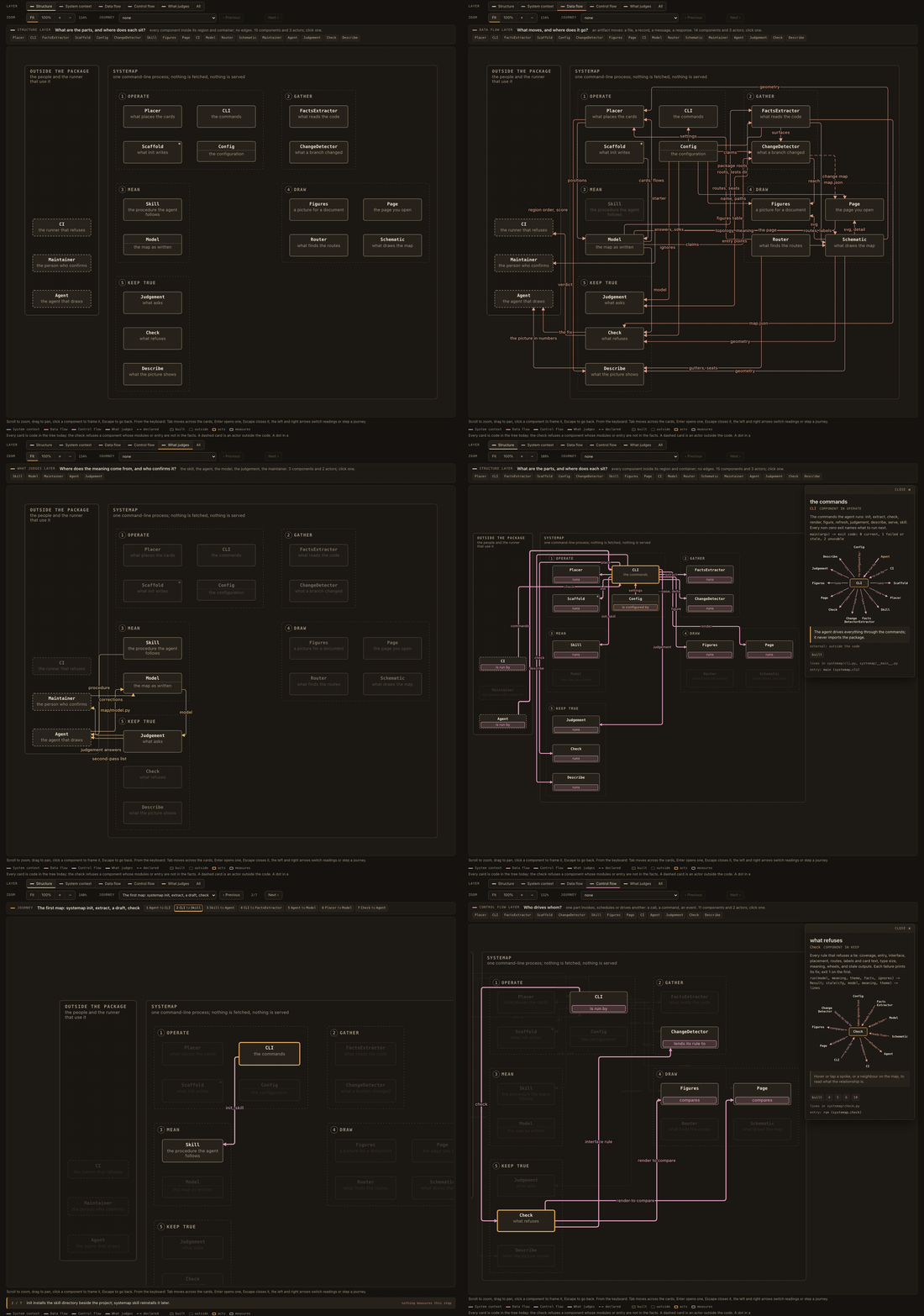
Open the live map, which is systemap's map of itself.
A card is one part of your system. A few modules that together do one job you would name out loud: the part that reads the code, the part that sends mail, the part that talks to the database. Not a file and not a folder. A job.
A line between two cards means something travels between them, and the label says what: a request, a recipe, a file on disk.
A journey is one trip through the system, step by step. A request arrives here, is checked there, is written down over there. The page shows one step at a time.
That is the whole notation. No other symbols to learn.

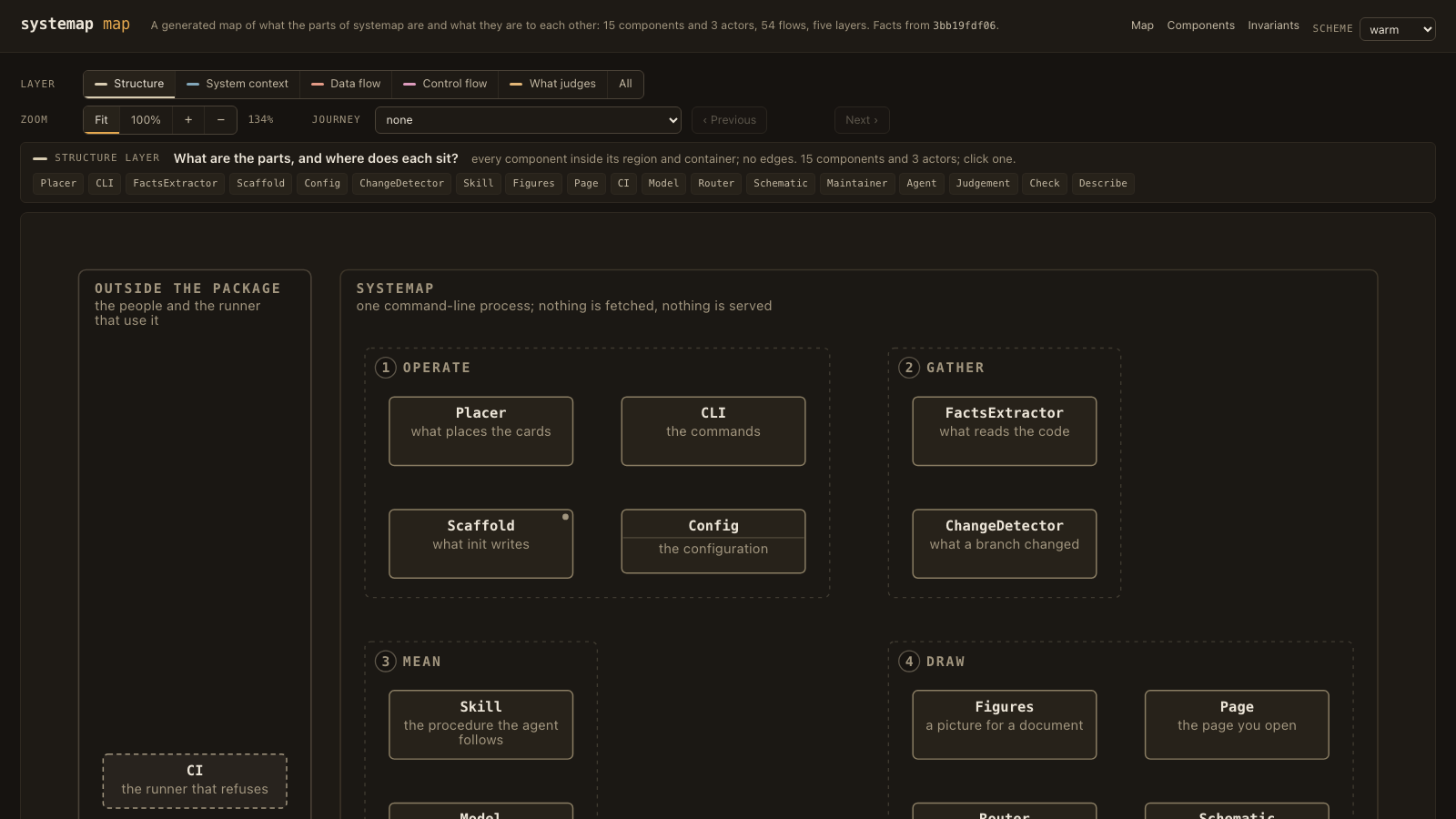
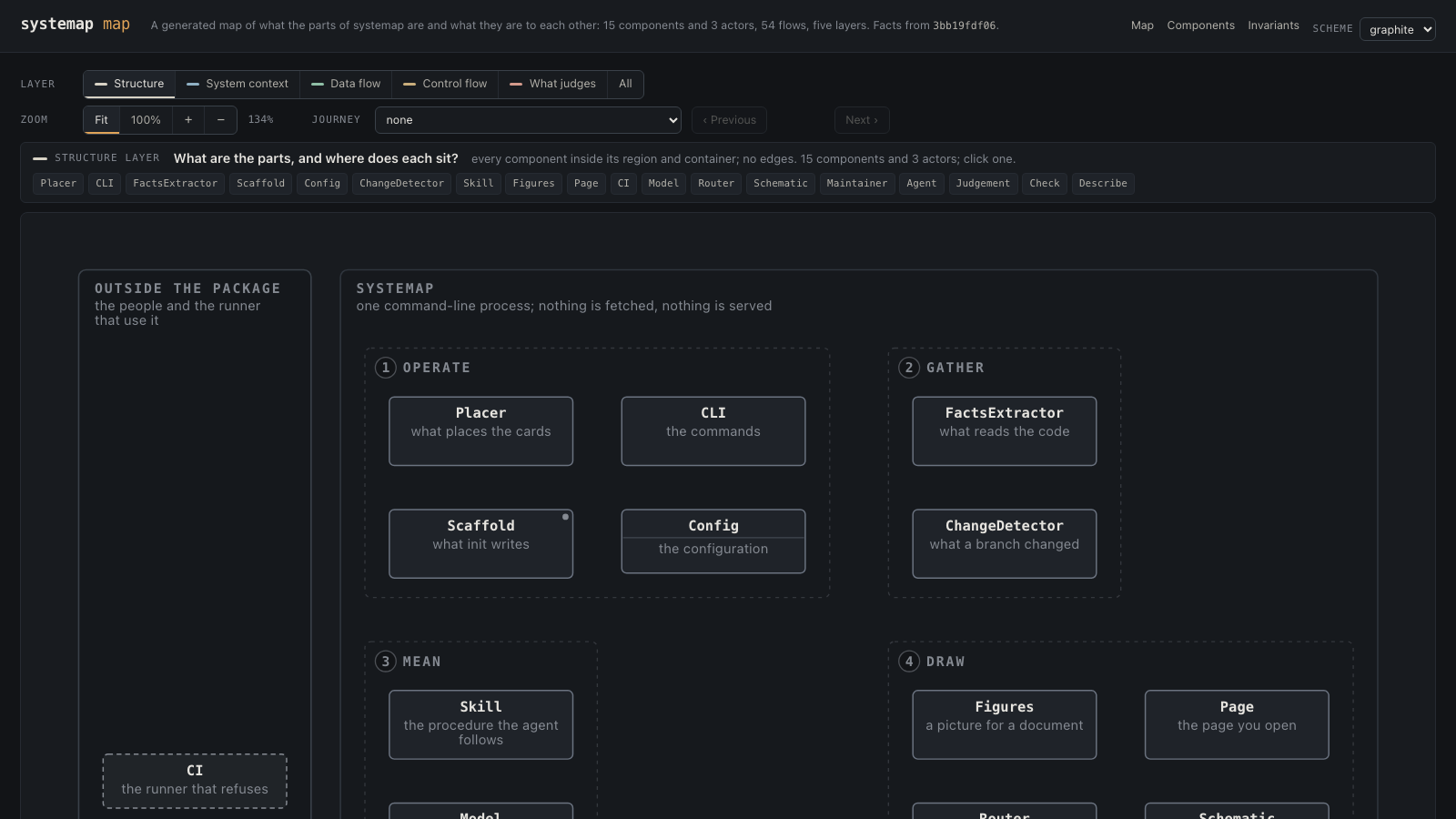
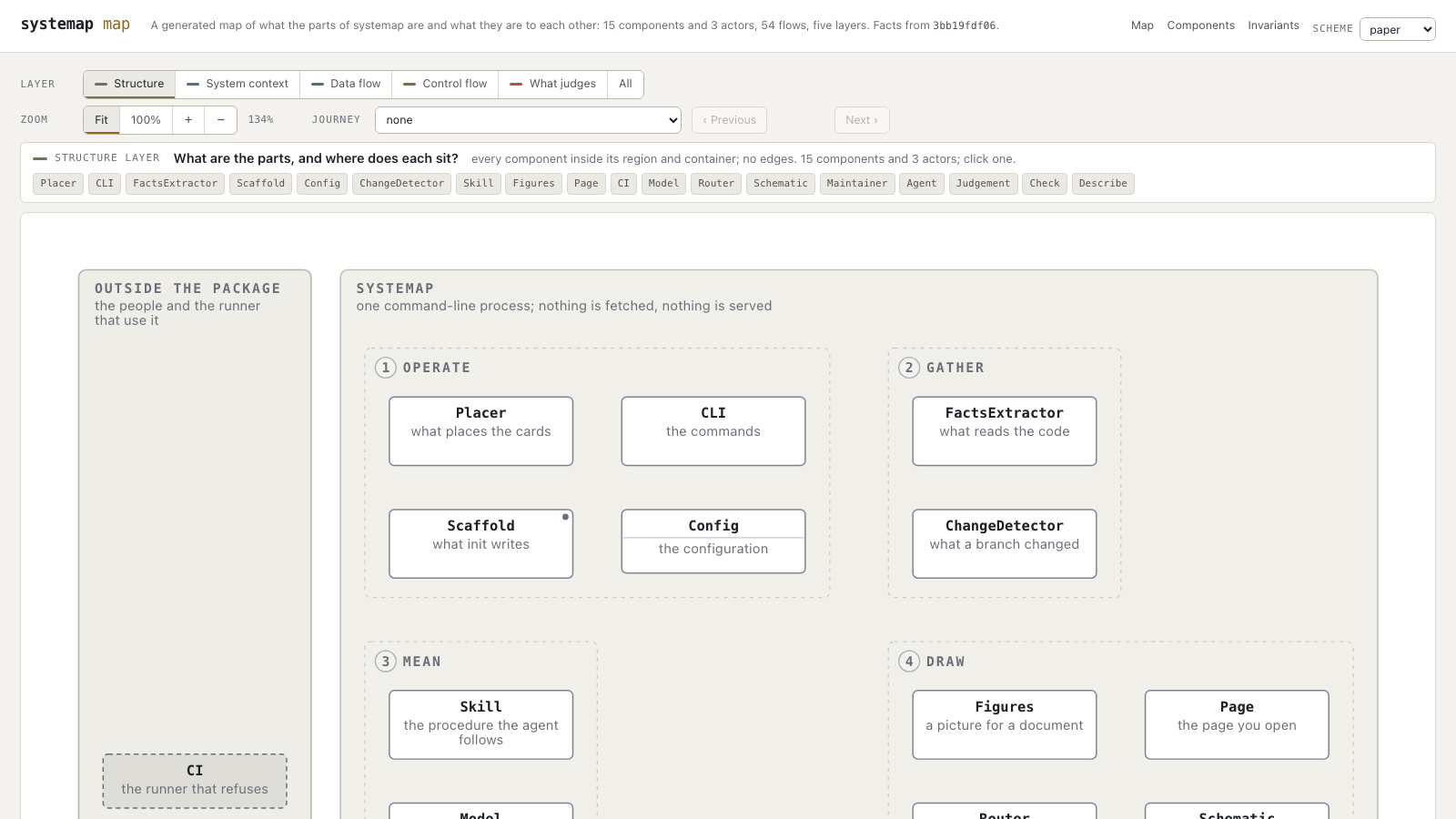
The picture above is systemap's own map with the lines hidden, so you can see the parts and how they group. Turn the lines on and you can ask one question at a time: what crosses the boundary of the system, what data moves, who calls whom. Click a card and the page highlights only the cards it connects to, each one labelled with what it does for that card.
The picture tells you one more thing no hand-drawn diagram can. A solid line means an import in your code really joins those two parts. A dashed line means no import joins them, so the line is a claim the code does not support. You can see which is which without reading any code, and so can your reviewer.
uv tool install systemap        # or: uv add --dev systemap
systemap init                   # --no-ci to skip the workflow
init writes a configuration file, an empty map for your agent to fill in,
the instructions your agent will follow, and a CI workflow. Then it prints the
one sentence you hand to your agent:
Map this repository with systemap. Follow the systemap skill.
That is all you have to do. The agent reads your code, decides which modules belong to which card, writes the lines between them, runs the checker until it reports no failures, and then goes round again looking for what it missed. When it stops, you read the handful of calls it had to make, change the ones you disagree with, and commit the page.
Using Claude Code? The repository is its own plugin marketplace:
/plugin marketplace add 0xfauzi/systemap
/plugin install systemap@systemap
Any agent that can read instructions and run a command works the same way.
Half of a map is mechanical: which modules exist, what each one exports, which tests cover it. A script reads that out of your code in a second and never gets it wrong.
The other half is judgement. Which four modules are really one part? What is the line between two parts actually for? A script cannot answer that. An import graph lists every import and still does not say which modules form one part. A person can answer it, but rarely has the patience to keep answering it through every refactor.
An agent can do both halves, on two conditions. It follows a written procedure, so it decides the same way every time. And something checks its work and rejects it when it is wrong. systemap supplies both: the procedure your agent follows, and the commands that reject a map that does not match the code.
Two commands, and your agent runs both until neither reports anything.
systemap check compares the map with the code. It fails when a module
belongs to no card, when a card points at a function the code no longer has,
when a line runs through a card it does not connect, when two labels overlap,
or when the page is older than the code. Eleven rules, and every failure names
the fix.
systemap judgement prints the questions a rule cannot answer. This card
holds a single module, so is it really a part of its own? Here is a way into
your system that no journey covers. These two cards import each other and your
map draws no line between them. You either change the map, or write the reason
it is correct as it stands into systemap.toml, where it stays, so the same
question is not asked twice.
systemap check && systemap judgement --strict
Six repositories have been mapped this way from start to finish, four of them written by somebody else, each finishing unattended with both commands quiet (docs/benchmarks.md).
Git tells you which lines of code changed. systemap delta --base main tells
you which parts, connections and claims changed, one line per thing, each
with the fix:
moved: pkg.old -> pkg.new (same content); Gateway names pkg.old in
  implemented_by: rename it in map/model.py
added: pkg.thing, claimed by no card; name it in a card's implemented_by
entry vanished: Gateway names entry serve, which its modules no longer define
Gateway is a card. implemented_by is the list of modules a card claims, and
entry is the one function it tells a newcomer to start reading at.
The workflow init writes posts exactly that as one comment on the pull
request and keeps it up to date as you push. So review starts with what the
change did to the parts and their connections, rather than with four hundred
lines of diff, and CI fails while anything on that list still needs a
decision.
Your agent then fixes those lines instead of redrawing the whole map. On three merged pull requests of one 111-module repository, that path cost 2.31, 4.39 and 2.50 dollars, against between 3 and 26 dollars to map a repository from scratch. Three pull requests of one repository is a small sample, and docs/benchmarks.md has each run.
- Ask why. Every line systemap prints comes with two more: why it matters
and what to do.
systemap explain "<kind>"prints any of them in full. - Let an agent write a journey for a way into your system that nobody has written one for. Each step is checked against the map before it is kept.
- See how the system changed over the past year.
systemap historysamples your repository back through time and says which parts grew, and which commits grew them. - Say what you are about to do.
systemap plan "<task>"names the parts the work will most likely touch, and afterwards compares that with the parts it did touch. - Have TypeSafe's Jev model check the judgement calls a name-and-import
checker cannot make. It needs
TYPESAFE_API_KEY.checkandjudgementmake no network requests, so CI runs offline unless you set that variable.
Every threshold in there was measured before the feature was built, and the
features that failed their test were written down rather than shipped
(bench/jev). systemap --help lists every command, and
docs/reference.md has every option, rule and setting.
It reads Python and only Python. It is not a call graph: the map shows the lines your agent declared and defended, not every function call. It is not a dependency diagram: modules are not parts, and the map shows parts. It is not a UML tool: one picture, one layout, and nothing to learn beyond card, line and journey.
uv sync
uv run pytest -q
uv run systemap check && uv run systemap judgement --strict
CI runs the tests, the types and the linter on Linux, macOS and Windows with Python 3.11 and 3.13, and installs the built package into an empty environment on each one to run the commands against a copy of this repository's own map.
MIT licensed.
Map something with it. If something blocks you, open an issue. Every version so far came out of somebody's log of where they got stuck, most of them an agent's.