This package is the Python surface for HypercubeCascade
(import hypercube_cascade).
Full API reference: docs/Python_SDK.md.
C++ integration guide: docs/CPP_SDK.md.
Project home: github.com/dliptak001/HypercubeCascade.
HypercubeCascade processes spatial data of the kind presented to a CNN. It is built from four core classes.
The Cascade class wraps the other three and manages training and prediction.
The other three form a pipeline: etalon → reservoir → readout.
The Exciter class is a preprocessing stage that consumes input patterns, mixes them nonlinearly, and returns a field with the same dimensions as the input.
The Reservoir class is a second preprocessing stage that consumes that field, drives a short synthetic orbit on a frozen hypercube reservoir, and returns a field with the same dimensions.
The Readout class is a small HypercubeCNN that classifies or regresses that field.
This is reservoir computing, but not only reservoir computing.
The point of this experiment is to see if two preprocessing stages in front of HypercubeCNN outperform HypercubeCNN by itself, and outperform either stage alone. HypercubeEtalon is the etalon alone. HypercubeWTF is the reservoir alone. Cascade runs them in series. The aim is a hypercube preprocessor effective enough that the readout can be a single layer with a single convolutional channel and no pooling. Then training is fast, the memory footprint is small, and little to no architectural engineering is required for the CNN.
HypercubeAI ecosystem
HypercubeESN · HypercubeCNN · HypercubeHopfield · HypercubeWTF · HypercubeEtalon · HypercubeCascade
HypercubeCascade is an experiment in the HypercubeAI project — our quest to systematically re-implement classical neural architectures on a Boolean hypercube topology instead of Euclidean grids or random graphs. The central thesis is “topology-native intelligence”: the hypercube’s algebraic structure (vertex-transitive symmetry, Hamming geometry, bitwise addressing) can serve as a first-class computational substrate.
- A topology you don’t store — the graph is specified: connectivity is implicit in the vertex indices; with a seed and a few config scalars the whole reservoir reconstructs mathematically.
- Perfect homogeneity — every vertex has the same degree and the same local world, so local dynamics mean the same thing everywhere — no structural favorites baked in by a random graph.
- Cheap navigation — each neighbor is a few bit operations on the vertex index, not a pointer chase through a stored edge list, so walks stay arithmetic and cache-friendly.
- Topology-native pairing — the readout consumes the reservoir’s output with zero geometric distortion, and the learned kernels exploit the same locality that generated the dynamics. The data never leaves the hypercube it was born on.
Each product in the family is a different architecture on that same foundation.
HypercubeEtalon and HypercubeWTF are two examples of how solutions can be built on that substrate. Cascade is both of them, in series, on one cube.
There is one cube dimension. The Exciter, the Reservoir, and the Readout all use it.
An etalon, here, is a vertex and its antipode treated as a reflective cavity. The Exciter walks every such cavity and writes one output sample per start. That walk is the etalon transit. The write-up is HypercubeEtalon.
The Reservoir is the HypercubeWTF encoder: frozen recurrent weights, a delay line, and a short synthetic orbit. Geometry stays put; the registration of the field moves. The write-up is HypercubeWTF.
The cascade itself goes something like this.
Copy the input field. Never write the caller's buffer.

Run one etalon transit. The cube is the same size it started as.

Multiply that field by the interstage gain.

Reload the reservoir's frozen start.

LOOP:

    Remap the scaled field by xor with the pass index.

    Inject that remapping. Step the reservoir.

GOTO LOOP

After T passes, the reservoir's live output is the feature field.
That is what the Readout sees.
The single-stage write-ups live with the siblings. This repository is the two-stage host.
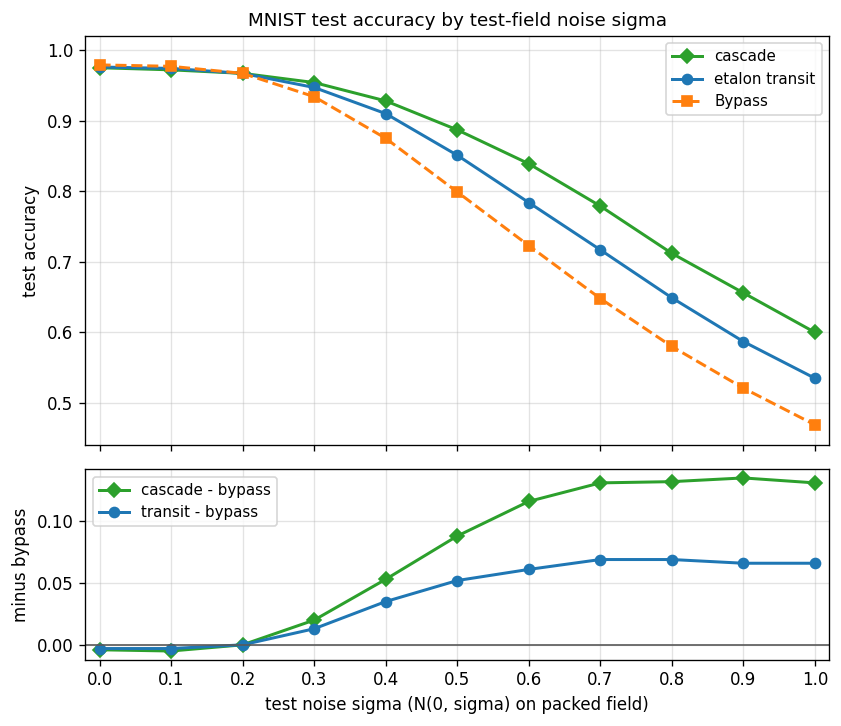
The Cascade preprocessor behaves as a near unity passthrough at low
to no white noise levels, and offers meaningful filtering effect
at moderate to high noise levels. The write-up is
examples/mnist/WhiteNoiseFilter.md.
The first real-world test is Raman spectra: recover the slow fluorescence background under sharp molecular peaks without lifting the baseline into the bands or cutting trenches beneath them. Polynomials, asymmetric least squares, and ordinary convolutional nets tend to follow the empty stretches well and then fail where it matters, under peaks and peak clusters. Analysts have worked around that for decades with spectrum-specific cleanup, because no method identifies and extracts a true baseline across a broad range of peak intensities and baseline characteristics without occasional, and often frequent, human intervention.
The Cascade appears to have solved that problem (albeit on synthetic data only so far).
Trained for 60 epochs on the LCOHard set — 10,000 synthetic LiCoO₂ (lithium cobalt oxide) spectra — it scores a validation RMSE of 4.82 counts on 2,000 held-out spectra whose baselines span hundreds of counts.
Below are four held-out validation spectra: grey is the raw spectrum, red the true baseline, blue the extract. For all four shown here, and for each of the remaining 1996 validation spectra not shown, baseline identification is, WITHOUT EXCEPTION, quite remarkable.
And it does this with the thin readout the project aims for: one HypercubeCNN layer, one convolutional channel, no pooling.
In our judgment this at least matches the best of the established techniques on spectra like these, and very likely beats them.
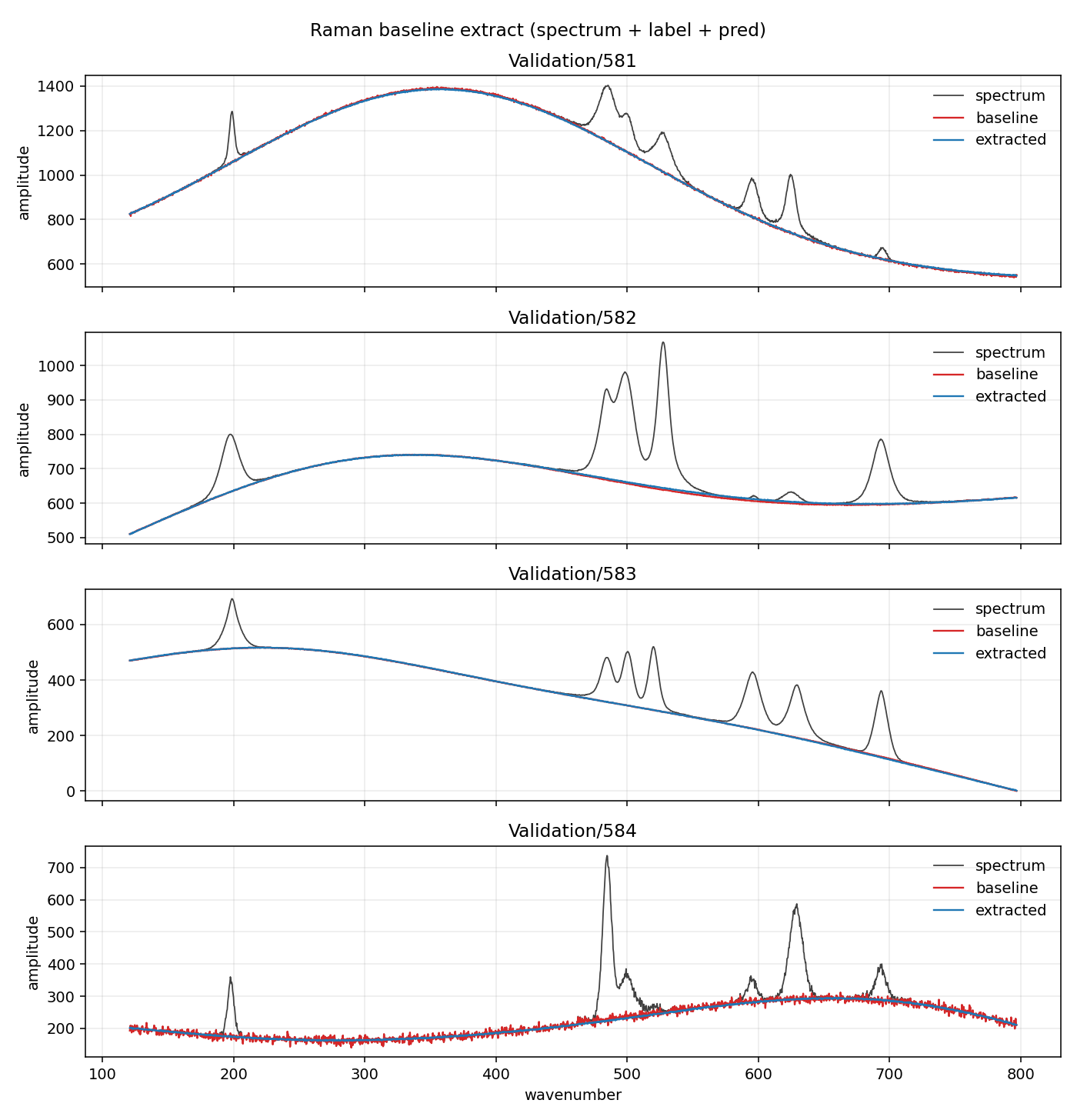
The etalon-only sibling (HypercubeEtalon) is this Cascade with the reservoir removed. The reservoir-only sibling (HypercubeWTF) is this Cascade with the transit removed: the same frozen reservoir — same seed, spectral radius, history depth, and pass count — driven by the normalized spectrum directly. Each of them, on its own, already does everything described above. With the very same readout configuration and the same 60-epoch budget, the Etalon scores 4.77 and WTF 4.76 against the Cascade's 4.82, and all three overlays are indistinguishable from the one shown. Three preprocessors that share no mechanism — a transit, an orbit, and the two in series — carry the same one-layer, one-channel readout to the same floor.
Real spectra, however, are not nearly this clean. Low laser power, short integration times, and weak scatterers all put noise on the spectrum, and that is where a baseline extractor has to earn its keep.
That is what the Cascade's second stage, the Reservoir, is for. On
the strength of the MNIST white-noise study
(examples/mnist/WhiteNoiseFilter.md),
the Cascade is expected to outperform the Etalon alone in that
noise — and WTF's own study
(examples/mnist/WhiteNoiseFilter.md)
found that same reservoir a filter that holds accuracy as the noise
rises. Whether the transit in front of it adds anything under noise,
or whether the reservoir is doing all of the filtering, is the open
question.
That is the next experiment.
Side-by-side overlays and all three training profiles are in
examples/RamanBaselineExtraction/.
Preferred: install a pre-built wheel from PyPI (no compiler).
pip install hypercube-cascadeimport hypercube_cascade as hc
print(hc.__version__)Package name on PyPI: hypercube-cascade. Import name:
hypercube_cascade. Main type: hc.Cascade.
Wheels target Python 3.10–3.14 on common Windows, Linux, and macOS machines. Runtime dependency: NumPy only.
To compile the extension yourself, clone this entire repository (not a
minimal source-only download of the python/ folder alone — the C++ core and
vendored HypercubeCNN live next to python/). You need Python 3.10+, a C++23
compiler, and CMake ≥ 3.20.
git clone https://github.com/dliptak001/HypercubeCascade.git
cd HypercubeCascade/python
pip install .
On Windows with CLion’s MinGW, put that compiler’s bin folder (and Ninja) on
your PATH, then:
pip install . --no-build-isolation --force-reinstall --no-deps(Exact CLion paths change with the version.) Step-by-step toolchain notes: docs/Python_SDK.md.
You bring each sample as a length-N float array (N = 2dim). How you get there — pad an image, reshape a spectrum, invent a layout — is up to you. This package does not pack 784 pixels or 300 bins for you.
Shapes that matter:
| Array | Shape | Notes |
|---|---|---|
fields |
(count, N) |
one length-N field per row |
labels (classification) |
(count,) |
integer class indices |
targets (regression) |
(count, num_outputs) |
float targets |
import numpy as np
import hypercube_cascade as hc

dim = 7
N = 2**dim
rng = np.random.default_rng(0)
fields = rng.standard_normal((200, N), dtype=np.float32)
labels = rng.integers(0, 4, size=200)

cas = hc.Cascade(
    dim=dim,
    exciter_subcube_dim=5,
    history_depth=4,
    T=50,
    ic_seed=2,
    readout_num_outputs=4,
    readout_task="classification",
    readout_epochs=80,
)
cas.fit(fields, labels)  # collect_batch + train

print(cas.N, cas.T, cas.num_collected)
print(f"train sanity check: {cas.accuracy_on_collected():.3f}")
print(cas.predict_class(fields[0]), cas.predict(fields[0]).shape)

cas.save("model.pkl")
loaded = hc.Cascade.load("model.pkl")cas = hc.Cascade(
dim=7,
exciter_subcube_dim=5,
readout_num_outputs=4,
readout_task="classification",
)
cas.collect_batch(fields_train, labels_train)
cas.train()
logits = cas.predict(fields_test[0]) # (num_outputs,) float32
cls = cas.predict_class(fields_test[0]) # int
test_acc = cas.accuracy(fields_test, labels_test) # held-out, fresh mapsFor regression, set readout_task="regression" and pass float targets instead
of class labels. Then use r2_on_collected() / r2(fields, targets) the same
way.
accuracy_on_collected and r2_on_collected only look at the samples you
already trained on — they are a quick sanity check, not a test score. For real
evaluation, hold fields out and call accuracy / r2 (or predict /
predict_class yourself).
- One class —
hypercube_cascade.Cascadeis the whole product surface - Map loop —
collect/collect_batch→train→predict/predict_class fit— clear, collect, and train when your arrays are ready- dim 5–12 — field length N = 2dim; one dim for all three
stages; orbit length
T; etalon faceexciter_subcube_dim - Two gains —
interstage_scale(transit → orbit) andreadout_scale(orbit → readout) - Classification or regression —
readout_taskfixed at construction - Held-out scoring —
accuracy(fields, labels)/r2(fields, targets)map fresh in bulk - Bulk calls can parallelize —
collect_threads(0 = auto) - Inspect a map —
run(x)thenlast_features(), plus per-stage probeslast_exciter()/last_interstage()/last_reservoir()for gain tuning - Save / load —
save/load(pickle: config + readout weights; collected samples are not stored). Optionalsave_readout_hcnn_model/load_readout_hcnn_modelfor portable HCNW + arch JSON - NumPy float32 — arrays converted for you; prefer contiguous float32
For a first try, paste the Quick start after
pip install hypercube-cascade. That is self-contained.
If you want a longer walk-through, the demo scripts on GitHub under
python/examples/
are there to open or download — they are not added to your machine by pip.
| Script | What it is for |
|---|---|
| synthetic_classification.py | Multi-class toy fields: fit, then train and test accuracy |
# from a clone of HypercubeCascade, after: pip install hypercube-cascade
python python/examples/synthetic_classification.py
These use easy made-up fields so the API is obvious — not scores to publish. More notes: python/examples/README.md.
| Doc | Role |
|---|---|
| docs/Python_SDK.md | Canonical Python API — every method, layout, pickle, limits |
| python/examples/README.md | Demo scripts on GitHub |
| Project README | Product story and C++ demos from the repo root |
| docs/CPP_SDK.md | Native library guide (same product, C++) |
| docs/CascadeWhitePaper.md | The two-stage concept, mechanism by mechanism |
| WhiteNoiseFilter.md | Early white-noise study (MNIST as a test bed) |
- HypercubeEtalon — the etalon transit alone; Cascade’s first stage.
- HypercubeWTF — the reservoir orbit alone; Cascade’s second stage.
- HypercubeCNN — cube-native conv stack; Cascade’s trainable head.
- HypercubeESN — echo-state / reservoir computing on streams.
- HypercubeHopfield — Hopfield-style dynamics on the cube.
Apache 2.0. See LICENSE.